
Reviewed · JEWISH GHETTO WALKING TOURS
The Roman Jewish Ghetto: A Self-Guided Audio Tour
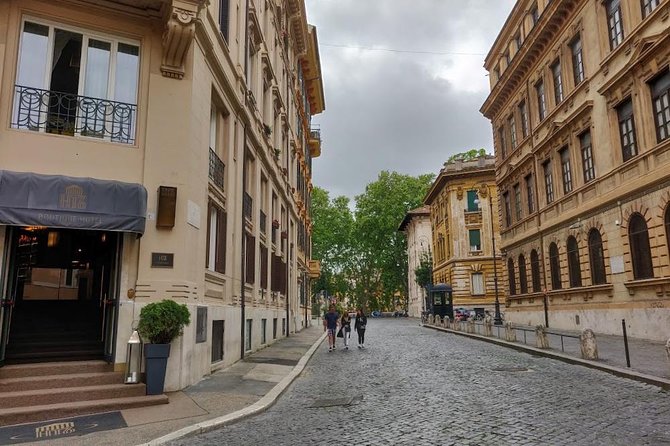
Rome’s Jewish quarter, guided by your phone. You follow an easy route through key sights of the Roman Jewish Ghetto with a self-guided audio tour designed to run without cell service once you download. It’s a simple way to turn a walk into a story, with clear scene setting and place-by-place context as you go.
What I like most is how GPS-based playback keeps you moving, starting and stopping as you reach each stop. I also like the plain value of lifetime access, since you buy the tour once and can replay it later whenever you want a refresher.
The main thing to watch is that you need a smartphone and a clean download, because if the audio files do not fully download, parts of the route can fail or feel confusing.
In This Review
- Key highlights at a glance
- A 30-minute walk that actually tells a story
- Price and value: what you really pay for at $8.99
- Starting at Via di S. Maria del Pianto, ending at Portico d’Ottavia
- Piazza delle Cinque Scole: why the name still matters
- The 1904 synagogue built by Armanni and Costa
- Portico d’Ottavia: Augustus, Octavia, and ancient layers
- Offline mode tips, download checks, and avoiding route confusion
- Who this self-guided Roman Jewish Ghetto tour is for
- Should you book this Roman Jewish Ghetto Audio Tour?
- FAQ
- Is this tour available in English?
- How long is the Roman Jewish Ghetto self-guided audio tour?
- Do I need cell phone reception during the tour?
- What device do I need to use the tour?
- Where does the tour start and end?
- Is the tour price refundable if I cancel?
- Are entrance fees or museum tickets included?
Key highlights at a glance
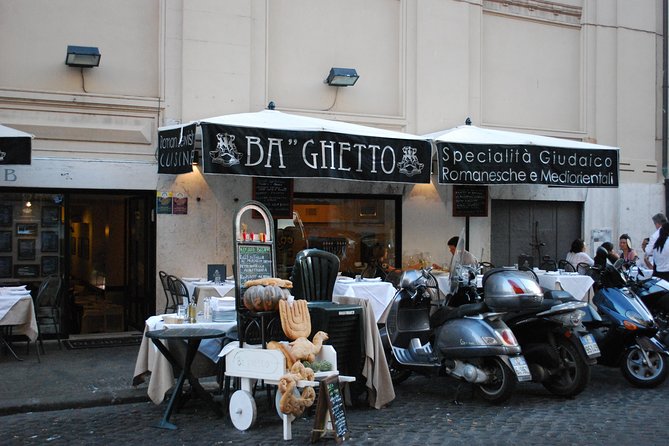
- Offline audio, maps, and geodata after you download with VoiceMap
- GPS-driven play and stop so you do not need to tap every few steps
- English voice guide for a focused, easy-to-follow narrative
- Lifetime access to the tour content for future Rome re-walks
- Straight shot route that starts on Via di S. Maria del Pianto and ends at Portico d’Ottavia
A 30-minute walk that actually tells a story
This Roman Jewish Ghetto audio tour is built for a short, high-impact visit. You are not just ticking off buildings. You get a guided sequence that explains what you are looking at, why it mattered, and why certain names and places survived even when buildings did not.
In about 30 minutes (approx.), you move from a square tied to synagogues, to a synagogue that took shape at the turn of the 1900s, and then onward to one of ancient Rome’s most dramatic structures connected to Octavia and Augustus. It is the kind of route that works well when you want history, but you do not want to spend half the day in museums.
If you like walking with a plan, but also want freedom to pause for photos or read small details at your own speed, this format fits. The audio is designed to play as you arrive, so you keep your bearings without constantly checking your screen.
Other walks through the old Jewish Ghetto:
- Rome Food Tour: Campo de’ Fiori, Ghetto, Trastevere Winner 2024
★ 5.0 · 3,205 reviews - Rome: Eat Like a Roman Ghetto & Campo de’ Fiori Food Tour
★ 5.0 · 1,037 reviews - Jewish Ghetto and Synagogues with Jewish Roman Guide 3 Hours
★ 5.0 · 907 reviews - Jewish Ghetto & Piazza Navona: Food, Wine & Sightseeing Rome Tour
★ 5.0 · 460 reviews
Price and value: what you really pay for at $8.99

At $8.99 per person, you are paying for three things that matter while you walk: the audio narrative, the map guidance, and offline functionality. The most practical value is that the tour includes lifetime access and comes with offline access to audio, maps, and geodata through the VoiceMap app. That means you do not need to worry about reception once the content is downloaded.
You also avoid extra surprise costs tied to admissions. Tickets or entrance fees are not included, so the audio tour is meant to be a way to understand what you see from the street and in public spaces, without adding museum fees into your day. If you choose to enter anything that charges separately, that would be on you.
Duration is also part of the value story. A half hour is long enough to get real context, but short enough that you can fit it between other Rome plans. That is often where the best “bang for your time” happens in a city packed with major sights.
Starting at Via di S. Maria del Pianto, ending at Portico d’Ottavia
This tour uses a fixed path, so your biggest win comes from starting in the right place. The start point is Via di S. Maria del Pianto, 22, 00186 Roma RM, and the end point is Via del Portico d’Ottavia, 39, 00186 Roma RM.
Here is the practical mindset I recommend: treat the tour like a guided walk with doors that only open in order. If you jump in mid-route or do not trigger the tour properly, the narrative can stop lining up with the streets in front of you.
The app’s GPS features are meant to make this easier. Your device should use location to guide playback and help you find each stop, which is exactly why the route feels smoother than a random self-guided wander. You can also pause and restart as you like, which is great when you need to step aside or take a moment to read.
It is also helpful to know that the tour is listed as operating throughout the day, and is available across the full week. And because it is offered in English, you can keep moving without language hassle.
Piazza delle Cinque Scole: why the name still matters
Your route begins at a place tied to the word scola. The audio explains that Scola means synagogue, and that Piazza delle Cinque Scole once contained multiple synagogues, including the Temple and synagogues identified by names such as New, Castilian, Catalan, and Sicilian.
What makes this stop more than a quick landmark is the story of what happened after the Ghetto changed. The audio notes that after emancipation of the Ghetto, the complex was torn down, but the name remained. That is a key theme for anyone visiting Rome: buildings can disappear, but names often carry memory forward.
When you stand in the square, listen for the way the narration links language to place. It helps you read the street with more care. Instead of seeing just a square, you start understanding it as a surviving label for a vanished cluster of worship spaces.
A good tip here is to slow down for a minute. You are at a conceptual starting point, so let the audio do its job before you rush into the next street. If you do that, you will feel the route make sense as it progresses.
The 1904 synagogue built by Armanni and Costa
The tour’s next stop focuses on a newer chapter, when the community commissioned architects Osvaldo Armanni and Vincenzo Costa to design and build a new temple. The audio states that in 1901 the commission happened, and by 1904 the new synagogue opened.
This is where the tour becomes especially useful if you want to understand continuity, not just change. You are not only tracking eras of suppression and alteration. You are also seeing how a community planned, built, and established a main place of worship that served Rome afterward.
In practice, this part helps you connect the dots between older roots and later structures. Even if you do not enter a building, the narrative gives you the dates, the architects’ names, and the basic purpose, so your photos are attached to meaning instead of just angles.
One thing to keep in mind: since entrance tickets are not included, the audio is designed for what you can observe from where you are standing. If you want to go inside, plan for separate rules or hours on your own.
More of Rome walked on your own clock:

Portico d’Ottavia: Augustus, Octavia, and ancient layers
The tour ends at Via del Portico d’Ottavia, where it turns your attention toward an ancient structure built by Augustus to honor his sister Octavia.
The audio describes a monumental arch and facade, followed by an internal portico that originally held two temples. Even if you are not an architecture expert, this part of the tour gives you a simple way to read the layers: you are looking at a Roman imperial tribute, and you are also walking through an area where later history overlays older stonework.
This stop can feel like a “reset,” in a good way. After the more community-focused synagogue narrative, you shift back to the scale of Rome’s empire. It adds perspective and helps you understand why the city’s geography and power structures matter when you study any neighborhood history.
Because this is the final stop, it is a nice moment to take stock. If you want to keep exploring, you now have names you can search later, and you can connect what you saw to what you might want to read next.
Offline mode tips, download checks, and avoiding route confusion
This tour is built to work without cell reception once you download, and that is one of its biggest practical advantages in Rome. Still, the way it fails is important to know, because a couple of common issues pop up with self-guided audio tours like this one.
First, make sure the tour fully downloads before you start walking. If you use a shared network, hotspot, or eSim, downloads can fail partway. When that happens, you might get an early portion of audio and then hit missing recordings later. So, do the download when you have stable Wi-Fi, then double-check that you see the offline content ready in the app.
Second, start the tour properly from the correct starting spot. The app works best when you use its start feature rather than manually jumping around in playback. If you accidentally start in the wrong mode or with a manual playback flow, the route guidance can feel mismatched with where you are on the ground.
Third, keep an eye on battery. A GPS-based tour uses location services. If your phone battery is low, you might get map or playback problems right when you need the directions most.
Finally, if something goes wrong, VoiceMap has a support contact process. The tour is designed to be fixable when the issue is download-related, so treat it like a tech problem, not a you problem.
Who this self-guided Roman Jewish Ghetto tour is for
This is a smart fit if you:
- Want a structured walk without joining a group
- Prefer history explained in plain language, place by place
- Like audio guidance that does the tapping for you using GPS
- Have limited time and still want meaningful context
It also works well for solo travelers, couples, and families who can handle a phone-based activity for a short while. You can pause, restart, and move at your own pace, which makes it easier to manage kids or to linger at a specific corner without feeling rushed.
The one hard requirement is a smartphone, because the tour is delivered through the VoiceMap app. And because the tour includes offline audio and maps, you will get the best experience if you download ahead of time rather than waiting until you are outside.
Should you book this Roman Jewish Ghetto Audio Tour?
If you want a thoughtful, time-efficient introduction to the Roman Jewish Ghetto area, this is an easy yes. The value is strong for the price because you get lifetime access, offline audio, and GPS-based guidance that keeps you oriented without constant screen time.
Skip it only if you hate phone-guided walking or you are likely to arrive without downloading content. For most people, though, the combination of a short route, clear narration, and offline reliability makes it one of the most practical ways to learn while you stroll.
FAQ
Is this tour available in English?
Yes. The tour is offered in English.
How long is the Roman Jewish Ghetto self-guided audio tour?
It runs for about 30 minutes (approx.).
Do I need cell phone reception during the tour?
No. Once you download the tour, it works offline, including audio, maps, and geodata.
What device do I need to use the tour?
You need a smartphone, since the tour uses the VoiceMap application. A smartphone is not included in the price.
Where does the tour start and end?
The tour starts at Via di S. Maria del Pianto, 22, 00186 Roma RM and ends at Via del Portico d’Ottavia, 39, 00186 Roma RM.
Is the tour price refundable if I cancel?
No. This experience is non-refundable and cannot be changed for any reason.
Are entrance fees or museum tickets included?
No. Tickets or entrance fees to museums or other attractions en route are not included.
Narrated As You Go
- Rome: Castel Sant’Angelo Entry Ticket & Audio App
★ 4.3 · 4,952 reviews - Rome: Colosseum, Forum, & Palatine Hill with Audio Guide
★ 4.3 · 4,591 reviews - Rome: Castel Sant’Angelo Entry Ticket with Audio guide
★ 4.4 · 3,646 reviews - Rome: Colosseum Experience with Audio Guide and Arena Option
★ 4.2 · 2,200 reviews
Latest additions from Rome
- Rome: Testaccio Market Food Tour with Street Food & Wine★ 5.0 · 8 reviews
- Exclusive Pasta & Tiramisu Class with Wine near by Colosseum★ 5.0 · 8 reviews
- Private Professional Photoshoot in Rome★ 5.0 · 8 reviews
- Loreto “Shrine of the Holy House of the Virgin Mary” Private Tour from Rome★ 5.0 · 8 reviews
- Rome Day to discover Florence and Pisa Hotel Pickup★ 4.5 · 8 reviews
- Rome: Christmas Nativities and Angels Tour★ 3.1 · 8 reviews
- Guided Tour of Vatican Museums and Sistine Chapel★ 5.0 · 8 reviews
- Rome: Cooking Class of fresh Pasta and Tiramisu Cake★ 5.0 · 8 reviews
Jewish Ghetto Walking Tours, compared.

Rome Food Tour: Campo de’ Fiori, Ghetto, Trastevere Winner 2024
Read our review →
Eat Like a Roman Ghetto & Campo de’ Fiori Food Tour
Read our review →
Jewish Ghetto and Synagogues with Jewish Roman Guide 3 Hours
Read our review →
Jewish Ghetto & Piazza Navona: Food, Wine & Sightseeing Rome Tour
Read our review →
Food & Wine Tour of Campo de Fiori, Ghetto, Trastevere
Read our review →
Jewish Ghetto and Campo Dè Fiori By Night Food, Wine and Sightseeing Tour
Read our review →
Trastevere and Rome’s Jewish Ghetto Half-Day Walking Tour
Read our review →
Browse the lists this tour appears in