
Reviewed · OSTIA ANTICA RUINS TOURS
Private tour of Ostia, the ancient city harbor, by van with a PhD archaeologist
Rome’s port ruins hit differently. This private Ostia Antica half-day is the kind of outing where a PhD archaeologist turns stone streets into real Roman life, and you get to see major set pieces like the forum and the necropolis without the usual hassle. One thing to consider: the on-site time is focused, so if you dream of a long museum crawl, you may wish for more hours at the park.
I also like how the van pickup and door-to-door ride keeps you out of Rome logistics, and how my guide Fernando kept the pace friendly while you still cover a lot. The overall value feels strongest if you want context, not just photos, because you are paying for interpretation plus transport, not a slow, self-guided stroll.
In This Review
- Key Things You Will Get Out of This Tour
- Ostia Antica by Van, With a PhD Archaeologist
- Price and Logistics: What You Are Really Paying For
- The Drive Into Ostia Antica: Leaving Rome Without Losing Your Day
- Necropolis and Entrance Gate: Setting the Tone for a Real City
- Decumanus, Warehouses, and Port-City Streets
- Baths of the Charioteers and Neptune: How Leisure Looks in Stone
- Caupona and Thermopolium: Food and Drink Stops You Can Picture
- Insulae and Middle-Class Life: Housing Beyond Palaces
- Theater and Square of the Guilds: Work, Performance, and Community
- Castrum and the Forum: When Civic Life Meets Power
- Capitolium, Lares Augusti, and Temple of Augustus and Rome
- Timing and Pace: Making the Most of Your Ruin-Focused Half-Day
- Hear the Guide, Not the Wind: Headsets and Private Group Comfort
- Who This Tour Is For (and Who Might Want Something Else)
- The Bottom Line: Should You Book This Ostia Antica Private Tour?
- FAQ
- How long is the Ostia Antica private tour, and how much time is spent at the site?
- Is admission to Ostia Antica included?
- Is this a private tour?
- Does the tour include pickup and transportation in a van or car?
- Is food included during the tour?
- Can I cancel and get a full refund?
Key Things You Will Get Out of This Tour
- PhD archaeologist guidance for context you can actually use while you walk
- Skip-the-line entry so your time goes to ruins, not waiting
- Focused 3-hour walk through the big highlights, with time to ask questions
- Luxury van transport that saves you time and stress getting there and back
- A sequence that makes sense from necropolis and walls to shops, baths, and the forum
- Headsets for larger parties so you hear every detail during the walk
Ostia Antica by Van, With a PhD Archaeologist
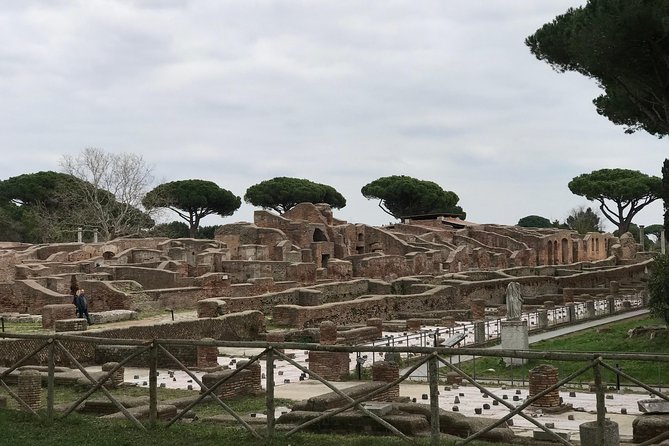
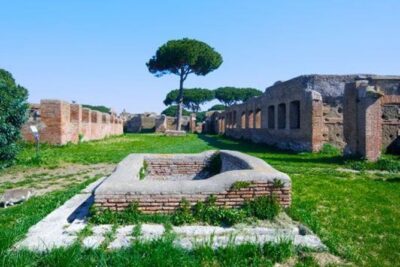
If you want Roman ruins with a working-city feel, Ostia Antica delivers. This was the harbor city that fed Rome, and walking its streets helps you understand how the empire ran day to day. It is not just temples and statues. You see the infrastructure of commerce, everyday housing, and even leisure.
The biggest reason this tour works is the level of expertise guiding the walk. A PhD archaeologist does not just point things out. You get a clearer sense of what you are looking at, why it mattered, and what daily life might have looked like in those spaces.
And yes, this is a private setup. You travel as one group, you get a local guide plus a PhD archaeologist guide, and you can ask as many questions as you like without feeling like a stop on someone else’s checklist.
More Private Tours in Rome
- Rome by Golf Cart Private Tour: Beyond the Landmarks
★ 5.0 · 4,361 reviews - Early Morning Vatican, Sistine, St. Peter’s Semi or Private Tour
★ 5.0 · 3,779 reviews - Rome on a Golf Cart Semi-Private Tour Max 6 with Private Option
★ 5.0 · 2,502 reviews - Rome Private Arrival Transfer: Fiumicino Airport to Hotel in Rome
★ 4.5 · 2,492 reviews
Price and Logistics: What You Are Really Paying For
At $528.09 per person, this is not a budget day trip. You are paying for four things: private guidance, protected time with skip-the-line entry, a full round-trip transfer by luxury car or van, and included ticket fees.
That mix matters. Ostia Antica is close enough to Rome for a half-day, but far enough that you can burn energy on transit and timing. With pickup offered, and the driver bringing you back to your accommodation after the visit, you can focus on the ruins instead of logistics.
The other value lever is the site coverage. The walk is planned around the major zones you would want to see anyway, from the city walls and necropolis area to the forum and major temples. If you are the type who enjoys learning what you are seeing, the price becomes easier to justify.
The Drive Into Ostia Antica: Leaving Rome Without Losing Your Day
Ostia Antica sits just outside Rome, and going by van makes the day feel smoother. You will get picked up within the defined area, and if your accommodation is outside it, you are told to contact customer support to find a solution.
The tour is designed as a walking experience. The driver takes you to the site, stays part of the day’s rhythm, and then returns you after your visit. In practice, that matters because you avoid the mental overhead of buses and schedules.
You should also know the tour is offered in English, and it is described as suitable for most travelers. Service animals are allowed too, which is a comfort for anyone who needs that support.
Necropolis and Entrance Gate: Setting the Tone for a Real City
Your first big impression at Ostia Antica is the necropolis area and the transition into the city’s built environment. Even before you hit the main streets, you can feel the planning. This was a place with boundaries, rituals, and order.
When you reach the entrance gate and city walls, take a slow look. Walls are not just background. They define where everyday life begins and where the city protects itself. A guide with strong academic grounding helps you connect those physical structures to Roman priorities: control, safety, and identity.
From here, your walk sets up the rest of the day. You are not drifting. You are moving through a sequence that helps you understand the city as a whole.
Decumanus, Warehouses, and Port-City Streets
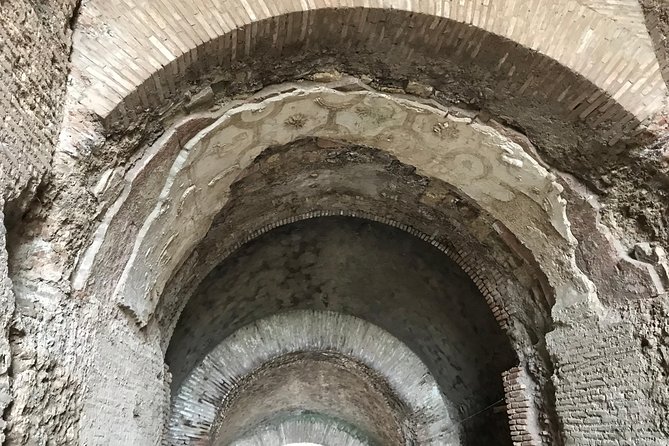
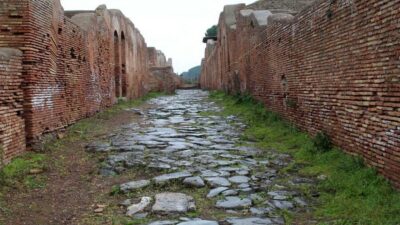
One of the highlights on the route is the decumanus, the main street. This is where you start to see how Ostia functioned as a traffic pattern, not only a monument. A main street in a Roman city is where movement concentrates, where people meet, and where businesses can thrive.
You will also pass warehouses, and this is where the harbor-city story clicks for many people. If Rome was the consumer, Ostia was the pipeline. Warehouses are practical clues. They tell you that storage, distribution, and timing were part of daily life, not just abstract trade.
As you walk, keep an eye out for how the route alternates between civic spaces and commercial spaces. That rhythm is the point. Ostia helps you see that Roman greatness was not only built in temples and politics, but also in streets, storage, and services.
More time in the ruins at Ostia Antica:
Baths of the Charioteers and Neptune: How Leisure Looks in Stone
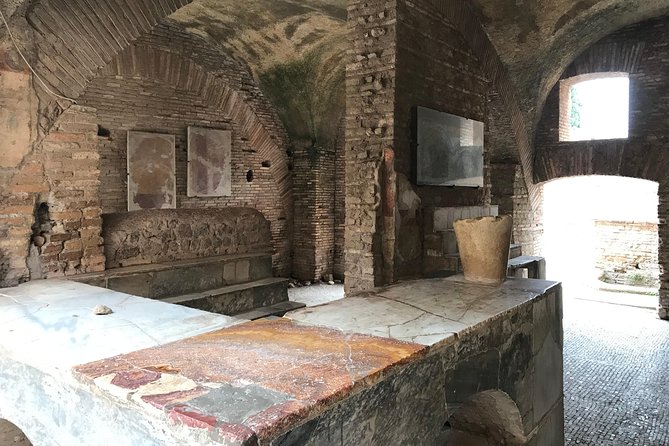
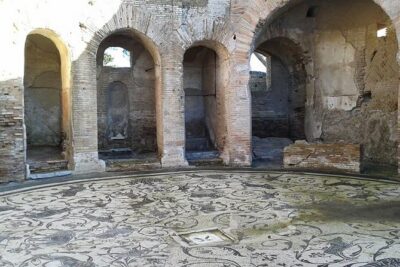
Roman baths are a top reason people love Ostia Antica. Here you get stops such as the Baths of the charioteers and the Baths of Neptune.
What I love about a guided pass through bath areas is that you can understand function. Baths were social engines. They were places to talk, relax, and mark status. Even if you are not trying to memorize layouts, having context helps you notice how the space is organized.
Pay attention to the idea that this is architecture for routine. When a guide connects the design to everyday behavior, you start picturing people showing up for a wash, a conversation, and some downtime. It makes the stones less distant.
Caupona and Thermopolium: Food and Drink Stops You Can Picture
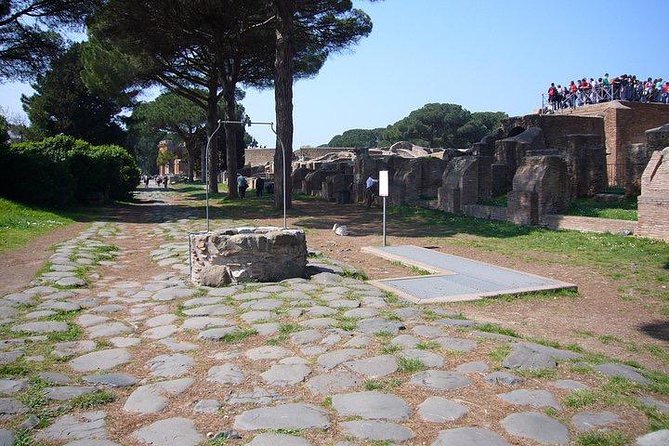
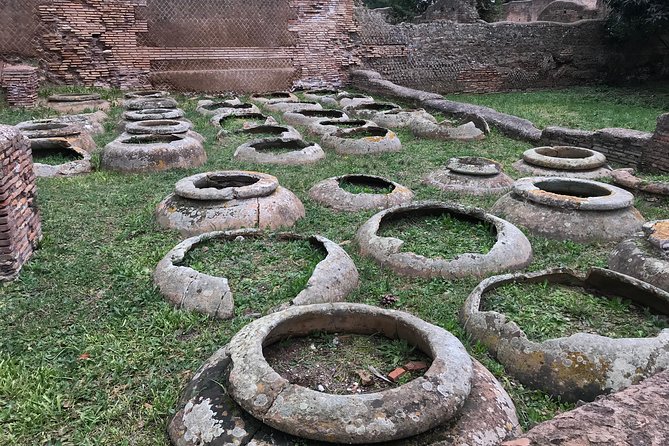
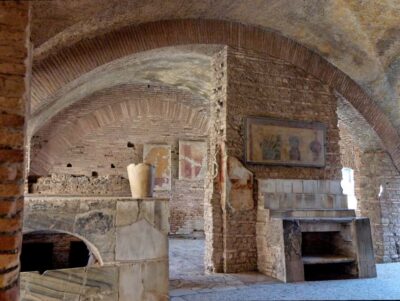
Two types of eating-and-drinking spaces show up on the route: caupona (a tavern) and later the thermopolium (a restaurant-style counter with hot food).
These spots are important because they anchor the day in Roman ordinary life. A lot of visitors focus on temples and big civic buildings, but taverns and counter restaurants tell you who came, what they likely ordered, and how daily routines fed off the city’s traffic.
With a knowledgeable academic guide, you are more likely to notice details that you might otherwise miss. You start seeing how these venues fit into a larger pattern, right alongside housing and public gathering areas.
Insulae and Middle-Class Life: Housing Beyond Palaces
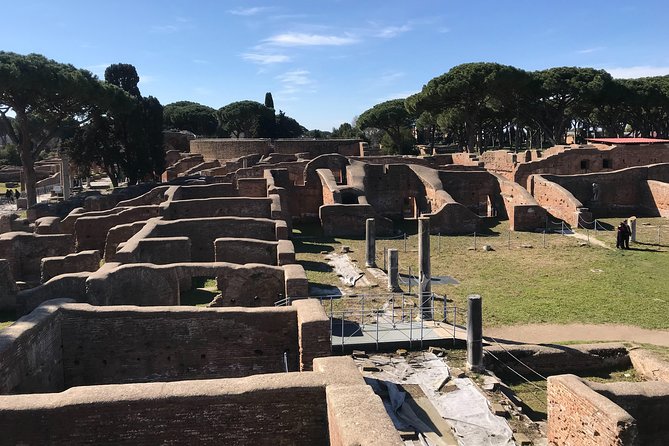
The walk also includes the insulae, the middle-class housing system. This is one of those moments where Ostia can shift how you picture Rome.
Palaces are famous. Insulae are revealing. They suggest density, shared realities, and a different kind of urban experience than the villa fantasies. The guide’s role here is huge. Without context, it can look like ruins. With context, it looks like a place where people planned their lives around shared space.
If you like architecture, housing, and city planning, this is where your brain starts building the city back in your head. That is the best type of souvenir.
Theater and Square of the Guilds: Work, Performance, and Community
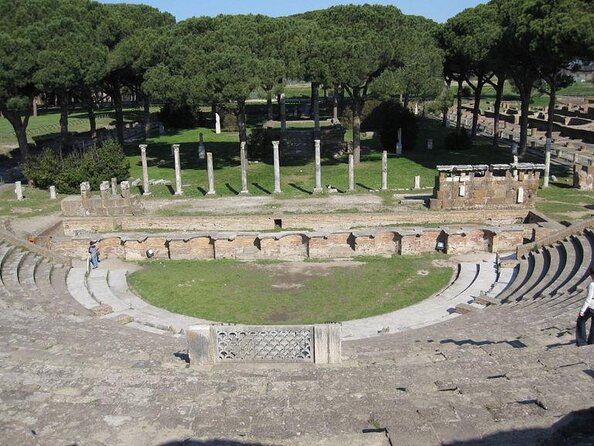
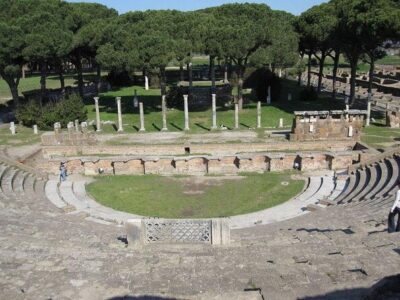
You will see the theater and the square of the guilds. These are not just decorative stops. They show how the city organized culture and identity.
The theater hints at entertainment and public gathering. The square of the guilds suggests organized groups, people linked by work or trade. Even if you do not learn a single new Roman name, you walk away with a clearer idea of who felt represented in public space.
This pair of stops is a smart reminder that the Roman Empire ran on more than politics. It also ran on local networks, public events, and the status of groups that helped keep the economy moving.
Castrum and the Forum: When Civic Life Meets Power
As the walk moves onward, you reach the castrum, a military camp area, followed by the civic heart of Ostia: the forum.
This is where Ostia Antica becomes more than a scenic walk. The forum is where power, decision-making, and social order show up physically. The presence of the castrum adds another layer. It reinforces the idea that this was not only a trade hub, but also a strategic, controlled outpost.
When you step into the forum zone, take your time with the scale and layout. The guide helps you connect buildings to roles. You start seeing how public space worked for authority and for everyday announcements, meetings, and movement.
Capitolium, Lares Augusti, and Temple of Augustus and Rome
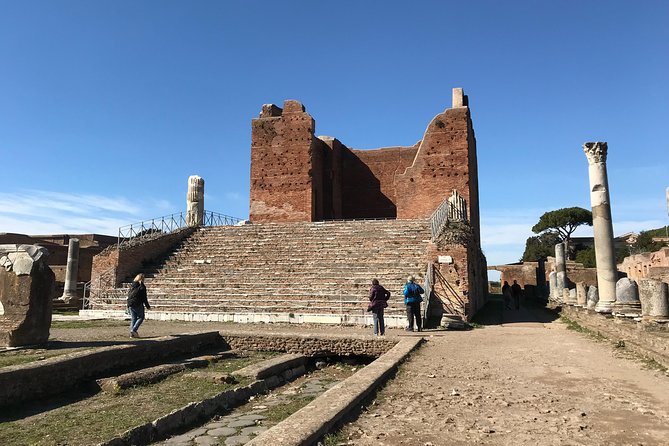
The tour includes the Capitolium, the temple dedicated to Jupiter, Juno, and Minerva. Nearby, you also visit the so called shrine of the Lares Augusti and the Temple of Augustus and Rome.
These stops can feel like a lot of names, but the best way to enjoy them is to focus on what they signal. Religious space in Roman cities was a social technology. It tied civic identity to the empire’s power and offered a shared way to interpret the world.
A good guide helps you connect the symbolism to what you can physically see in the ruins. You are not just looking at pillars and foundations. You are watching how belief and authority were arranged in the built environment.
This is one of the most praised aspects of the experience, because the academic approach makes the layout easier to follow and the meanings less vague.
Timing and Pace: Making the Most of Your Ruin-Focused Half-Day
The site portion runs about three hours, with the full experience lasting around four hours including transport. That timing is tight in a good way. You get a clear “big picture” route, and you avoid getting stuck in one zone too long.
Here is how I recommend you use that time:
- Wear comfortable shoes because you are walking a lot.
- Bring water and protect yourself from sun and humidity, especially when the weather is heavy.
- Ask questions early, because the best explanations come while the relevant structures are still fresh in your mind.
Some people wish they had more time for museum content or extra slow wandering. That is a fair feeling, because Ostia Antica has plenty to look at beyond the core route. Still, this tour is built for momentum and context, not for a full-day deep soak.
Hear the Guide, Not the Wind: Headsets and Private Group Comfort
If you have a larger party, headsets are provided for groups of 6 or more. Even if you think you will hear fine, headsets make the experience smoother. You can listen for details while still keeping your eyes on architecture and layout.
And since it is private, your group controls the rhythm. Your guide can slow down where you want clarity, and speed up if you are in photo-taking mode.
Who This Tour Is For (and Who Might Want Something Else)
This tour is a strong match if you want:
- a guided walk through major Ostia zones without crowd pressure
- academic-level explanations that help you read ruins
- private transport that reduces Rome stress
It might not be your best fit if you want a long, unhurried day at the park plus a museum-focused afternoon. With only a few hours at the ruins, this is more like a well-paced guided tour than a full-day deep exploration.
The Bottom Line: Should You Book This Ostia Antica Private Tour?
I think it is worth booking if your goal is understanding, not just sightseeing. The combination of private van transport, skip-the-line access, included ticket fees, and a PhD archaeologist guide makes it a high-value way to see Ostia Antica without wasting time.
Book it if you want to walk from necropolis and city walls to the forum and major temples, while someone skilled helps you connect the dots. If you want extra time for museums or for very slow wandering, consider adding more time on your own before or after, because the tour is designed to be focused.
If you like Roman history as a living system of trade, housing, food, religion, and civic power, you will leave Ostia with more than photos. You will have a map in your head.
FAQ
How long is the Ostia Antica private tour, and how much time is spent at the site?
The experience runs for about 4 hours total. You spend around 3 hours at Parco Archeologico di Ostia Antica, with time structured around the key areas of the site.
Is admission to Ostia Antica included?
Yes. Ticket fees are included, and admission is included for the Parco Archeologico di Ostia Antica stop.
Is this a private tour?
Yes. It is a private tour/activity, and only your group participates.
Does the tour include pickup and transportation in a van or car?
Pickup is offered, and transportation to and from the site is included by a luxury full optional car or van. If your accommodation is beyond the defined area, you are asked to contact customer support to find a solution.
Is food included during the tour?
No. Food is not included, and you should plan accordingly.
Can I cancel and get a full refund?
You can cancel for free up to 24 hours in advance for a full refund. If you cancel less than 24 hours before the start time, the amount paid is not refunded.
Latest additions from Rome
- Rome: Testaccio Market Food Tour with Street Food & Wine★ 5.0 · 8 reviews
- Exclusive Pasta & Tiramisu Class with Wine near by Colosseum★ 5.0 · 8 reviews
- Private Professional Photoshoot in Rome★ 5.0 · 8 reviews
- Loreto “Shrine of the Holy House of the Virgin Mary” Private Tour from Rome★ 5.0 · 8 reviews
- Rome Day to discover Florence and Pisa Hotel Pickup★ 4.5 · 8 reviews
- Rome: Christmas Nativities and Angels Tour★ 3.1 · 8 reviews
- Guided Tour of Vatican Museums and Sistine Chapel★ 5.0 · 8 reviews
- Rome in One Day: with Colosseum, Piazzas and Vatican City★ 5.0 · 8 reviews
Ostia Antica Ruins Tours, compared.
Ancient Ostia Antica Semi-Private Day Trip from Rome by Train with Guide
Read our review →
Horse Sanctuary & Trail Ride in Ostia Antica
Read our review →
Browse the lists this tour appears in