
Reviewed · OSTIA ANTICA RUINS TOURS
Ostia Antica Archaeological Park with Italian Gelato
One of Rome’s quiet time machines waits outside the city. This small-group walking tour takes you through Ostia Antica, the Roman Republic and Empire’s major river port, then finishes in the Borghetto medieval citadel with a classic Italian gelato. I love how the ruins feel like a real working town, not a museum set, and I love getting a guide-led path that points out the big stories in specific spots.
Two names keep coming up with this tour, Chiara and Federico, and that matters, because they explain how the port city functioned, from monumental tombs to market and bath areas. The only drawback to plan for is that most of the experience is on foot, including some short steep stair options, and the archaeological park entrance fee is not included in the tour price.
In This Review
- Key things I’d plan around
- Why Ostia Antica feels different from Rome’s big ruins
- Price and what your $119.27 includes (and what it does not)
- Meeting at Viale della Stazione di Ostia Antica, start at 9:30
- Stop 1: Parco Archeologico di Ostia Antica, the Roman port-city walk
- Necropolis and monumental tombs
- Romana gate and Victory Square along the main street
- Neptune Baths and a big-picture view
- Roman theatre, corporation square, and the Ara of Romulus and Remus
- Forum areas, the Capitoline Triad, and Castrum
- Painted houses, Diana’s house, and the Thermopolium
- Mills, guild identity, and firemen headquarters
- Cisiari’s Baths and the harbor-side sidewalk
- Stop 2: The Borghetto citadel, Giulio II castle, and gelato outside the walls
- Courtyard time, not just a quick photo stop
- Italian gelato just outside the medieval walls
- How the small-group format changes the way you see Ostia Antica
- Who should book this tour
- Should you book this Ostia Antica and gelato tour?
- FAQ
- How long is the Ostia Antica with gelato tour?
- What language is the tour offered in?
- What is included in the tour price?
- Do I need to buy an entrance ticket for the archaeological park?
- Where do we meet for the tour?
- What time does the tour start?
- How many people are in the group?
- Is the tour suitable for most travelers?
- Is the meeting point easy to reach by public transportation?
- What happens if weather is bad?
- Is there free cancellation?
Key things I’d plan around
- Small group size (max 6) means more time for questions and less traffic-style walking.
- Ostia Antica’s port-city layout helps you understand how commerce shaped daily life.
- Neptune Baths viewpoint gives you one of the easiest ways to read the site’s scale.
- Borghetto and Giulio II castle courtyard add a medieval layer after the Roman day.
- Gelato is included, and it’s timed right after the citadel visit.
Why Ostia Antica feels different from Rome’s big ruins
If you’ve seen the headline ruins in central Rome, you already know the “wow” factor. Ostia Antica adds something else: the sense of a city that did a job. As you walk, you can follow the logic of an ancient commercial waterfront, with neighborhoods, baths, guild spaces, and even areas tied to everyday supplies. The site covers a lot of ground, but a guided route helps you connect the dots.
I also like the pacing here. You get a focused walking route through the archaeological park, then you switch gears to a medieval pocket of stone streets and a castle courtyard. It breaks the day into two meaningful chapters instead of one long march of ruins.
One more practical point: this is a calmer setting than staying in the densest tourist center. You still see major monuments, but the overall feel is quieter and more spacious, especially compared with packed city stops.
More time in the ruins at Ostia Antica:
- Ancient Ostia Antica Semi-Private Day Trip from Rome by Train with Guide
★ 4.5 · 579 reviews - From Rome: Ostia Antica Guided Half-Day Trip by Train
★ 4.8 · 486 reviews - Horse Sanctuary & Trail Ride in Ostia Antica
★ 4.5 · 276 reviews - Ostia Antica Semi Private Tour from Rome
★ 5.0 · 238 reviews
Price and what your $119.27 includes (and what it does not)
The tour price is $119.27 per person, and it’s structured around guided time plus a small included snack. What you do get is clear: a walking tour of the route described and Italian gelato. It’s also offered in English, and you’ll have a mobile ticket for the experience.
What you don’t get is also important: entrance fee to the archaeological park is not included. So if you budget only the tour price, you may be surprised when you arrive. In other words, the real cost is the tour price plus the park admission you pay separately.
Given the group size cap (up to 6 people), the English guiding, and the gelato inclusion, I think the price can make sense if you want more than a self-guided wander. If you’re the type who prefers flexible roaming and you already know the site well, then the guided portion may feel less essential.
Meeting at Viale della Stazione di Ostia Antica, start at 9:30
The meeting point is Viale della Stazione di Ostia Antica, 00119 Roma RM, Italy. The tour starts at 9:30 am, and it ends back at the same meeting point.
This matters because Ostia Antica is outside the city core, so you need a reliable plan to reach the start area. The good news is that it’s near public transportation. In practice, you’ll want to arrive a bit early so you can settle in before the walking begins.
The tour is designed to be walk-forward friendly, and the experience notes say most travelers can participate. Still, you should know the day is built for walking: the archaeological portion alone takes about two hours, and you’ll cover multiple zones across the park.
Stop 1: Parco Archeologico di Ostia Antica, the Roman port-city walk
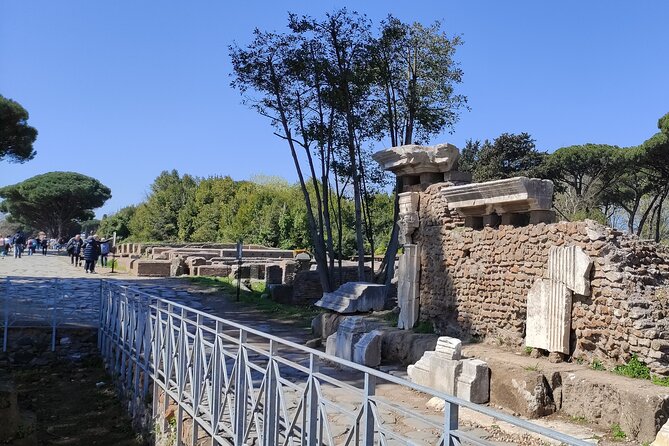
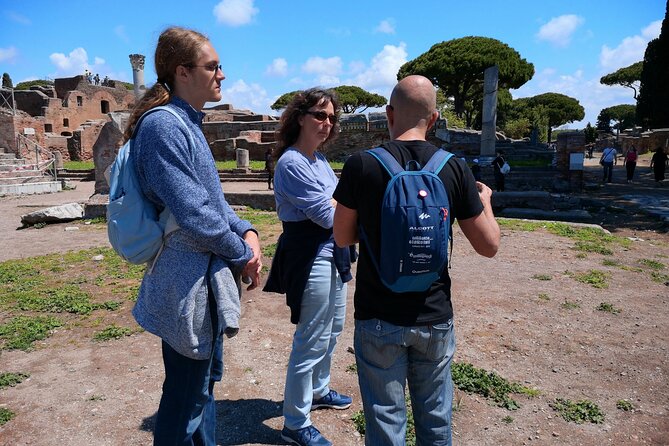
This is the heart of the day. You spend about two hours walking through Parco Archeologico di Ostia Antica, guided across the bones of what used to be the once biggest river port of the Roman Republic, and later the Empire.
The route also gives you a built-in way to understand the city’s complexity. You’re not just seeing a pile of columns. You’re moving through areas tied to burial, government and commerce, public entertainment, food and trade, and everyday working spaces. That structure turns the ruin experience into a story you can follow.
Necropolis and monumental tombs
You start with the Necropolis of Ostia Antica, where you’ll see monumental tombs and mausoleums. I like this beginning because it sets the tone for how important the area was long before everyday waterfront business. Burial sites close to a working hub also hint at the city’s density and long-term human presence.
Another shape for the same afternoon in Rome:

Romana gate and Victory Square along the main street
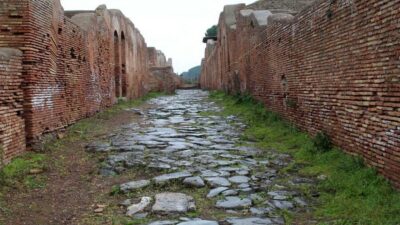
Next come the Romana gate and Victory Square along the Decumanus Maximus. When you walk a main axis like this, you get a better sense of Roman urban planning. It’s one thing to read that Romans built cities in grids or along major streets. It’s another to stand on the line itself and feel how movement through the city was meant to work.
Neptune Baths and a big-picture view
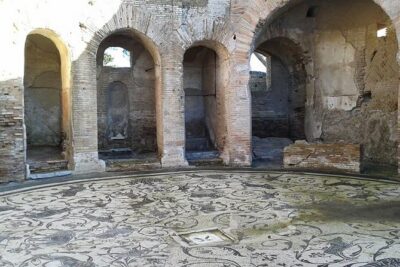
Then you reach the Neptune Baths, known for impressive mosaics and a great view from above. The mosaic details are part of the appeal, but the viewpoint is the smarter memory-maker. Looking down helps you understand the scale of what you’ve already walked past, and it makes the rest of the route easier to interpret.
Roman theatre, corporation square, and the Ara of Romulus and Remus
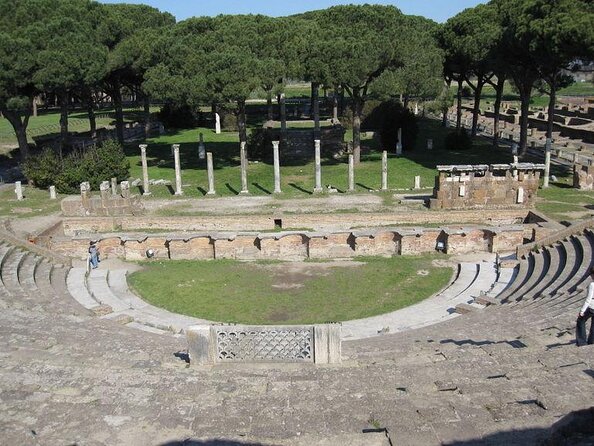
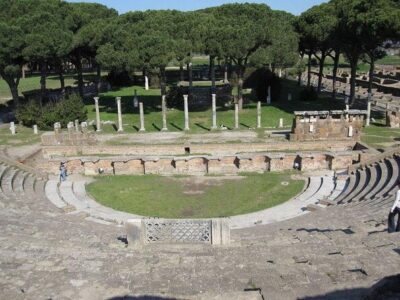
You continue toward the Roman Theatre, then through the Corporation square and the ARA of Romulus and Remus. This cluster matters because it connects performance space, civic or collective identity, and symbolic meaning. It’s a reminder that even a working port city had spaces built for public culture and shared identity.
Forum areas, the Capitoline Triad, and Castrum
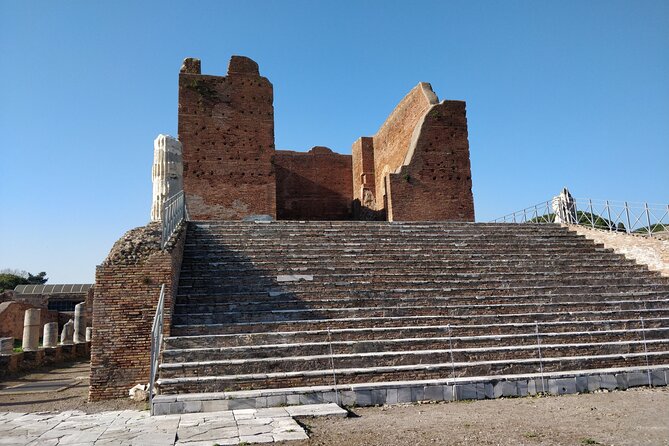
The walk moves into forum baths, the Forum, and highlights like the Capitoline Triad temple and the Castrum. In a single span, you’re seeing how central public life mixed religion, administration, and civic authority. This is also where the site starts to feel less like “one ruin” and more like “a functioning city that once had an order.”
Painted houses, Diana’s house, and the Thermopolium
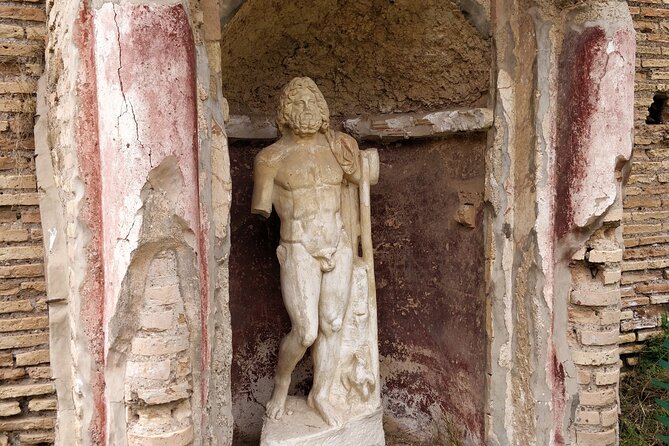
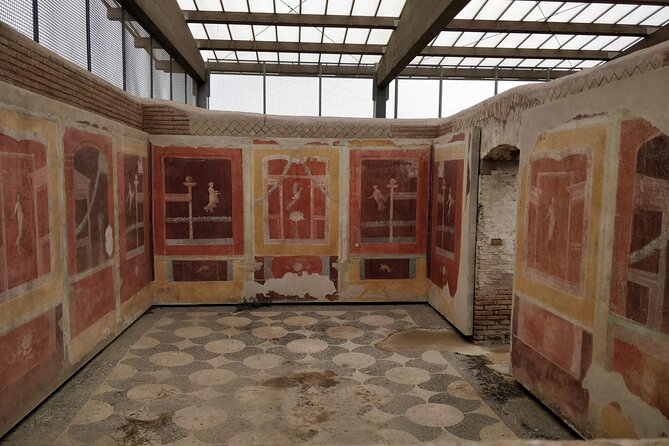
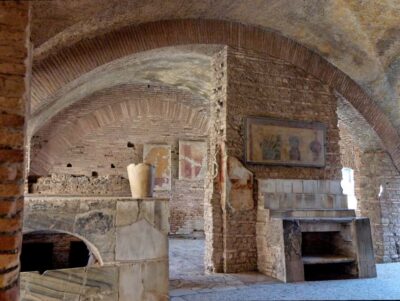
Later, the focus shifts to domestic and street-level life, including painted houses, Diana’s house, and the Thermopolium. The Thermopolium is the key idea here: these spaces relate to how people ate and grabbed food, not how emperors posed for statues.
If you want the day to feel practical and human, this is the part that does it. It’s about daily consumption and neighborhoods, not only big monuments.
Mills, guild identity, and firemen headquarters
You then pass through Silvano’s Mills, the Guild of Pistores (bakers), and the Firemen headquarters. This is one of my favorite parts of the route because it shows the city’s job system. Guild spaces connect food production and commerce, and the fire-fighting angle is a blunt reminder that the city had risks and services, not just art.
Cisiari’s Baths and the harbor-side sidewalk
The archaeological portion finishes with Cisiari’s Baths and the harbor’s sidewalk. I like ending with the waterfront concept. Even if you’ve never been a port expert, the idea lands: this city existed because ships and river trade mattered.
By the time you reach the harbor-side stretch, the earlier parts start to click. Burial zones, streets, baths, entertainment, and work spaces all feel tied to one reality: a busy riverfront economy.
Stop 2: The Borghetto citadel, Giulio II castle, and gelato outside the walls
After the archaeological park walk, the tour shifts to the Centro Storico di Ostia Antica, known as the Borghetto. You get about 30 minutes here, which is short, but it’s enough to get the flavor of the medieval layer.
The Borghetto is described as a charming medieval village dating back to the 9th century A.D., with a key highlight: the 15th century Giulio II castle, built on a Michelangelo design. This is not just a pretty stone stop. The castle’s role was strategic, tied to papal state control over trade on the river Tevere and defense of farmers against raids by the Saracens.
Courtyard time, not just a quick photo stop
You visit the castle and courtyard inside the citadel. Courtyards are great on tours like this because you get light, scale, and architectural context without needing a long indoor museum session. It’s also a good mental reset after the open-air archaeological walking.
Italian gelato just outside the medieval walls
The tour ends with Italian gelato just outside the medieval walls. Since the included gelato is part of the tour price, it’s a nice built-in reward. It also means you don’t have to immediately hunt for a place to eat during the final stage of the day.
How the small-group format changes the way you see Ostia Antica
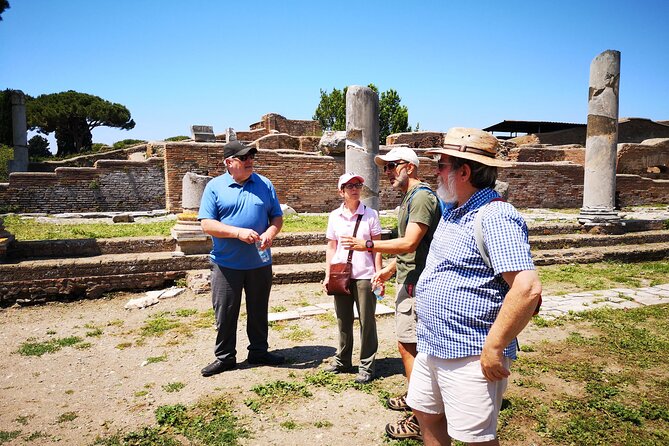
With a maximum of 6 travelers, this tour is built for interaction. That’s not just a comfort detail. In a place like Ostia Antica, questions help you connect the remains you’re standing next to with the bigger systems the guide is describing, like the way a port city worked.
The tour also has optional ways to handle the terrain. One of the reviews notes there are a couple of spots with short steep stairways for views, and those climbs are skippable. If you’d rather not deal with steep steps, you can plan to take the easier route while still seeing the highlights.
The tour timing is designed to fit a morning schedule starting at 9:30 am. That means you get to see a major part of the site before the day fully warms up and crowds multiply in other Rome areas. You won’t feel like you’re racing all day, but you should treat it as a real walking commitment.
Who should book this tour
I’d recommend this experience if you want:
- A guided route through Ostia Antica’s port-city highlights rather than a random stroll
- A small-group setting with time for questions
- A day that pairs Roman ruins with a medieval citadel stop
- An included snack in the form of Italian gelato
It may not be the best fit if:
- You already know the site well and want free-form time only
- You strongly dislike walking and want a mostly seated museum-style visit
- You don’t want to pay park admission on top of the tour price
Should you book this Ostia Antica and gelato tour?
Yes, I think you should book it if you’re looking for an efficient, guided way to understand how a real working Roman port functioned. The combination of a structured walk across the major zones, plus the Borghetto castle courtyard, makes the day feel like two connected eras instead of one long list of ruins.
If you book, budget for park entrance fees in addition to the tour price, since that part is not included. Also plan for walking, and remember that some steep stair viewpoints are optional.
If you want a Rome escape with actual context, this one is a strong call, especially because the tour keeps the group small and the route focused on the places that help you read the city.
FAQ
How long is the Ostia Antica with gelato tour?
The tour duration is approximately 2 hours 30 minutes. The archaeological park walk is about two hours, and the Borghetto part is about 30 minutes.
What language is the tour offered in?
The tour is offered in English.
What is included in the tour price?
You get the walking tour as described and Italian gelato (snacks). The archaeological park entrance fee is not included.
Do I need to buy an entrance ticket for the archaeological park?
Yes. The entrance fee to the archeological park is not included in the tour.
Where do we meet for the tour?
The meeting point is Viale della Stazione di Ostia Antica, 00119 Roma RM, Italy. The tour ends back at the same meeting point.
What time does the tour start?
The tour starts at 9:30 am.
How many people are in the group?
This activity has a maximum of 6 travelers, so it stays a true small-group format.
Is the tour suitable for most travelers?
The tour notes say most travelers can participate. It is a walking tour, and there may be short steep stair options, which can be skipped if needed.
Is the meeting point easy to reach by public transportation?
Yes. The meeting point is near public transportation.
What happens if weather is bad?
This experience requires good weather. If it’s canceled due to poor weather, you’ll be offered a different date or a full refund.
Is there free cancellation?
Yes. There is free cancellation, and you can cancel up to 24 hours in advance for a full refund. If you cancel less than 24 hours before the experience starts, the amount you paid will not be refunded.
Latest additions from Rome
- Private Professional Photoshoot in Rome★ 5.0 · 8 reviews
- Rome: Testaccio Market Food Tour with Street Food & Wine★ 5.0 · 8 reviews
- Exclusive Pasta & Tiramisu Class with Wine near by Colosseum★ 5.0 · 8 reviews
- Loreto “Shrine of the Holy House of the Virgin Mary” Private Tour from Rome★ 5.0 · 8 reviews
- Rome Day to discover Florence and Pisa Hotel Pickup★ 4.5 · 8 reviews
- Rome: Christmas Nativities and Angels Tour★ 3.1 · 8 reviews
- Guided Tour of Vatican Museums and Sistine Chapel★ 5.0 · 8 reviews
- Rome: Cooking Class of fresh Pasta and Tiramisu Cake★ 5.0 · 8 reviews
Ostia Antica Ruins Tours, compared.
Ancient Ostia Antica Semi-Private Day Trip from Rome by Train with Guide
Read our review →
Horse Sanctuary & Trail Ride in Ostia Antica
Read our review →
Browse the lists this tour appears in