Reviewed · HIKING & TREKKING
Free Urban Trekking with an Archaeologist
Rome changes when your phone turns 3D. This free urban trek in Rome uses your phone to show augmented reality layers, so key sites feel closer to their ancient look. You also get an archaeologist guide’s street-level explanations as you move through famous spots and a few quieter, more local corners.
I love the small group size (max 10). It keeps things relaxed, and you can actually ask questions as you walk, not just shuffle past monuments. I also like that the pace fits the sights, with frequent breaks and time to take photos. One thing to consider: the route includes uphill and downhill sections and lasts about 3 to 4 hours, so you will want a moderate fitness level and truly comfortable shoes.
In This Review
- Key highlights worth your time
- The big idea: 3D Rome in your pocket, with real archaeology talk
- Price and what you actually pay for
- Meeting point, start time, and what to wear
- Teatro di Marcello: the theater that looks like a medieval castle
- Ghetto Ebraico di Roma: Jewish Rome, medieval charm, and good food nearby
- Isola Tiberina: the legends that turn a small island into a big story
- Bocca della Verità and Santa Maria in Cosmedin
- Foro Boario: early Roman temples and the marble puzzle
- Giardino degli Aranci on Aventine Hill: the panorama plus the St. Peter shrink trick
- Buco della Serratura: the keyhole view and the Malta Order twist
- Testaccio: where you skip the biggest crowd lines and see real daily Rome
- Piramide Cestia: an Egyptian-shaped detour that tells you about Roman taste
- How the pace feels over 3 to 4 hours
- Who this tour suits best
- Should you book this archaeologist-led urban trek?
- FAQ
- How long is the urban trekking tour?
- Is the tour in English?
- What is the group size?
- Is there a mobile ticket?
- Where does the tour start, and what time?
- How fit do I need to be?
- What should I wear and bring?
- Are the listed stops free to enter?
- Can the tour change if weather is bad?
- Are service animals allowed?
Key highlights worth your time
- Phone-powered 3D and AR views that help you picture ancient structures where you stand today
- An archaeologist-led route with street-smart explanations (Anastasia is repeatedly praised in reviews)
- Off-center stops like the Jewish Ghetto area and Tiber Island, not just the usual photo loop
- Great viewpoints without a long detour, including Aventine Hill and the Orange Garden panorama
- Easy on the wallet: the listed stops show admission tickets as free, so you pay mainly for the guided experience
The big idea: 3D Rome in your pocket, with real archaeology talk
This tour’s hook is simple: you do not just look at Rome, you see Rome. Your phone brings additional layers through 3D and augmented reality so the ancient structures feel less like guesses and more like something you can picture. The highlights specifically call out the Colosseum and the Forum in this AR style, which is a smart way to make those landmarks click fast.
What I like most is how the archaeology fits the street. You are not stuck in one museum room. As the guide points out details, you can compare what you see in front of you with what the phone overlays. That combo helps you remember, even after the walk ends.
One practical note: AR works best when your phone battery is healthy and your screen is easy to read outdoors. If you tend to run low on power, bring a charging option if you have one.
Not settled yet? These cover similar ground in Rome:
- Vatican Museums, Sistine Chapel & St. Peter’s Basilica Tour
★ 4.3 · 73,970 reviews - Vatican Museums, Sistine Chapel & St Peter’s Basilica Guided Tour
★ 4.5 · 39,149 reviews - Rome: Colosseum, Palatine Hill and Roman Forum Guided Tour
★ 4.8 · 32,814 reviews - Rome: Guided Tour of Colosseum, Roman Forum & Palatine Hill
★ 4.7 · 27,897 reviews
Price and what you actually pay for
The price listed is $3.61 per person, which feels almost symbolic for a guided, archaeologist-led trek. The itinerary marks admission tickets as free for each of the listed stops, so your money goes to the guide and the experience, not separate entry fees.
Value wise, this is a great fit if you already plan to walk around Rome anyway. You are basically buying context and access to a brain that can explain what you are looking at. With a small group, that context does not get watered down by crowd control.
Meeting point, start time, and what to wear
You start at Gusto Massimo Bar Bistrò di TIZIANO DI M. E. F. S.r.l, Via del Circo Massimo, 5a, 00153 Roma RM, Italy. The start time is 10:00 am, and the tour ends in a different location.
Because the route includes uphill and downhill sections, the tour asks for moderate physical fitness and flat, comfortable shoes. Reviews back up that you will climb a hill, and you will still feel good if you are prepared.
I would treat the day like a solid walking half-day: lightweight layers, a hat for sun, and sunscreen in summer. Bring a bottle or cup for water, especially because you have multiple short stops, not a long sit-down break.
Teatro di Marcello: the theater that looks like a medieval castle
Teatro di Marcello is the kind of Rome stop that makes you do a double take. You know amphitheaters and gladiators, but this one brings actors, stages, and decoration back into the picture. The fun twist here is how it can look like a medieval fortress, which makes it a great first stop for orienting your eye.
Why it matters on this tour: it sets up the big theme. Rome is not one era. It is layers. This stop helps you notice how later centuries repurposed or blended older structures, so the rest of the walk feels more logical.
Time on site is about 20 minutes. That is enough to take in the exterior and get the story without turning it into a slow museum visit.
Ghetto Ebraico di Roma: Jewish Rome, medieval charm, and good food nearby
Next you shift into Ghetto Ebraico di Roma. This is where Rome’s Jewish community left its mark, with architecture and street life shaped by history and time. The tour framing is practical too: you get the sense of a neighborhood, not just a set of monuments.
What makes this stop work in a walking tour: the scale is human. You are not staring from a distance. You can absorb the feel of the area, and then your guide can connect that lived-in history to broader Roman timelines.
Potential drawback: this portion can be crowded depending on the hour and day. The tour is still only about 20 minutes here, so it is usually manageable, but go with the mindset that you may need to squeeze a little for photos.
Another shape for the same afternoon in Rome:
Isola Tiberina: the legends that turn a small island into a big story
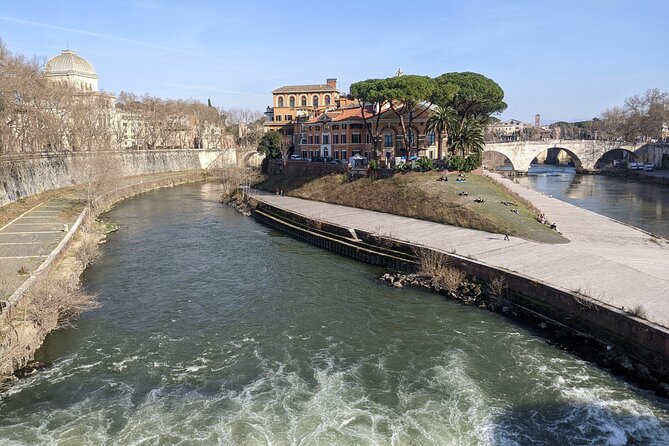
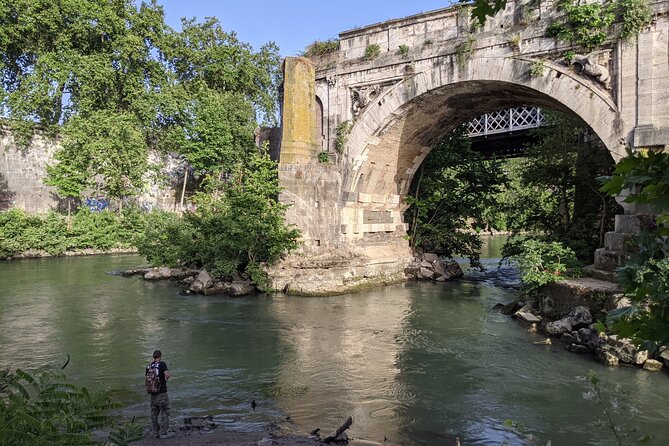
Isola Tiberina, Tiber Island, is small, but it has a long list of legends and significance. The tour’s playful angle is that it is connected to the birth of new true Romans, which helps you remember the symbolism behind the place.
Why it is a smart stop: it is easy to underestimate. A tiny island does not look like it should hold major meaning, but Rome loves exactly this kind of twist. The guide’s story helps you see why this is not just a scenic interlude.
Time is short, about 20 minutes. That is fine here, because you are mostly building a mental map of why the island mattered, rather than spending forever photographing it.
Bocca della Verità and Santa Maria in Cosmedin
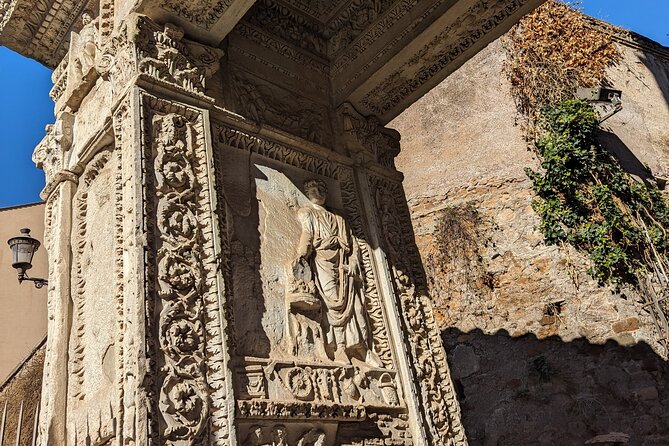
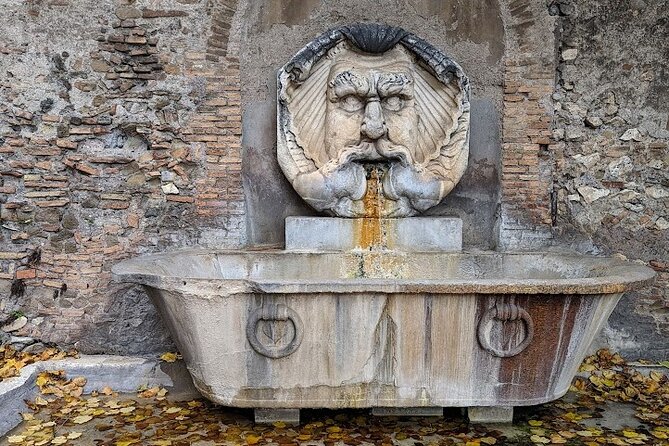
Bocca della Verità is the classic one: a face mask people use for a truth test. The tour also pairs it with the medieval church of Santa Maria in Cosmedin, where relics of St. Valentine rest.
This stop is good for two reasons. First, it anchors you in a famous medieval tradition. Second, it gives you a bridge between ancient Rome and the religious Rome that followed, so the walking story feels continuous rather than random.
Practical consideration: this is one of those places where crowds tend to gather. You get about 20 minutes, so you can do the essentials, listen, and move on without losing the day.
Foro Boario: early Roman temples and the marble puzzle
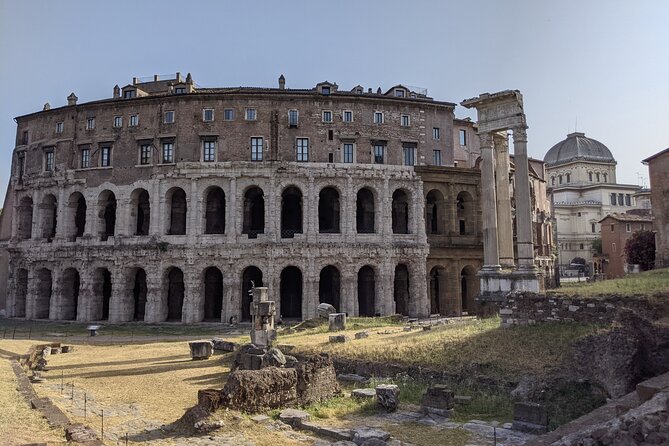
Foro Boario is the early-temple zone, and the tour uses it to explain what early Roman worship buildings looked like. You also get to admire a first temple in marble that is still well-preserved, which is a big visual payoff for a relatively short stop.
The guide’s explanation of why the marble survives so well can surprise you. And if you are the type who likes details that make Rome feel tangible, this is where the tour style shines.
One bonus point from review-style memories: the guide includes niche facts, including ideas like marble recycling and even a fish tax story. That kind of detail turns a stone building into something you can picture being used, reused, and reshaped.
Time here is about 20 minutes.
Giardino degli Aranci on Aventine Hill: the panorama plus the St. Peter shrink trick
Then you climb to Aventine Hill, with the Orange Garden viewpoint. This is a straightforward win. You get Rome skyline views, and the tour calls out a specific optical illusion involving St. Peter’s Basilica seeming to shrink as you approach.
Optical tricks are not only fun. They also force your brain to notice perspective, distance, and angles in a way that makes the city easier to navigate later. After seeing it once, you start spotting sightlines everywhere.
Time is about 20 minutes. That is enough for the view, a few photos, and the story, without turning it into an all-day hike.
Buco della Serratura: the keyhole view and the Malta Order twist
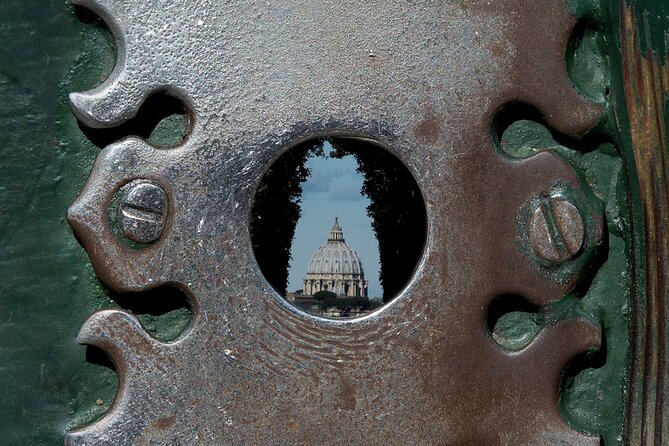
Buco della Serratura is a clever stop. You peer through the keyhole of the Priory of the Knights of Malta and see the Sovereign Military Order of Malta. The tour’s angle is political and historic, a reminder that Rome contains institutions with unusual rules and identities.
Why it works on this itinerary: it is a private-feeling moment inside a big city. You go from open views to a tiny portal experience, and the contrast makes the story stick.
Time is about 20 minutes. This is one of those moments where you might want to be ready with your phone camera, but also listen first. The guide’s framing matters.
Testaccio: where you skip the biggest crowd lines and see real daily Rome
Testaccio is where the day turns local. The tour explicitly steers you away from main tourist crowds and into a neighborhood where ancient history meets modern life. You spend about 30 minutes exploring, with attention on the market atmosphere, street art, and a mysterious hill connected to secrets from Rome’s ancient past.
This stop is a great change of pace. Many Rome walks are just a highlight reel. Testaccio gives you rhythm: people buying food, vendors, murals, and the sense that the city is still alive, not frozen for visitors.
Potential drawback: Testaccio is less predictable than a landmark plaza. If you expect everything to look exactly like postcards, you might feel a little less “wow” than at the big sites. But that is also the point. You are here to understand how Rome functions day to day.
Piramide Cestia: an Egyptian-shaped detour that tells you about Roman taste
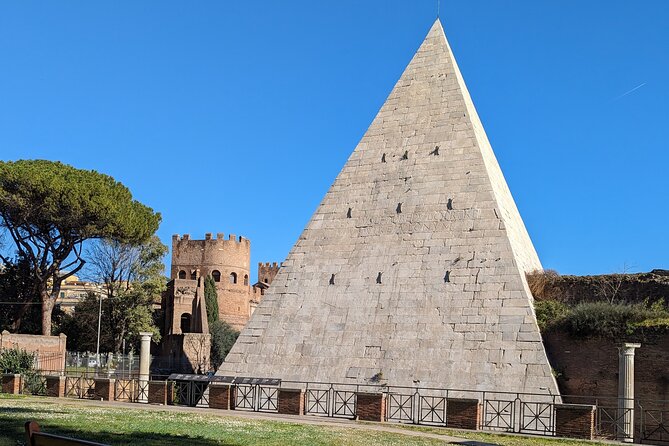
The Pyramid of Cestius is a lone survivor of Rome’s fascination with Egyptian culture. It is a striking shape among Roman structures, and it gives you a chance to talk about eclectic tastes among wealthy figures in ancient Rome.
The tour frame connects it to the wealthy magistrate who ordered it, and you get the sense of how Rome absorbed styles from far away. This is another example of how the walk uses contrasts to teach.
Time is about 15 minutes, which is plenty for a landmark like this. It is short, but memorable.
How the pace feels over 3 to 4 hours
The entire route is about 3 to 4 hours, and it is broken into lots of 15 to 30 minute segments. That structure helps you absorb stories without fatigue. Reviews also mention that you often do not feel exhausted even when you climb, especially if you keep up with the pace.
Because it is weather dependent, the guide may change or cancel the tour in poor conditions. If you are planning a tight schedule, consider booking earlier in your Rome stay or having a flexible day.
Group size stays max 10, so the walk usually feels conversational. In reviews, people also mention picture time and that the archaeologist made an effort to take photos of the group, not just point and move.
Who this tour suits best
This is a strong choice if you like walking Rome but want more than facts you can read on a sign. The combination of phone-based 3D/AR and a real archaeologist guide fits travelers who learn visually and by story.
It is also ideal if you have already seen the Colosseum from the outside and want a faster, clearer understanding of what you are looking at. The Forum and Colosseum AR pieces can make those big landmarks feel less intimidating.
If you have very limited mobility or you hate uphill stretches, this may be harder. The tour asks for good physical fitness because of the terrain.
Should you book this archaeologist-led urban trek?
Yes, if you want a low-cost Rome experience that teaches you how to see. For a little over $3, you are paying for a small-group archaeologist walk plus AR moments that connect ancient Rome to what you stand beside today. The itinerary mixes famous names with neighborhood texture, so you leave with a more personal mental map.
Book it if you:
- want augmented reality help for the Colosseum and Forum
- enjoy learning details that go beyond the obvious
- like a small group where questions feel welcome
Skip it if you:
- cannot handle hills and uneven walking
- are going on a day with very poor weather and no flexibility
FAQ
How long is the urban trekking tour?
It runs about 3 to 4 hours.
Is the tour in English?
Yes, it is offered in English.
What is the group size?
The tour has a maximum of 10 travelers.
Is there a mobile ticket?
Yes, the tour uses a mobile ticket.
Where does the tour start, and what time?
The meeting point is Gusto Massimo Bar Bistrò di TIZIANO DI M. E. F. S.r.l, Via del Circo Massimo, 5a, 00153 Roma RM, Italy, with a 10:00 am start time.
How fit do I need to be?
You should have a moderate physical fitness level because the route includes uphill and downhill sections.
What should I wear and bring?
Wear flat, comfortable shoes. Bring layered clothing and sun protection in summer, plus a bottle or cup for water.
Are the listed stops free to enter?
The itinerary shows admission tickets as free for each listed stop.
Can the tour change if weather is bad?
Yes. The guide reserves the right to change or cancel due to unfavorable weather conditions.
Are service animals allowed?
Service animals are allowed.
If you want, tell me your travel dates and whether you prefer fewer crowds or more iconic stops, and I’ll suggest the best day and time strategy for Rome.
Latest additions from Rome
- Rome: Testaccio Market Food Tour with Street Food & Wine★ 5.0 · 8 reviews
- Exclusive Pasta & Tiramisu Class with Wine near by Colosseum★ 5.0 · 8 reviews
- Private Professional Photoshoot in Rome★ 5.0 · 8 reviews
- Loreto “Shrine of the Holy House of the Virgin Mary” Private Tour from Rome★ 5.0 · 8 reviews
- Rome Day to discover Florence and Pisa Hotel Pickup★ 4.5 · 8 reviews
- Rome: Christmas Nativities and Angels Tour★ 3.1 · 8 reviews
- Guided Tour of Vatican Museums and Sistine Chapel★ 5.0 · 8 reviews
- Rome: Cooking Class of fresh Pasta and Tiramisu Cake★ 5.0 · 8 reviews
Hiking & Trekking, compared.
Hiking the Highest Waterfall in EU Hike, Rome
Read our review →