
Reviewed · HISTORICAL TOURS
Rome in Golf Car a Private Trip between History and Beauty
Rome, neatly packed in a golf cart. This private 3-hour loop strings together Trevi Fountain, the Spanish Steps, and the Pantheon, with hotel pickup and quick stops for photos.
I especially like the flexible pacing from guides such as Max and Mauricio, who help you focus on what you care about and keep the explanations clear. It is also the kind of tour where you get help with photos, not just sightseeing.
One possible drawback: it is weather-dependent, so heavy rain can change the day. Also, I would double-check the checkout details, since one booking issue added a child to the price when it should not have.
In This Review
- Quick reasons this Rome golf-cart route works
- How a private Rome golf-cart loop saves your legs in 3 hours
- Your pickup and drop-off: starting near Fontana dell’Adriatico
- Stop 1: Trevi Fountain, baroque spectacle and the coin tradition
- Piazza Venezia and the Colosseum area: Vittorio Emanuele II views
- Piazza di Spagna and the Spanish Steps: 135 steps and Barcaccia Fountain
- Via del Corso: the main artery for shops, churches, and quick looks
- Piazza del Popolo and the Flaminian Obelisk with three church faces
- Trinità dei Monti: Renaissance church details above the steps
- Bocca della Verità and Teatro di Marcello: classic stops, short and sweet
- Imperial Forums area and Mercati di Traiano: ancient administration in stone
- Pantheon with an admission ticket: Hadrian’s dome and the oculus
- Via dei Condotti: luxury shopping street between Piazza di Spagna and Piazza del Popolo
- Giardino degli Aranci on the Aventine Hill: orange trees and wide city views
- Guides make the difference: Max, Mauricio, Alessandro, and more
- Price and what you really get for $131.81 per person
- When to go, what to bring, and how to make the short time pay off
- Should you book Rome in Golf Car?
- FAQ
- How long is the Rome in Golf Car private trip?
- What is the price per person for this tour?
- Is pickup from hotels available?
- Is this tour private?
- What languages are the guides available in?
- Are admission tickets included?
- Do I need to pay tips?
- What is the meeting point and where does the tour end?
- What happens if the weather is poor?
- What is the cancellation policy?
Quick reasons this Rome golf-cart route works
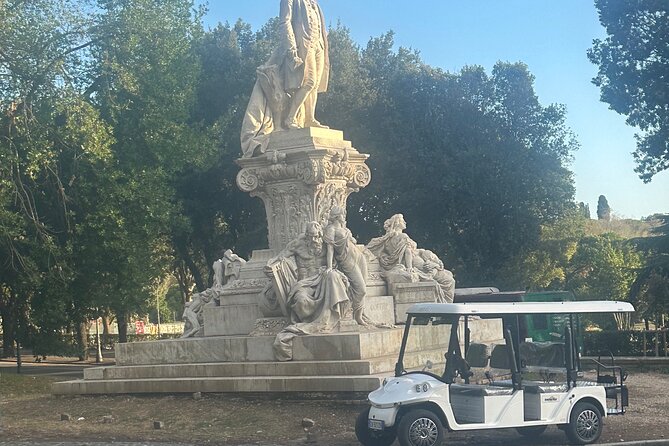
- Hotel pickup so you start close to your lodging, not in a far-off meeting point
- Photo pauses at major stops, so you do not rush past the best angles
- Two admission-ticket moments (Trevi Fountain and the Pantheon) built into the time
- Small-footprint sightseeing in areas where buses and walking can feel tough
- Guides who tailor the itinerary, with standout names like Max, Mauricio, and Alessandro
- A mix of icons and calmer viewpoints, including the Orange Garden for a breather
How a private Rome golf-cart loop saves your legs in 3 hours
If you only have a short window in Rome, this kind of private golf-cart sightseeing makes a lot of sense. You get a guided route that links huge landmarks without turning your day into a walking marathon. That matters because Rome is not flat, and many of the most famous areas are crowded and full of sudden turns.
I also like the timing. The tour is about 3 hours, so it works well on an arrival day, or as your first pass to get your bearings fast. Instead of guessing how far apart everything is, you see the key parts of central Rome in one go and you can plan the rest of your trip with more confidence.
You should still expect short walking moments. Even with a cart, some stops are best enjoyed at street level, and you will want to step out for photos and quick looks. The upside is that the big distances get handled for you, and you stay in the sightseeing rhythm.
More Private Tours in Rome
- Rome by Golf Cart Private Tour: Beyond the Landmarks
★ 5.0 · 4,361 reviews - Early Morning Vatican, Sistine, St. Peter’s Semi or Private Tour
★ 5.0 · 3,779 reviews - Rome on a Golf Cart Semi-Private Tour Max 6 with Private Option
★ 5.0 · 2,502 reviews - Rome Private Arrival Transfer: Fiumicino Airport to Hotel in Rome
★ 4.5 · 2,492 reviews
Your pickup and drop-off: starting near Fontana dell’Adriatico

The meeting point is Fontana dell’Adriatico in Piazza Venezia, and the tour ends back at the same location. The big convenience is that hotel pickup is offered, so you can start right from where you are staying, then return the same way or get dropped back at the meeting area.
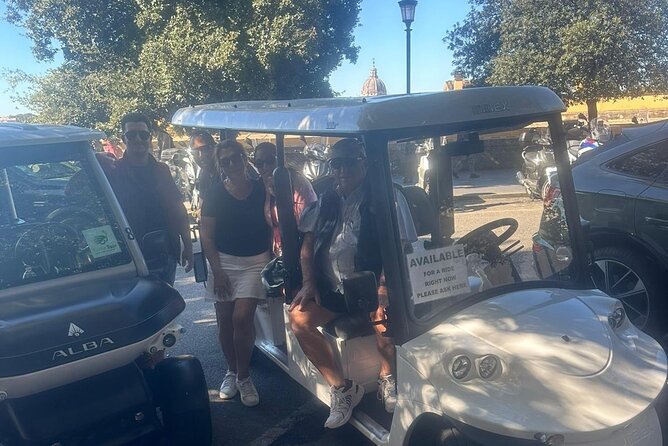
This format helps if you are staying just a bit outside the main tourist lanes, because you avoid the stress of figuring out the exact meeting spot while dragging luggage or fighting jet lag. It also helps if you want to keep your day flexible. A private tour means your group stays together, with only your party on the cart.
The tour also includes a mobile ticket, and you receive confirmation at booking time. Service animals are allowed, and the tour notes that most travelers can participate. If you rely on public transport sometimes, this area is near transit, which can be handy for getting back into your own schedule after the tour.
Stop 1: Trevi Fountain, baroque spectacle and the coin tradition
Trevi Fountain is the star you came for, and this route treats it that way. You get a 20-minute stop with an admission ticket included, which is valuable because this is one of those places where getting your timing wrong can feel frustrating. Even if crowds are present, you still get a real window to take in the details.
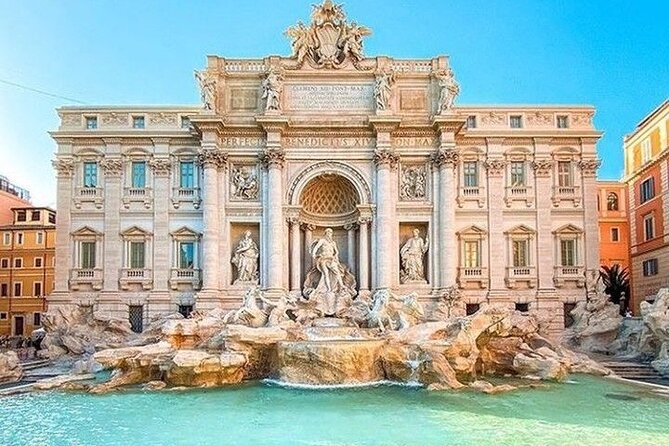
The fountain’s design is pure drama. It was designed by Nicola Salvi and completed in 1762, with a large semicircular basin surrounded by columns and statues. At the center is Oceanus, driving a shell-shaped chariot pulled by sea horses and sea figures. You also get allegorical sculptures tied to themes like the four seasons, health, and wealth.
If you like small traditions, this is where you hear the classic Trevi ritual: throwing a coin into the fountain is said to symbolize the desire to return to Rome. It is simple, but it is part of what makes Trevi feel special beyond the photos.
Piazza Venezia and the Colosseum area: Vittorio Emanuele II views
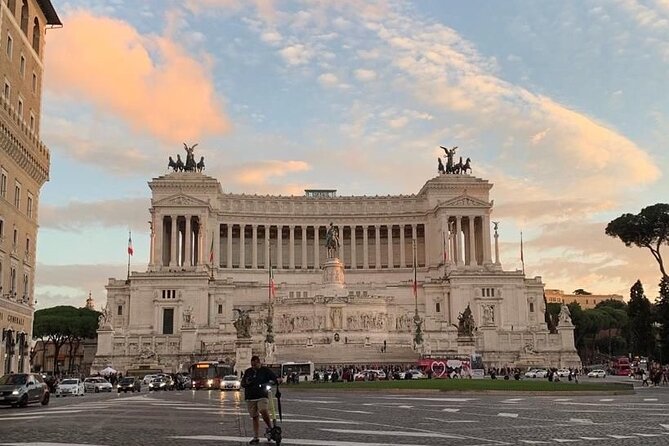
Next, you head to the Piazza Venezia area, a major central hub where you can orient yourself in Rome. This stop is listed as connected to the Colosseum area, and the key landmark here is the monumental monument to Vittorio Emanuele II, also known as the Altare della Patria.
The square is famous for its big architecture and the constant movement of cars and people around it. In the center, the Vittoriano monument creates a strong visual anchor, and the terrace viewpoint adds a practical benefit: you can grab a broad view that helps you understand how the city pieces line up.
You get about 10 minutes here with admission ticket details listed as free at this stop. Even if you are not going inside anything at this moment, it is still a smart pause because Piazza Venezia is a starting point for exploring other sights.
The only thing to keep in mind is that this is a traffic and crowd zone by nature. It can feel loud and busy, so if you prefer quiet sightseeing, plan to focus your energy on photos and the guide’s explanations rather than lingering.
Piazza di Spagna and the Spanish Steps: 135 steps and Barcaccia Fountain
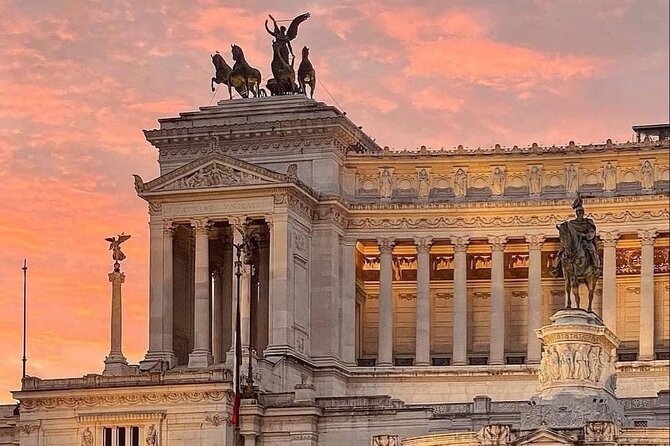
Piazza di Spagna is one of Rome’s most photogenic areas, and the tour gives you a short, focused stop that still feels worthwhile. You get around 10 minutes here, right by the Scalinata di Trinità dei Monti, the Spanish Steps made of 135 steps.
At the center of the square, you will see the Barcaccia Fountain, a baroque work designed by Pietro Bernini and Gian Lorenzo Bernini. The fountain represents a boat on the verge of sinking, meant to symbolize the rising waters of the Tiber. It is the kind of detail you might miss if you were just rushing through on your own.
The area also has what I call a built-in Rome vibe: people watching, street activity, and high-end shopping nearby. You can pair the sightseeing with a quick browse, then move on without losing time.
The practical trick is to arrive with photo goals in mind. This is one of those spots where the line for the best angle forms fast. A guide who knows the flow helps you pick the time window for pictures.
A few more Rome options worth a look
Via del Corso: the main artery for shops, churches, and quick looks

From Piazza di Spagna’s world of steps and boutiques, you connect into Rome’s shopping spine with Via del Corso. This street stretches for about a kilometer and runs between Piazza del Popolo and Piazza Venezia, making it a natural link between the big squares.
What makes it more interesting than just a shopping corridor is the mix of settings along the way. You can see churches and historic buildings, plus places like Palazzo Doria Pamphili, which is noted for housing one of the most important private art collections in Rome. You also get plenty of cafes and restaurants if you want a quick break.
The advantage of doing this by cart is simple. You experience the street without committing to a long walk, then you can decide if you want to return later on foot when you have more time. It is a good “map in motion” moment.
One caution: the street can be crowded, especially during peak hours. If you want smoother photos, aim for early or later in the day and let the guide position your stop.
Piazza del Popolo and the Flaminian Obelisk with three church faces
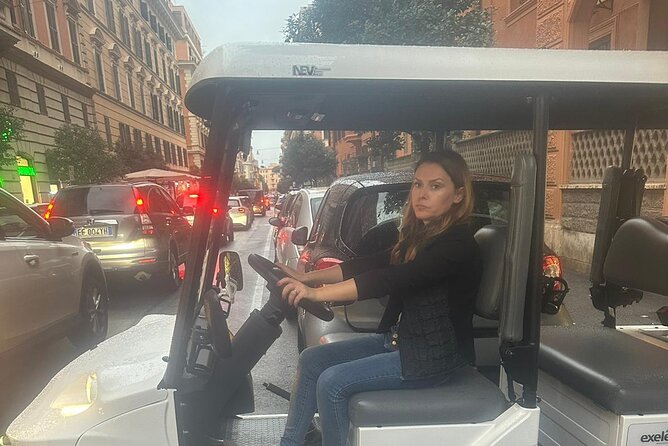
At Piazza del Popolo, you get another classic Rome square with a distinct shape: it is elliptical, framed by notable historic buildings. The centerpiece is the Flaminian Obelisk, an ancient Egyptian obelisk erected in 10 BC, standing above a decorative fountain.
This stop also includes a useful cultural detail: the square is surrounded by three churches. Santa Maria in Montesanto and Santa Maria dei Miracoli sit on either side of the obelisk, while Santa Maria del Popolo is at the opposite end and is noted for artworks by Caravaggio.
Even with only about 10 minutes, this is a great place to look around because the obelisk gives you a strong landmark to orient from. It also connects directly into Via del Corso, so your route feels logical instead of random.
If you are sensitive to crowds, this area can still be busy because it is a gateway to the main shopping street and a common meeting point. The best strategy is to treat it as a short orientation stop, then move quickly to the next viewpoint.
Trinità dei Monti: Renaissance church details above the steps
If you want one more layer of “Rome above the postcards,” you will likely enjoy Trinità dei Monti. The church is listed as Trinità dei Monti, built between 1502 and 1585, and it is described as Renaissance in character with an elegant façade.
The most visually obvious features are the two twin bell towers and the imposing portico. Inside, you can expect frescoes and paintings by artists such as Francesco Salviati and Daniele da Volterra. It is dedicated to the Holy Trinity and hosts religious celebrations, though the tour time here is brief.
This stop can be a nice contrast to the crowds below the Spanish Steps. You still get the major landmarks, but you also get architecture and interior art details that feel a bit more grounded than just street-level sightseeing.
The tour listing includes about 10 minutes for this portion. So think of it as a “quick quality look” more than an extended church visit.
Bocca della Verità and Teatro di Marcello: classic stops, short and sweet
The itinerary also includes Bocca della Verità as a stop name, but the details provided here do not expand much beyond the mention. The key point for planning is that this tour does include the stop as part of its route, and you should budget for a brief visit window.
Then comes Teatro di Marcello, described as the Theater of Marcellus near the Tiber. This is one of Rome’s powerful ancient remnants. Built between 13 and 11 BC, requested by Emperor Augustus and dedicated to his nephew Marcellus, it held about 20,000 spectators. The theater’s semicircular design and marble seating are part of what made it a major cultural venue.
You also learn how much Rome changes over time. The structure deteriorated, then over the centuries it was partially incorporated into modern buildings. Today, you can still see it, which gives you that tangible sense of history layered under daily life.
You get around 20 minutes here. That makes it long enough to walk a little, take pictures, and let the guide’s context land, without dragging the day too far.
Imperial Forums area and Mercati di Traiano: ancient administration in stone
When the route shifts toward the Imperial Forums, you are moving into the political and social core of ancient Rome. The tour includes Mercati di Traiano – Museo dei Fori Imperiali and also describes the Imperial Forums in detail.
These forums were built between the 1st century BC and the 3rd century AD, commissioned by multiple emperors over time, from Julius Caesar through Trajan. The complex is made up of areas like the Forum of Caesar, Forum of Augustus, Forum of Nerva, and Forum of Trajan.
What I like about this stop conceptually is that you are not just looking at a single building. You get a sense of how the city functioned. The description includes temples, basilicas, columns, and triumphal arches, which served as public spaces and symbols of imperial power.
This portion is listed with about 20 minutes, and admission is noted as free at this point. If you are the type who likes to connect monuments to a story, this is where the guided explanation pays off. You will probably leave with a stronger mental map of what you are seeing at other sites later.
Pantheon with an admission ticket: Hadrian’s dome and the oculus
The Pantheon stop is the other big “don’t miss” moment with an admission ticket included and about 20 minutes. This is a perfect pairing with the Trevi Fountain stop, because both are the kind of masterpieces where quick timing helps you catch the right mood.
The Pantheon is described as an ancient Roman temple built in the 2nd century AD under Emperor Hadrian. The dome is the headline: a 43-meter diameter dome, noted as the largest unreinforced concrete dome in the world. The façade includes a portico with Corinthian columns and a grand pronaos.
Inside, symmetry and space are emphasized, and the oculus is the magic. Light filters in through the central opening, creating an atmospheric effect. The tour also notes that the building was transformed into a Christian church in the 7th century, which helped preserve it over time.
Practical advice: keep your eyes on the dome and then down toward the details. A guide who knows how to point out symmetry makes a short visit feel more complete.
Via dei Condotti: luxury shopping street between Piazza di Spagna and Piazza del Popolo
If you like the modern Rome side, the route includes Via dei Condotti. This street is described as a prestigious luxury shopping hub stretching from Piazza di Spagna to Piazza del Popolo.
Along Via dei Condotti, you will see designer stores and ateliers, with examples given such as Gucci, Prada, Valentino, and Bulgari. It is also noted for cafes and restaurants, so you can treat this as a small atmosphere break even if you do not plan to shop.
This stop can be surprisingly useful even if your budget is set. Looking at the street gives you a sense of where you might want to wander later, and it helps connect the Spanish Steps area back to the Popolo side without guessing.
Admission here is listed as free, with about 20 minutes. That is enough to walk a little, check a few storefronts, then get back to the ancient highlights.
Giardino degli Aranci on the Aventine Hill: orange trees and wide city views
To balance the crowds, the tour includes Giardino degli Aranci, also known as Parco Savello, on the Aventine Hill. This garden dates back to the 14th century and is described as famous for both scenery and panoramic views over the city and the Tiber River.
This stop is one of the reasons the route feels more human. You get a chance to slow down in a place with orange trees and aromatic plants. The description mentions shaded paths, flower beds, and green spaces, so you can actually breathe for a few minutes.
You also get a different kind of Rome photo. Instead of icons, you are shooting a viewpoint. That tends to make the day feel less like a checklist and more like a real outing.
Plan for this as a comfort stop. Even on a day packed with major sights, the garden can help your legs and your mood.
Guides make the difference: Max, Mauricio, Alessandro, and more
The highest praise in the tour style is not about carts or stops. It is about the guide. People consistently highlight guides like Max and Mauricio for being knowledgeable and flexible, plus taking photos. You see it again with names like Alessandro, and also Christina and Andreas in other cases.
What matters for you is how that translates into your day:
- Your itinerary can adjust to your preferences.
- Your guide is clear even in tricky situations, including a mention of hearing loss where the guide made things understandable.
- The vibe is practical, not lecture-only, and you get help staying comfortable in hot weather, including shade and drinks.
I also like that this tour handles real-world conditions. One mention notes the guide’s commitment when rain could have derailed the day. With good weather dependence, having a guide who keeps morale up is not a small thing.
Finally, the guide is offered in multiple languages, including English, Spanish, Italian, Russian, Ukrainian, and Polish. So if English is not your strongest language, you should still have options.
Price and what you really get for $131.81 per person
At $131.81 per person for about 3 hours, you are paying for a private, guided route plus the transportation method. You also get pickup offered, mobile tickets, and group discounts listed, even though it is a private experience with only your group.
The value gets clearer when you consider admissions. The tour includes admission ticket notes at Trevi Fountain and the Pantheon. Other listed stops show free admission at their points. That means you are not paying separately for every single stop, and you spend less time stuck in line situations that can eat your short Rome time.
Tips are not included, so you should budget for them if you plan to reward good guiding. Also, one practical note from experience with similar booking flows: the checkout process may be picky about participant details. Double-check that your group size matches what you want to pay for, especially if there is a child field involved.
Overall, this price looks strongest if you want a guided overview and you do not want to spend your day calculating transit, taxis, and walking distances between major Rome sights.
When to go, what to bring, and how to make the short time pay off
This experience requires good weather. If weather turns, the plan can change, or you can be offered a different date or a full refund. So I would book based on your Rome schedule flexibility, not just the day that looks best on paper.
A few practical tips for getting the most out of the route:
- Bring sunscreen and water, especially in summer heat.
- Have your camera ready, because the stops are photo-friendly and time windows are short.
- If you use mobility aids or move slower than average, tell the guide what pace you want. The flexibility is part of what people love.
Timing matters too. One mention describes booking at 7 pm and enjoying cooler summer temperatures. If your day is flexible, evening can make the crowded areas feel easier while still letting you see the highlights.
If you are sensitive to crowds, treat this as a “strategic sightseeing” tour. You will see a lot, but you will not get hours of deep, unhurried time at a single site. That is not a flaw if your goal is orientation and guided context.
Should you book Rome in Golf Car?
Book this if you want a smart first look at Rome, with minimal walking, a private group pace, and guided context at the biggest icons. It is also a great fit if you value good photos and you like guides who adjust to what you want to see. Names like Max, Mauricio, and Alessandro pop up for a reason: people remember the guide style.
Skip it or think twice if you want to linger for long stretches at one monument, or if your schedule is locked to a single weather-sensitive date. Also, if you dislike getting swept along a tight route, this might feel like too much movement in too little time.
If your goal is to see Trevi, the Pantheon, the Spanish Steps, the Forum zone, and panoramic viewpoints like the Orange Garden within one coordinated outing, this tour hits that sweet spot.
FAQ
How long is the Rome in Golf Car private trip?
The duration is approximately 3 hours.
What is the price per person for this tour?
The price is $131.81 per person.
Is pickup from hotels available?
Yes, pickup is included, with direct pickup from hotels listed as available.
Is this tour private?
Yes. Only your group will participate.
What languages are the guides available in?
The guide is offered in English, and guides can also be provided in Spanish, Italian, Russian, Ukrainian, and Polish.
Are admission tickets included?
Admission ticket included stops are Trevi Fountain and the Pantheon. Other listed stops are marked as free.
Do I need to pay tips?
Tips are not included.
What is the meeting point and where does the tour end?
The tour starts at Fontana dell’Adriatico, Piazza Venezia, 00186 Roma. It ends back at the meeting point.
What happens if the weather is poor?
The experience requires good weather. If it is canceled due to poor weather, you will be offered a different date or a full refund.
What is the cancellation policy?
You can cancel up to 24 hours in advance for a full refund. If you cancel less than 24 hours before the experience starts, the amount paid will not be refunded.
Latest additions from Rome
- Guided Tour Vatican Museums & Sistine Chapel★ 4.1 · 30 reviews
- Exclusive Rome by Night Vespa Tour★ 5.0 · 30 reviews
- Transfer Rome to Airports★ 4.5 · 30 reviews
- Vatican: St.Peter’s Basilica & Dome – Reserved Entry & Tour★ 4.1 · 30 reviews
- Rome street art tour: off the beaten path with a local guide★ 5.0 · 30 reviews
- Tivoli, Hadrians Villa and Villa d’Este, a charming day trip from Rome★ 4.5 · 30 reviews
- Rome Food Tasting with Wine Pairing Italian Authentic Flavors★ 5.0 · 31 reviews
- Inspirational Cooking on the Roman Chef’s Panoramic Terrace★ 5.0 · 30 reviews
Historical Tours, compared.

Forbidden History Walking Tour & Pub Crawl with Drinks
Read our review →
Twilight Treasures: An Evening Tour Through Rome’s Rich History
Read our review →
Small-Group Rome to Pompeii & Amalfi: Day of History & Sea
Read our review →
Heritage Site: Villa d’Este and Hadrian’s Villa in Tivoli Tour from Rome
Read our review →
Piazza del Popolo and Historical Sights Walking Tour in Rome
Read our review →
Private Rome Food Tour in the Historic Centre with 8+Tastings
Read our review →Browse the lists this tour appears in