
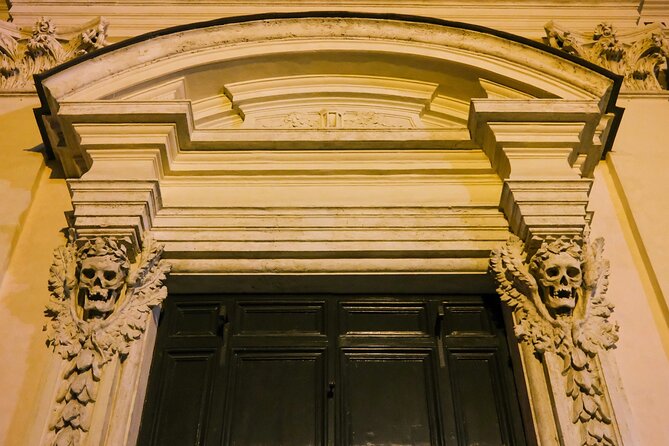
Reviewed · ROME GHOST AND MYSTERY TOURS
Rome Historical True Crime Tour
Rome has a darker side, and it walks. This Rome historical true crime tour is a 2-hour, 8:00 pm evening stroll through famous squares and sketchy backstreets, where the guide links infamous stories to what you can actually see on foot.
What I like most is the mix of real street-level details and storytelling that feels grounded, not just sensational. The small group size (up to 15) also keeps things moving at a comfortable pace, even if you want a first-night plan in Rome that does not require a museum.
One thing to consider: the audio can be tricky because Rome is busy at night. If you are sensitive to hearing, plan to get closer to the guide early so you catch every beat.
In This Review
- Key Highlights You Should Know Before You Go
- Why This Dark-Side Rome Walk Works at Night
- Start in Campo de’ Fiori, Where the Story Engine Turns On
- Piazza Farnese: Renaissance Looks Pretty, the Footnotes Get Dark
- Vicolo delle Grotte and Ponte Sisto: Small Streets, Big Legends
- Via Giulia: Monks, Macabre Jobs, and How Systems Get Used
- Via di Monserrato: Harsh Prison History and Borgia Mafia Vibes
- Via dei Banchi Vecchi and the Gelato Shop Twist
- Via del Banco di Santo Spirito: Executioner’s House, Real Human Consequences
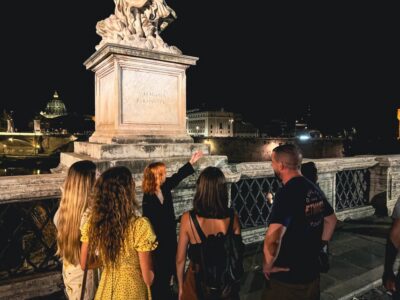
- Castel Sant’Angelo: From Emperor’s Tomb to Fortress and Execution Site
- Group Size, Pace, and Why Comfortable Shoes Actually Matter
- Price and Value: What $30.07 Buys You in the Real World
- Who Should Book This Rome True Crime Tour
- Should You Book This Rome Historical True Crime Tour?
- FAQ
- What is the duration of the Rome Historical True Crime Tour?
- What time does the tour start, and when does it end?
- Where do I meet for the tour?
- Is the tour offered in English?
- How much does the tour cost?
- Is food or drink included?
- Are any admission tickets required at the stops?
- How big is the group?
- Can I get help if I have hearing or sight impairment?
- Is cancellation possible if plans change?
Key Highlights You Should Know Before You Go
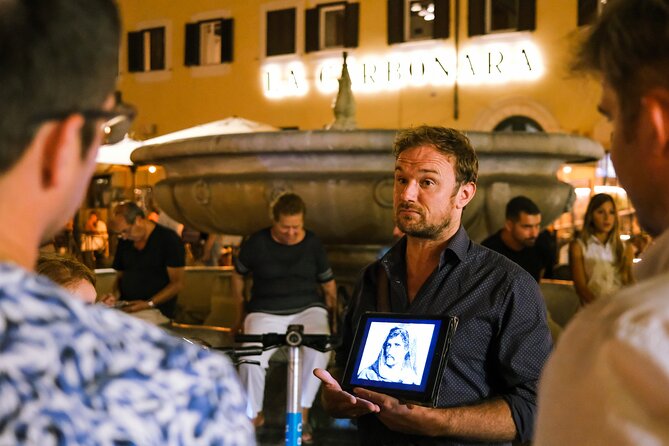
- Small group of 15 maximum, so the guide can keep the flow tight
- English-speaking expert guide, focused on facts with a controlled dose of horror
- A night walk with story stops, from Campo de’ Fiori to Castel Sant’Angelo
- Off-the-main-road backstreets, like Vicolo delle Grotte, where the setting does half the work
- No paid entry tickets listed for the stops, so you are mostly sightseeing outdoors
- Manageable walking for most people, but comfortable shoes are a must
Why This Dark-Side Rome Walk Works at Night
Rome is one of those cities where the buildings do not just look old, they carry consequences. This tour leans into that idea, using darker characters and crimes to help you read the city like a story you can walk through.
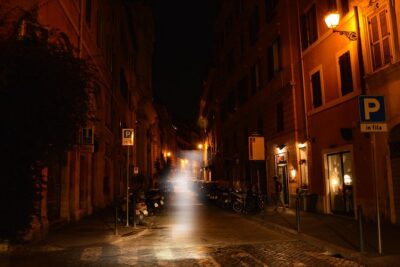
At night, the streets feel more like the Rome people imagine when they think about punishment, power, and betrayal. You still get structure, though. The route is paced in short story segments, so you are not stuck listening for ages before you see another street corner.
The best part is that you are not racing between major monuments. Instead, you are moving from square to alley to bridge to fortress, and each stop is chosen because it connects to a grim theme you can picture immediately.
Other walks through Rome after dark:
- Haunted Rome Ghost Tour – The Original
★ 4.5 · 668 reviews - Rome: Haunted City Night Walking Tour
★ 4.9 · 616 reviews - Haunted Rome Ghost Night Walking Tour
★ 5.0 · 495 reviews - Rome: Illuminati Trail Angels & Demons Tour
★ 4.3 · 414 reviews
Start in Campo de’ Fiori, Where the Story Engine Turns On
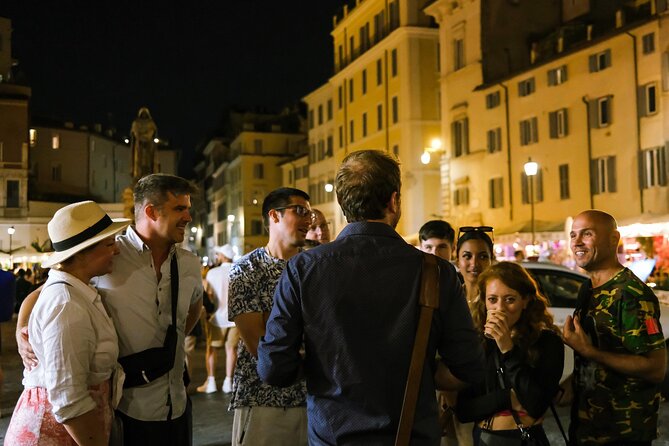
You meet at Campo de’ Fiori at 8:00 pm, then the guide starts right away with the first story. The square is famous and easy to find, which matters, because a tour like this depends on a calm start and a smooth handoff into the narrower streets.
What makes this opening effective is timing. Starting in an area like Campo de’ Fiori lets you orient yourself first, then the tour gradually tightens into the less obvious corners of Rome. You are not just learning history in theory. You are learning how to move through the city while the guide paints a criminal past onto the streets.
If you like tours that give you a mental map for later, this start helps. After the first stop, you will have a better sense of where you are in Rome and how the surrounding neighborhoods connect.
Piazza Farnese: Renaissance Looks Pretty, the Footnotes Get Dark
Next comes Piazza Farnese, anchored by the grand Renaissance Palazzo Farnese. The setting is beautiful, but the tour uses that contrast on purpose, moving from visual splendor into the sort of secrets a city keeps off to the side.
The guide focuses on both the palazzo’s story and the lesser-known darker side of the square. That approach is smart for a one-evening tour. You get context for what you are seeing, then you get the uncomfortable human layer underneath it.
A practical note: this part is short, about 5 minutes. So treat it like a sharp introduction, not a deep museum visit. If you want to linger, make sure you step closer for photos and then keep pace so you do not fall behind the group.
Vicolo delle Grotte and Ponte Sisto: Small Streets, Big Legends
After Piazza Farnese, you slip into Vicolo delle Grotte, one of Rome’s darker backstreets. The story centers on a notorious swindler, or maybe a magician, depending on which version the guide presents. Either way, the point is the same: the setting supports the myth-making.
Backstreets like this are where Rome tours often become great or boring. Here, it is great because the alley is not just scenery. It is part of how the tale makes sense, and the guide keeps the tone cinematic without losing track of what is actually being claimed.
Then you move to Ponte Sisto, where the tour shifts to a story about a woman who ruled Rome after suspicious deaths of two rich husbands. This is a good place to pause and look at the bridge and surrounding river area, because it gives you a wider view after the tight alleys.
If you are the type who likes to understand the city’s shape, these two stops in sequence do that work for you. Narrow lane to bridge gives your eyes a chance to reset while the stories keep escalating.
Via Giulia: Monks, Macabre Jobs, and How Systems Get Used
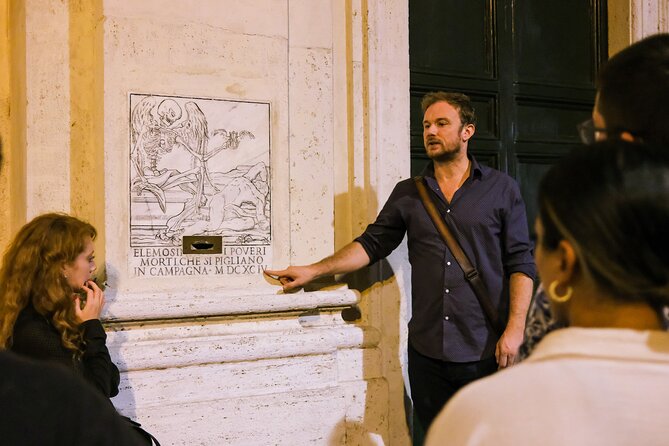
Via Giulia is next, and the tone turns even more specific. The guide talks about an order of monks with a macabre task, and how it possibly benefited the criminal element of Roman society.
This is where the tour becomes less about one shocking person and more about how power structures operate. You start noticing that the theme is not only crime. It is the way institutions, religion, and punishment can connect to people who were never supposed to hold any leverage.
The stop is about 10 minutes, which is exactly right for this kind of topic. Long enough to get the idea, short enough that you keep moving. Rome evening air can cool you down fast, and you will want your energy for the later portion.
A few more Rome options worth a look


Via di Monserrato: Harsh Prison History and Borgia Mafia Vibes
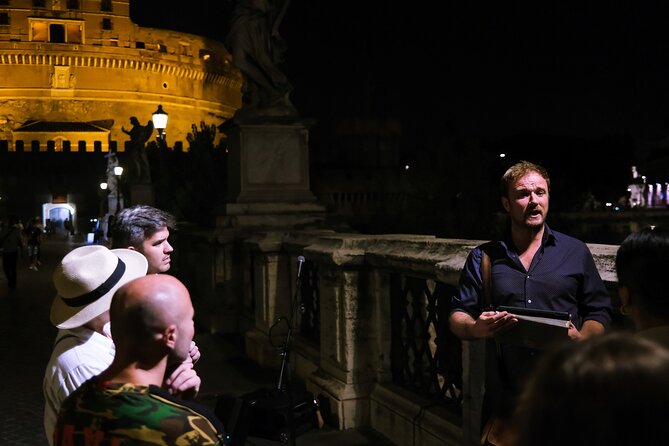
Via di Monserrato is one of the more intense segments. The tour addresses the history of one of the world’s harshest prisons, then adds tales of the Borgia family, with Rome described in terms of family rule and mafia-like control.
This stop works because it stacks themes: prison architecture as punishment, then the human engine behind it, and then the rumor layer that grows around rulers. Even if parts of the story are presented with uncertainty, the guide’s goal is to show you why these names and places stick in the city’s memory.
You will spend about 15 minutes here, making it a longer beat than most other stops. If you need a quick mental break during the tour, use this as a moment to step slightly aside, listen, and steady your pace before continuing.
Via dei Banchi Vecchi and the Gelato Shop Twist
Next is Via dei Banchi Vecchi, where the tour points out that what is now a gelato shop used to be something very different. The guide connects that location to a woman said to be responsible for the deaths of hundreds of men.
That kind of contrast is why walking tours beat reading alone. The city stays in front of you while the guide explains how the same walls could belong to a totally different world.
This stop also nudges you to look at street life as historical evidence. Businesses change. People change. But the street pattern, and often the building footprints, keep the past close enough to feel uncomfortable.
The stop is about 10 minutes, so keep your camera ready but do not let photos slow you down. You will have a bigger visual payoff at the end.
Via del Banco di Santo Spirito: Executioner’s House, Real Human Consequences
At Via del Banco di Santo Spirito, you see the house of Rome’s most famous long-lasting executioner. The guide shares tales of his life, tying this person to how punishment was carried out in a public way.
This is a strange topic to process while walking, which is exactly why it sticks. Executioner stories can turn into cartoon villains if the guide is careless. In this tour, the tone aims to keep it factual while letting the grim atmosphere speak.
Also, this is not an optional sidebar. It supports the tour’s overall logic: crime was not only committed. It was managed, dramatized, and enforced by specific roles and specific places.
Castel Sant’Angelo: From Emperor’s Tomb to Fortress and Execution Site
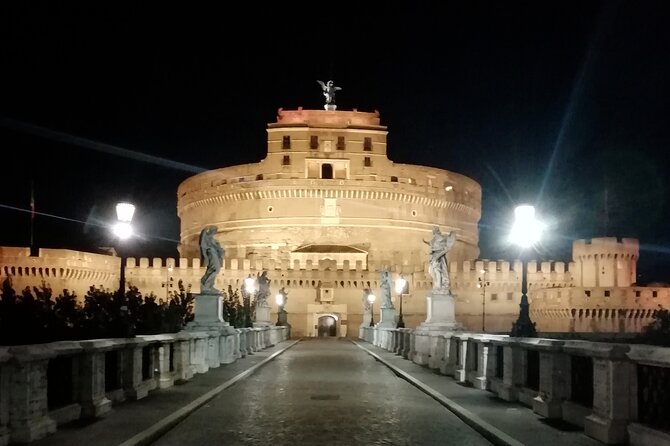
The finale is Castel Sant’Angelo, closing the loop from an emperor’s tomb to a fortress and a prison, and then to one of Rome’s main execution locations. This is the biggest setting on the route, and the guide uses it to pull the entire night’s themes together.
The story focuses on a tragic family, with an emphasis on how executions carried out here shaped the legend of the place. Even if you do not know the details going in, the fortress quality does the convincing. The building looks like it was made for control, which helps the guide’s narrative land.
You will spend about 10 minutes here as part of a 2-hour walk. That can feel short for a site this famous, but the tour is not designed to function like a full fortress ticket day. It is designed to give you the right context so you can connect the monument to the darker street-level stories you just heard.
Group Size, Pace, and Why Comfortable Shoes Actually Matter
This is a small-group tour with a maximum of 15 people and a total runtime of about 2 hours. That smaller size tends to make a difference on a walking story tour, because you are not waiting for people to catch up, and the guide can keep eye contact while moving.
Walking is key here. The route includes narrow backstreets and bridges, and one of the best practical lessons from the experience is simple: wear comfortable shoes. You will cover several different street textures in a short time, and Rome cobblestones do not forgive poorly chosen footwear.
In terms of comfort level, the tour is described as comfortable for a wide range of walking levels. That said, you still need to plan like it is an evening walk. If your mobility needs breaks, build in extra time before the meeting point so you are not stressed when the story starts.
Finally, note that Rome can be loud at night. One review mentioned difficulty hearing the guide, and that matches real-world conditions. Get in the right spot, close to the guide, and you will solve a lot of the problem.
Price and Value: What $30.07 Buys You in the Real World
At $30.07 per person for about 2 hours, you are paying for two things: a focused guide and a route you might not choose yourself. The stops listed are mostly story beats, with admission tickets marked as free, so you are not funding museum entrances during most of the walk.
What makes the value feel real is the combination of structure and small group size. You get an English-speaking expert guide, and the tour format keeps you moving from one scene to the next without long dead periods.
You should also budget for basics. Food and drink are not included, though a rest stop is offered at a cafe. That can be a helpful reset during a spooky story night, but plan to cover your own drinks or snacks.
Who Should Book This Rome True Crime Tour
This tour is a strong fit if you want:
- a night walking plan that is easy to join without a complicated schedule
- a story-driven way to learn how Rome’s streets link to crimes and punishments
- a route that favors backstreets and atmosphere over only the obvious big sights
It also tends to work well for families if your kids are comfortable with gory topics and you like stories that are told with energy rather than graphic detail. The tour’s style is built around character and setting, which is often what keeps younger minds engaged.
If you are someone who wants lots of landmark time, you might feel the stops are brief. The tour is built for multiple scenes in a short window, so you are learning connections, not doing long sightseeing blocks.
Should You Book This Rome Historical True Crime Tour?
I think it is worth booking if you want a compact way to see Rome’s darker side while still getting your bearings. The small group pace, the street-level storytelling, and the way the tour ends at Castel Sant’Angelo make it feel like a complete night arc rather than random horror stops.
If you are very sensitive to sound, or you hate spooky themes, then you may want a different style of Rome walk. The only real friction point is hearing in a noisy city, but choosing a better position at the front solves a lot.
Overall, for $30.07 and about two hours, you get a high-energy, fact-focused evening route with a memorable finale. If you love walking tours that make places feel alive, book it and plan to dress for cobblestones.
FAQ
What is the duration of the Rome Historical True Crime Tour?
The tour lasts about 2 hours.
What time does the tour start, and when does it end?
It starts at 8:00 pm and ends at Ponte Sant’Angelo.
Where do I meet for the tour?
The meeting point is Campo de’ Fiori, 00186 Roma RM, Italy.
Is the tour offered in English?
Yes, it is offered in English.
How much does the tour cost?
The price is $30.07 per person.
Is food or drink included?
No. Food and drink are not included, but a rest stop at a cafe is offered.
Are any admission tickets required at the stops?
Admission tickets are listed as free for the stops included on the tour.
How big is the group?
The tour has a maximum of 15 travelers.
Can I get help if I have hearing or sight impairment?
Interpreters can be provided for sight or hearing impaired guests.
Is cancellation possible if plans change?
Yes, you can cancel for a full refund up to 24 hours in advance of the experience start time.
Latest additions from Rome
- Private Professional Photoshoot in Rome★ 5.0 · 8 reviews
- Rome: Testaccio Market Food Tour with Street Food & Wine★ 5.0 · 8 reviews
- Exclusive Pasta & Tiramisu Class with Wine near by Colosseum★ 5.0 · 8 reviews
- Loreto “Shrine of the Holy House of the Virgin Mary” Private Tour from Rome★ 5.0 · 8 reviews
- Rome Day to discover Florence and Pisa Hotel Pickup★ 4.5 · 8 reviews
- Rome: Christmas Nativities and Angels Tour★ 3.1 · 8 reviews
- Guided Tour of Vatican Museums and Sistine Chapel★ 5.0 · 8 reviews
- Rome: Cooking Class of fresh Pasta and Tiramisu Cake★ 5.0 · 8 reviews
Rome Ghost and Mystery Tours, compared.
Small Group Rome’s Dark Side – Ghosts & Legends Tour
Read our review →
Dark Heart of Rome – Facts, Legend & Mystery Walking Tour
Read our review →
Ghosts, Legends & Mysteries of Rome Tip-Based Walking Tour
Read our review →
Ghosts Legends and Mysteries of Rome Walking Tour
Read our review →Browse the lists this tour appears in