
Rome at night can feel different. This 80-minute ghost and legend walk threads together execution sites, rumors of hauntings, and real crimes tied to streets you’ll walk right by.
I especially love how the guide turns each stop into a story you can picture, not a dry recitation. Two big wins for me are the focus on specific locations like Via Giulia and Campo de’ Fiori, and the way the tour mixes chills with clear historical context. One possible drawback is that it is a walking tour at night, so you will want solid footing and stamina.
This is also a smart value option. At $15 per person, you’re paying for a live English guide plus a bit of special access when permitted, without spending extra on church entrances (those are closed during this time anyway). Still, if you want lots of indoor time or museum-style displays, this is not that kind of experience.
In This Review
- Key things that make this tour worth your evening
- Why this Rome haunted history tour works so well at night
- Starting at Via del Banco di Santo Spirito, spotting your meeting point
- Castel Sant’Angelo and the ghost of Beatrice Cenci
- Via Giulia and Giulia Tofana, Rome’s poisoner legend
- The Church of Death and the crypt feeling close to the bone
- Via Monserrato and disappearances you can’t just walk past
- Palazzo Farnese and the rumor of a woman walled up alive
- Campo de’ Fiori, flames, fate, and Giordano Bruno’s statue
- What you get from the guide, and why it matters for this type of tour
- Price, duration, and value of a compact night walk at $15
- Who should book this and who should skip it
- Should you book the Ghosts, Legends, and Haunted History Night Tour?
- FAQ
- How long is the Rome Ghosts, Legends, and Haunted History Night Tour?
- What language is the tour guide speaking?
- Where do I meet, and where does the tour end?
- How much does it cost?
- What should I bring for the night tour?
- Does the tour include entrances to churches?
- Is the tour suitable for wheelchair users or people with heart problems?
Key things that make this tour worth your evening
- Beatrice Cenci at Castel Sant’Angelo, including the tragic backstory behind the haunting on the bridge
- Via Giulia poison history, with the 17th-century poisoner Giulia Tofana and why women sought her help
- Church of Death on Via Giulia, plus the unsettling reminder of unclaimed bodies in the crypt area
- Via Monserrato disappearances, where quiet streets pick up eerie whispers of unsolved cases
- Campo de’ Fiori at night, including Giordano Bruno’s fiery end and the bronze statue’s grim presence
- Palazzo Farnese rumors, where the beautiful Renaissance façade meets a darker legend of a woman walled up alive
Why this Rome haunted history tour works so well at night
This tour is built for an after-dinner walk. You start in the Saint Angelo area and end at Campo de’ Fiori, so the whole evening feels like a guided route through Rome’s darker reputation, without requiring timed tickets or long waits.
The real trick is pacing. You get frequent story beats, then you’re moving again, so the experience stays light on boredom and heavy on atmosphere. It helps that the route hits a set of famous corners you can recognize later in the daytime, but it also points out lesser-noticed bits of the neighborhood vibe.
You’ll also learn to “read” Rome differently. Instead of only seeing stone and views, you start noticing how executions, poverty, law, and superstition left fingerprints on squares, churches, and street names.
Other walks through Rome after dark:
- Haunted Rome Ghost Tour – The Original
★ 4.5 · 668 reviews - Rome: Haunted City Night Walking Tour
★ 4.9 · 616 reviews - Haunted Rome Ghost Night Walking Tour
★ 5.0 · 495 reviews - Rome: Illuminati Trail Angels & Demons Tour
★ 4.3 · 414 reviews
Starting at Via del Banco di Santo Spirito, spotting your meeting point
You meet at Via del Banco di Santo Spirito, 25, by a barbershop with a big sign reading BARBIERE. The listing notes the barbershop will be closed, so don’t wait for an open storefront, just look for that sign and your guide.
This matters because Rome has plenty of look-alikes nearby. A clear landmark makes it easy to find the group fast, so you can start hearing stories without losing the first chunk of time.
If you’re visiting in cooler months, plan for evening chill. The tour strongly suggests a light jacket, because you’re outdoors for the whole experience.
Castel Sant’Angelo and the ghost of Beatrice Cenci
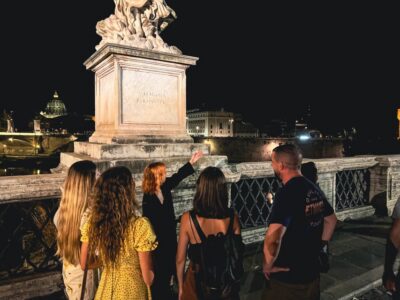
Your evening begins at Castel Sant’Angelo, where the story centers on Beatrice Cenci. The haunting is tied to the bridge, and the tour connects the supernatural mood to the brutal 16th-century reality behind her life and execution.
What I like about this start is that it sets the tour’s tone. It’s not just jump-scares or campy ghost acting. Instead, you hear why Rome became a city where tragedy quickly turned into legend.
You’ll get the emotional spine of the story, including the abusive father angle and Beatrice’s defiance, then the historical shock of an execution that rocked Rome. That context makes the later stops hit harder, because you understand how quickly public punishment became street lore.
Practical tip: you’re likely standing and listening for parts of the route early on. Wear shoes you can trust on uneven sidewalks, especially if the evening is slick.
Via Giulia and Giulia Tofana, Rome’s poisoner legend
Next you move onto Via Giulia, one of Rome’s prettiest streets that also happens to carry a truly grim reputation. The tour’s poison theme focuses on Giulia Tofana, a 17th-century poisoner whose story is tied to women trapped in unhappy marriages.
This stop is worth it even if you’re not a horror fan. It teaches you how fear, desperation, and social power show up in history. And it gives you a reason why these legends stuck: people weren’t telling spooky tales for fun, they were trying to explain what they could not control.
You’ll also notice how Rome treats old trauma through architecture and street placement. Via Giulia is elegant, but the tour frames it as a corridor where private horror could become public rumor.
If you like crime history, you’ll probably find this part the most memorable. The story gives you motives and stakes, not just “she did a thing” mythology.
The Church of Death and the crypt feeling close to the bone
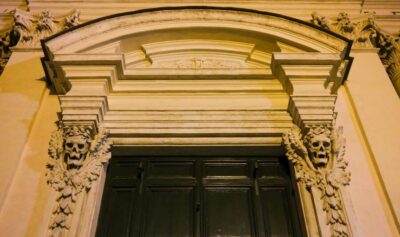
On Via Giulia, the tour includes the Church of Death, connected to a confraternity responsible for burying unclaimed bodies. The vibe here is unsettling in a real-world way, because the tour isn’t only about ghosts, it’s about what unclaimed human lives meant in that era.
You’ll hear what the confraternity did and why it mattered. You’ll also learn about an unsettling crypt below, which reinforces the tour’s main theme: death was not remote in old Rome.
A key practical note: the tour does not include entrances to churches, since churches are closed at this time. That means you’re getting the story and the atmosphere more than you’re doing formal interior sightseeing.
Still, the exterior and the nearby spaces are strong enough for the guide to make the place feel immediate. It’s one of those moments where your brain catches up with what the stones have been holding onto.
More of Rome after the lights come on:

Via Monserrato and disappearances you can’t just walk past
The tour then heads toward Via Monserrato, where it highlights rumors of unsolved crimes and eerie appearances. The big story thread here is mysterious disappearances tied to this quieter corner of Rome.
I like this stop because it shifts the focus from famous punishments to the less documented side of city fear. Big public events get remembered in statues and headlines, but smaller disappearances feed long-term legend, because there’s no clear ending.
This is also the moment when night walking starts to feel like part of the storytelling. The narrower streets and darker edges make it easier to imagine how quickly someone could vanish without the modern safety net you assume today.
If you’re the type who gets pulled in by true-crime style mysteries, this section will keep you leaning in.
Palazzo Farnese and the rumor of a woman walled up alive
One of the most visually striking stops on the route is Palazzo Farnese. From the outside, it’s Renaissance grandeur, but the tour brings forward dark rumors tied to it, including the idea of a woman walled up alive.
This is a legend stop, but it’s not empty entertainment. The guide uses the palazzo’s beauty to make the contrast sharper, so you feel how Rome can hold kindness and cruelty inside the same façade.
What I appreciate here is how the tour keeps linking the spooky claims to the historical mindset that produced them. In old Rome, rumors spread fast, and architecture became a way to label power and fear in stone.
Photo note: you’ll likely want a quick shot, but don’t block the group. The tour works best when you can hear the guide clearly at each viewpoint.
Campo de’ Fiori, flames, fate, and Giordano Bruno’s statue
The tour finishes in the Campo de’ Fiori area, and it leans into the square’s reputation for flames and fate. A central moment is the story of philosopher Giordano Bruno, burned at the stake in 1600 for beliefs the authorities labeled as heretical.
You’ll also see the bronze statue that stands in the square. It’s hard to ignore at night, and even harder after you’ve heard the human story that put him there.
This ending works well because it ties together the tour’s major threads. Executions become legend. Public punishment becomes story. And Rome keeps those stories in sight, so you carry the mood with you as you walk away.
If you like a strong final beat, this delivers. By the time you reach Campo de’ Fiori, you’ve already heard enough to understand why this square became a symbol, not just a location.
What you get from the guide, and why it matters for this type of tour
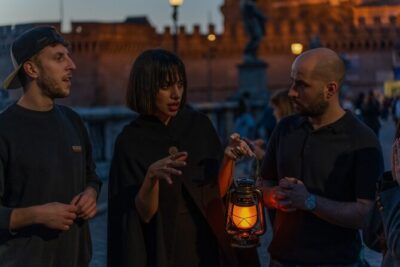
This is a live-guided experience in English. The tour is designed so the guide does more than point at buildings. In the best moments, the guide helps you connect the street details to the reason the legend formed in the first place.
Two guide styles that have shown up for this tour are Emilie and Mike. Both are described as friendly and engaged, with clear English, an ability to answer questions, and a knack for keeping the pace lively so the walk never turns into a slow lecture.
I also appreciate that the tour style leans toward storytelling with humor, not just gloom. It helps if you’re bringing teenagers or anyone who thinks history needs to be “proven” before it can be fun. The tone stays approachable while still respecting the subject matter.
Price, duration, and value of a compact night walk at $15
At $15 per person for 80 minutes, this is the kind of tour that fits tight schedules. You’re not committing to a half-day, and you’re not paying for extra attractions or entrances to churches that are closed anyway.
For me, the value comes from two things. First, you get a live English guide to translate Rome’s legends into understandable context. Second, you get the route logic: Castel Sant’Angelo to Via Giulia to Campo de’ Fiori, so you end where the evening energy is.
If you want to see more of Rome in less time, this is a good match. If you want a calm sit-down museum day, skip it and choose something else.
Who should book this and who should skip it
This tour suits you if you like history with an edge. It’s ideal for people who want to walk through famous Rome spaces, but with a focus on darker stories: executions, poison lore, and disappearances.
It’s also a great evening plan for families with older kids. The tour’s ability to keep attention is part of its strength, as long as everyone can handle standing and walking for 80 minutes.
Skip it if you have mobility concerns. It is not suitable for wheelchair users, and the tour notes it is not suitable for people with heart problems.
Should you book the Ghosts, Legends, and Haunted History Night Tour?
I think you should book this if you want an entertaining Rome night walk with real historical anchors behind the spooky mood. The route hits major landmarks like Castel Sant’Angelo, Via Giulia, and the ending at Campo de’ Fiori, but it also focuses on crime legends that you won’t get from a basic sightseeing checklist.
Book it when you’re ready for something interactive: listening closely, walking steadily, and letting the guide connect the dots between architecture and trauma. For $15 and 80 minutes, it’s a strong evening value and a memorable way to see Rome after dark.
FAQ
How long is the Rome Ghosts, Legends, and Haunted History Night Tour?
The tour lasts 80 minutes.
What language is the tour guide speaking?
The tour is led in English.
Where do I meet, and where does the tour end?
You meet at Via del Banco di Santo Spirito, 25 near a barbershop with a big sign that says BARBIERE, and the tour finishes at Campo de’ Fiori.
How much does it cost?
The price is $15 per person.
What should I bring for the night tour?
Bring comfortable shoes and a jacket, since it can get chilly at night.
Does the tour include entrances to churches?
No. The tour notes that entrances to churches are not included because churches are closed at this time.
Is the tour suitable for wheelchair users or people with heart problems?
No. It is not suitable for wheelchair users and not suitable for people with heart problems.
More Historical Tours in Rome
- Rome: Forbidden History Walking Tour & Pub Crawl with Drinks
★ 4.9 · 688 reviews - Rome: Guided Bar Crawl with Drinks & Dark History
★ 4.9 · 444 reviews - Rome: Vespa Photo Tour with Historic City Highlights
★ 5.0 · 395 reviews - Twilight Treasures: An Evening Tour Through Rome’s Rich History
★ 4.5 · 263 reviews
Once the Piazzas Fill
- Rome: Small-Group Guided Day or Night Walking Tour
★ 4.8 · 1,009 reviews - Rome: Guided City Center Evening Sightseeing Walking Tour
★ 4.4 · 953 reviews - Colosseum by Evening Guided Tour with Optional Arena Floor Access
★ 4.0 · 867 reviews - Night Tour of Rome with Local Pizza Dinner and Gelato Experience
★ 4.5 · 780 reviews
Latest additions from Rome
- Guided Tour Vatican Museums & Sistine Chapel★ 4.1 · 30 reviews
- Exclusive Rome by Night Vespa Tour★ 5.0 · 30 reviews
- Transfer Rome to Airports★ 4.5 · 30 reviews
- Vatican: St.Peter’s Basilica & Dome – Reserved Entry & Tour★ 4.1 · 30 reviews
- Rome street art tour: off the beaten path with a local guide★ 5.0 · 30 reviews
- Tivoli, Hadrians Villa and Villa d’Este, a charming day trip from Rome★ 4.5 · 30 reviews
- Rome Food Tasting with Wine Pairing Italian Authentic Flavors★ 5.0 · 31 reviews
- Inspirational Cooking on the Roman Chef’s Panoramic Terrace★ 5.0 · 30 reviews
Rome Ghost and Mystery Tours, compared.
Small Group Rome’s Dark Side – Ghosts & Legends Tour
Read our review →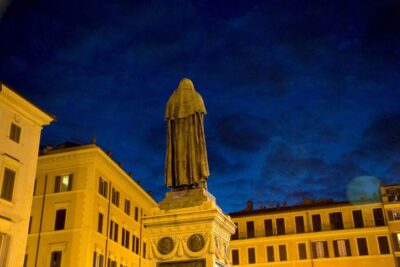
Dark Heart of Rome – Facts, Legend & Mystery Walking Tour
Read our review →
Ghosts, Legends & Mysteries of Rome Tip-Based Walking Tour
Read our review →
Ghosts Legends and Mysteries of Rome Walking Tour
Read our review →Browse the lists this tour appears in