
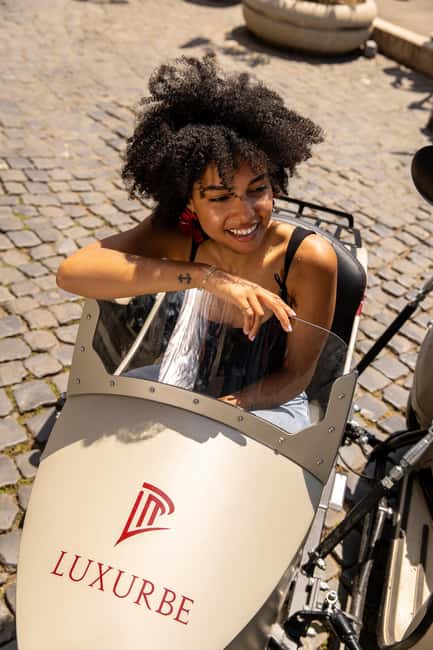
Reviewed · VESPA TOURS IN ROME
Vespa Sidecar Tour: Highlights of Rome
Rome at Vespa speed is a smart shortcut. This 3-hour Vespa sidecar tour strings together the big Rome icons with earphones, helmets, and guided photo stops so you spend less time figuring out where to go next.
I especially like the small group format, capped at 10 people, and I like that the driver is the one handling the Vespa. You get to focus on landmarks like Trevi, the Pantheon dome, and the Colosseum area views instead of traffic math.
One consideration: ride comfort. One rider said they did not feel safe because they could not hold on well, so at the start, get settled and make sure you can brace comfortably for the ride.
In This Review
- Key highlights that matter
- Why a Vespa sidecar tour makes sense for Rome
- Meeting at Piazza del Popolo, then rolling out
- Stop 0, Piazza del Popolo and the view from above
- Trevi Fountain, coins, and a quick but meaningful photo stop
- The Pantheon’s dome and the lighting through the oculus
- Piazza Navona’s three fountains and the geometry of Rome
- Piazza Venezia and the Monument to Vittorio Emanuele II
- Colosseum stop: iconic exterior views, with tickets extra
- The Ghetto: Roman remains, shops, and the synagogue area
- Colle del Gianicolo: views, Garibaldi, and the noon cannon
- Vatican City area time: St. Peter’s Basilica without included admission
- Trastevere: cobblestones, alleys, and the real street-level Rome
- Safety and comfort on a sidecar ride
- Who this tour suits, and who should think twice
- Price and value: what you get for $114.12
- Should you book the Vespa Sidecar Highlights of Rome?
- FAQ
- How long is the Vespa Sidecar Highlights of Rome tour?
- Where does the tour start and end?
- Is hotel pickup included?
- What language is the tour offered in?
- How many people are in each group?
- What safety and audio equipment is included?
- Are tickets included for the Colosseum and Vatican stops?
- Is food and drink included?
- Can I drive the Vespa during the tour?
- What happens if the weather is bad or I cancel?
Key highlights that matter
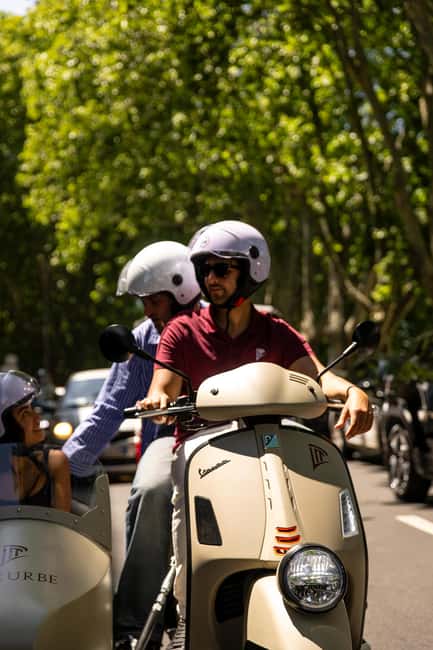
- Expert driver-guides who control the route and the pace, so you are just along for the ride
- Earphones included, so the commentary stays clear in busy streets
- Helmets, insurance, and helmet certificates for passengers
- A tight 3-hour loop that hits Trevi, Pantheon, Piazza Navona, Colosseum area, Ghetto, Gianicolo, Vatican area, and Trastevere
- Photo stops at the most iconic points, not just quick drive-bys
- Max 10 travelers, which usually means less crowd pressure during stops
Why a Vespa sidecar tour makes sense for Rome
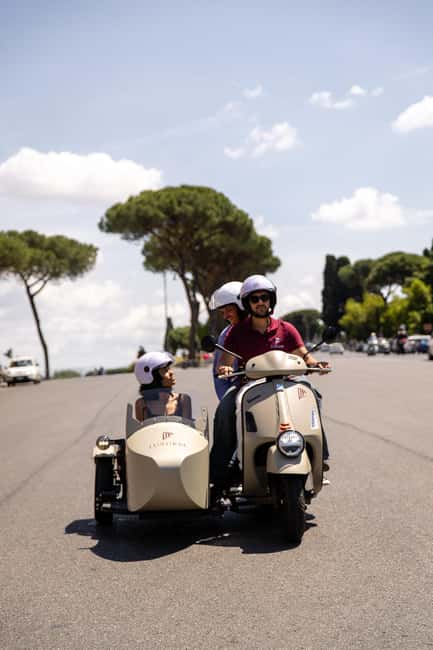
Rome is gorgeous, but it can also be a lot. Lots of landmarks, lots of walking, and lots of decision fatigue. A sidecar tour is a simple way to get your bearings fast while still seeing what most people come for.
You get guided context, too. The route is built around recognizably Roman places, but the guide’s job is to give you the “why” behind what you are seeing. That matters at the Pantheon, at the Trevi Fountain tradition, and when you look at the Colosseum area from the outside.
The price, $114.12 per person, is not a bargain if you compare it to a self-guided walk. But you are paying for four practical things: your guide driving and directing, earphones that improve the experience, photo stops, and safety gear plus passenger insurance. For many people, that turns it into good value because you are compressing time into one coordinated outing.
More Rome in a Day Tours
- Rome in a Day Group Tour with Vatican Museums and Colosseum
★ 4.5 · 2,450 reviews - Rome Highlights by Golf Cart Private Tour
★ 5.0 · 2,379 reviews - Best of Rome Walking Tour including Trevi Fountain
★ 4.5 · 923 reviews - Golf Cart Small-Group Guided Tour: Rome City Highlights
★ 5.0 · 907 reviews
Meeting at Piazza del Popolo, then rolling out
The tour starts at Piazza del Popolo, 11, 00187 Rome. It ends back at the same meeting point.
If you choose pickup, it is available on request with a supplement. Otherwise, you meet at the main entrance area at street level. The driver arrives at the scheduled time, or within a 10-minute waiting window. You will want to be ready a few minutes early so your departure does not slip.
This is also a small-group experience, maximum 10 travelers. That is a big deal in Rome, where crowds can make “icon time” feel more like “queue time.” Here, the stops are short, so being in a smaller group helps you actually see what is in front of you.
One more practical note: the guide is an employee, and you will not be able to drive. You are a passenger, helmeted, listening through earphones, and following the guide’s instructions.
Stop 0, Piazza del Popolo and the view from above
You begin near one of Rome’s grand city gates, the kind of spot that makes you feel like you just stepped into a story. Piazza del Popolo has twin church facades that create a symmetrical frame, and at its center sits an ancient Egyptian obelisk brought to Rome in Augustus’ era.
Then there is the angle that many first-time visitors do not expect. The Pincio viewpoint above the square can give you a sweeping panorama over the city. Even when your stop is brief, this is the kind of moment that helps you understand Rome’s layout before you chase smaller details.
If you are wondering where the “best photos” happen, start here. This is where your camera will feel like it is already working, and you get a clean orientation point for the rest of the day.
Trevi Fountain, coins, and a quick but meaningful photo stop
Trevi Fountain is one of the most famous fountains on Earth for a reason. It is Baroque, dramatic, and unmistakable, designed by Nicola Salvi in the 18th century.
What I like about the way the tour handles Trevi is the rhythm. You get about 10 minutes, and that is enough time to see the main composition, spot the sea-themed figures, and take a few photos without the stop stretching into “stand here forever.”
You will also learn the tradition around tossing a coin into the fountain. The key detail is simple: the ritual is about ensuring your return to Rome, and it is something people do daily as a little act with a bigger charitable story behind it.
Quick tip for value: if crowds make you want fewer pictures, use Trevi for one great shot and then move on. The tour is designed for momentum, not for endless waiting.
The Pantheon’s dome and the lighting through the oculus
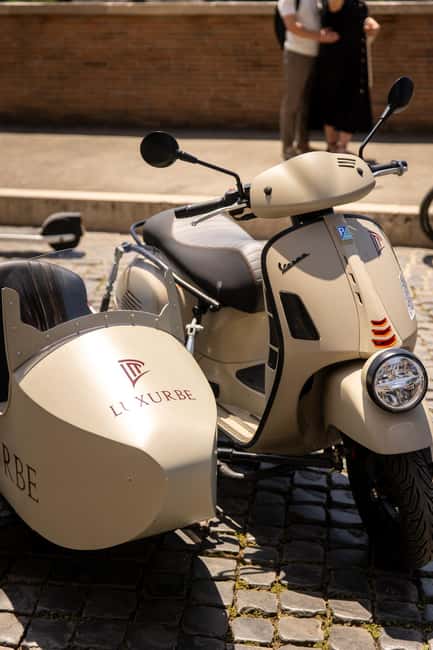
The Pantheon is hard to describe without sounding dramatic, so I will keep it practical. It is one of the best preserved ancient Rome monuments, and the headline feature is the dome, still the largest in the world in unreinforced concrete.
The “wow” moment is the oculus, the open circle at the top. Light filters in naturally, turning the interior into a kind of living stage. Even if you only get a short window, the lighting effect gives you a different perspective than what you see from outside.
This stop is worth it even if you have seen photos before. The Pantheon is one of those places where your brain recalibrates. You realize the engineering is real, and the space is built to be experienced, not just admired.
More Vespa Tours in Rome
Piazza Navona’s three fountains and the geometry of Rome
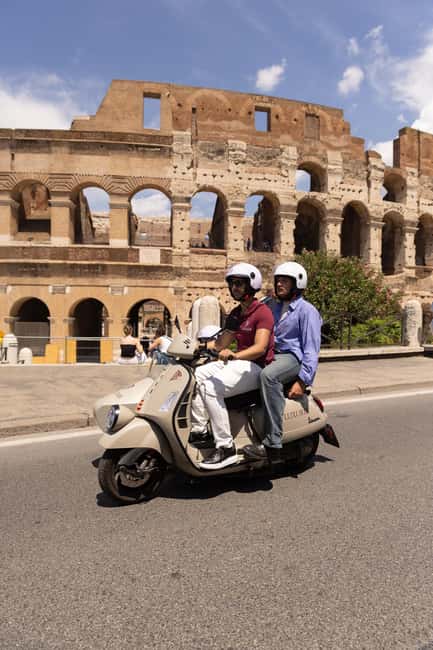
Next up is Piazza Navona, built on the ancient stadium site of Domitian. That layering is part of why it feels Roman in a more old-world way than some newer squares.
The square’s big draw is the fountains, especially Bernini’s Fountain of the Four Rivers, which represents four major rivers known in the seventeenth century. The sculpture work is intricate, and the layout of the square makes it feel like you can walk around the fountain without missing the main angles.
Your stop time here is about 5 minutes. That is short, so think of this as a “get your bearings and pick your angles” stop. If you linger for too long, you will lose time for the later viewpoints that are the payoff for many people.
Piazza Venezia and the Monument to Vittorio Emanuele II
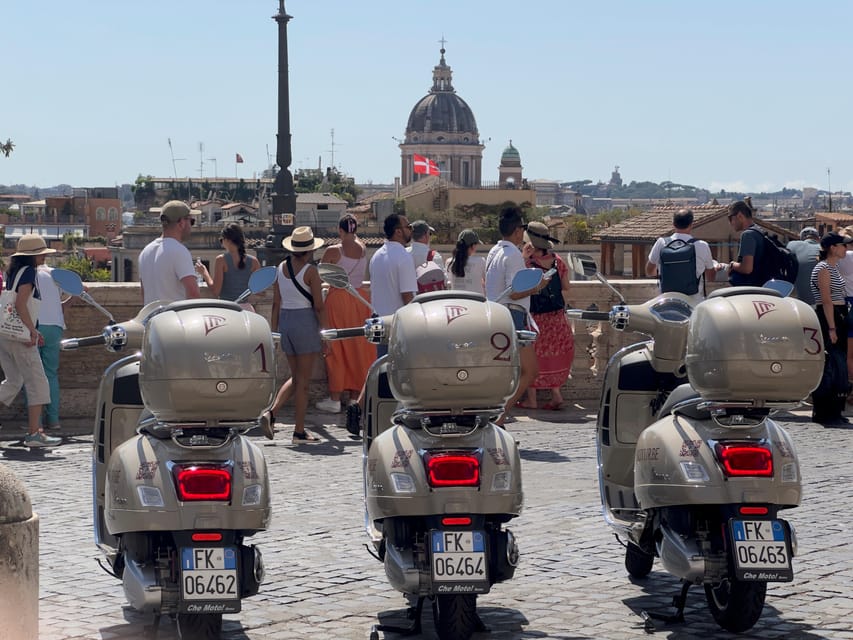
From the fountains, you shift to a crossroads that links modern Rome to the center of ancient power. Piazza Venezia is dominated by the Monument to Vittorio Emanuele II, often called the Altar of the Fatherland.
This is the kind of landmark where your eyes go upward first. The scale is the point. Nearby, the square also connects you to major political and historical chapters, including the Palazzo Venezia area, which served as a papal residence and later as Mussolini’s headquarters during World War II.
Even if you are not a museum person, this stop helps you understand that Rome is not only ancient. It keeps changing, and it keeps rewriting itself on top of older walls.
Colosseum stop: iconic exterior views, with tickets extra
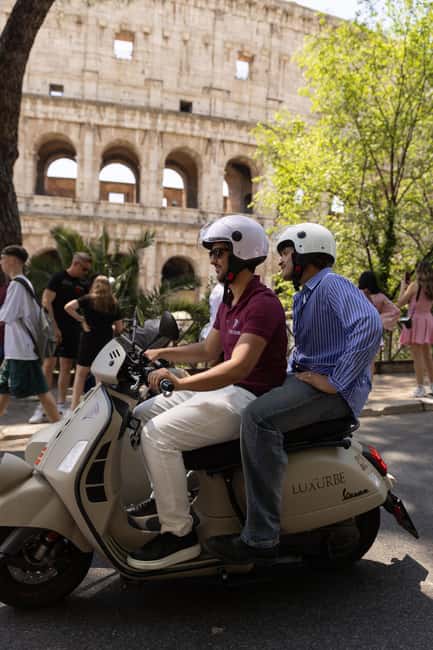
The Colosseum is the big headline for a reason. It is ancient Rome’s most recognizable amphitheater, built in the first century AD, and it could hold over 50,000 spectators for gladiator fights, animal hunts, and public performances.
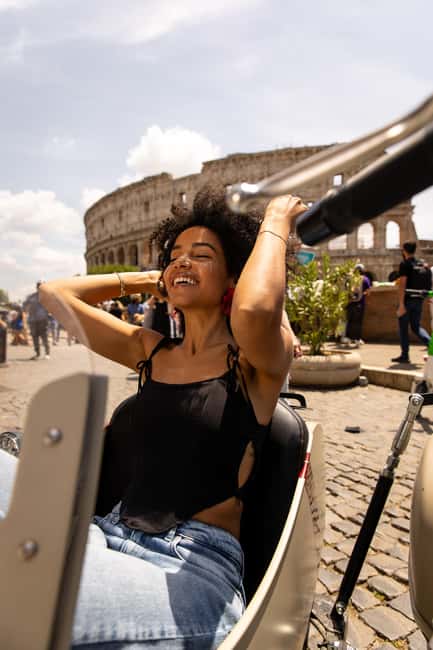
In this tour, the Colosseum stop is about 10 minutes, and admission is not included. So you are likely getting exterior viewing plus a photo window, not a full timed-entry experience.
That can be a good thing. If your goal is to see multiple top sites in one half-day, a short Colosseum moment makes sense. If your goal is deep exploration, you might pair this tour with a separate Colosseum ticket later.
The Ghetto: Roman remains, shops, and the synagogue area
Then you head into the Ghetto, one of the more textured neighborhoods on the route. Here you are looking at the mix of long-standing community life, traditional shop streets, and visible traces of ancient Roman remains.
A standout feature mentioned for this area is the Synagogue, tied to the Roman Jewish community. This stop is about 15 minutes, which is longer than some of the other “icon shots.” That extra time matters, because neighborhood spaces need a slower glance to register.
If you prefer Rome that feels human-scale, this is the stop that tends to feel most grounded. You are not only seeing a structure, you are seeing a place where people lived, worked, and worshiped over centuries.
Colle del Gianicolo: views, Garibaldi, and the noon cannon
The route saves a major payoff for the viewpoint: Colle del Gianicolo. This hill gives some of the most spectacular city views, the kind that helps you understand why Rome keeps inspiring painters and filmmakers.
There is also a big historical layer. Gianicolo is tied to battles led by Giuseppe Garibaldi during Italian unification. And yes, there is a tradition: every day at noon, a cannon fire marks the exact time for the whole city, a practice that has lasted since 1847.
Your stop time here is about 10 minutes. If you are traveling in the late morning or near noon, you may be in the right window to catch the moment. If you are not, you can still enjoy the viewpoint without losing anything.
Practical photo note: golden hour on Gianicolo can be beautiful, but even in daytime, you get strong sightlines. If you only want one “big Rome view” picture, this is a smart contender.
Vatican City area time: St. Peter’s Basilica without included admission
Next is Città del Vaticano, with St. Peter’s Basilica at the center. This is the heart of the Catholic Church, famous for Renaissance architecture and for the broader artistic atmosphere of the Vatican area.
In this tour, admission is not included for the Vatican side, so your visit is likely focused on seeing the basilica area and getting the classic exterior or front perspective that fits a short stop.
Your stop time is about 15 minutes. That is enough for a first look, a few photos, and some context from the guide, but it is not enough for a full Vatican Museums plan.
If you want Vatican museums, plan that as a separate day or book an additional timed experience. This tour is built to connect the dots between major neighborhoods and icons.
Trastevere: cobblestones, alleys, and the real street-level Rome
To close the loop, you head into Trastevere, one of Rome’s most authentic-feeling districts. Expect cobbled streets, narrow alleys, and lively squares where the atmosphere feels more local than staged.
This stop is about 10 minutes, so you will not be wandering for hours. But short time can work well here because the goal is to get the feel of Trastevere, see a few key viewpoints, and end on a warm, human-scale note.
If you are planning dinner afterward, this is a strong ending point. You will likely be ready to eat somewhere nearby, and you will have a better sense of where streets lead.
Safety and comfort on a sidecar ride
This is where you should pay close attention, because it is not just “optional comfort.” The tour includes helmets approved for maximum safety, helmets certificates, and insurance for passengers.
The driver is in full control and you cannot drive, so it is a guided ride, not a rental situation. Plus, you get earphones, which helps you follow instructions and stay calm.
Still, comfort can vary by person and by seating fit. One lower-rated experience mentioned feeling unsafe because they could not hold onto something during the ride and ended the tour early to avoid anything major. That is rare, but it is a fair reminder.
Before the ride starts, do a quick personal check:
- Sit in a position where you can brace comfortably
- Ask the driver if you are unsure where to hold on
- Tell them if you feel awkward at any point
With the helmets and insurance included, you should still feel like the tour is controlled. But your body has to feel stable too.
Who this tour suits, and who should think twice
This experience is described as most travelers can participate, and it is built for a short time window. If you want to see a lot without long walks, you will likely like that structure.
This can be especially good if:
- You have limited time in Rome and want top icons in one route
- You prefer fewer decision moments, because the guide handles sequencing
- You want photos at the major stops without guessing where to stand
It may not be the best fit if:
- You dislike riding on a motorbike-style sidecar, even with helmets
- You need a lot of time inside major sites like the Colosseum or Vatican
- Your schedule is extremely tight, since delays can happen on any road-heavy city tour
One more practical point: the tour has a weather dependency, so a plan B helps. Rome has plenty of weather drama.
Price and value: what you get for $114.12
For $114.12 per person, the main value comes from coordination and included gear. You are not paying just for sightseeing. You are paying for:
- Expert driver-guide service
- Earphones, which make the experience easier to enjoy
- Helmets and passenger safety setup
- Insurance for passengers
- Photo stops at iconic points
- A route that connects major neighborhoods and monuments in about 3 hours
Not included items are also clear: food and drinks, tips, and entrance tickets for places where listed as not included, including the Colosseum and Vatican basilica area.
So here is how to maximize value if you book:
- Eat beforehand or after, since food is not part of the tour
- Bring water if you think you will need it
- Budget separately for major admissions if you want interior time beyond what this tour includes
- Treat it as a highlight route, not a replacement for full museum days
Also, this tour is often booked about 28 days in advance on average, so if your dates are firm, it is wise to reserve early.
Should you book the Vespa Sidecar Highlights of Rome?
I think this is a strong choice if you want a fast, guided hit list of Rome’s greatest landmarks, with real safety basics and a small-group feel. The route structure makes sense, and the inclusion of earphones plus photo stops tends to turn “tour time” into actual memory time.
I would book with confidence if:
- You like guided stops and short photo windows
- You want help with timing and sequencing in a crowded city
- You are comfortable as a passenger on a sidecar with a helmet on
I would hesitate if:
- You are worried about physical comfort or holding position on the ride
- You want deep time inside the Colosseum or Vatican Museums, because admission is not included for those parts
If you do book, choose the time slot that fits your energy, and build in a little buffer afterward. Rome runs on cobblestones and traffic, and this tour shines when you treat it as the fun starter, not your whole day.
FAQ
How long is the Vespa Sidecar Highlights of Rome tour?
It runs for about 3 hours.
Where does the tour start and end?
It starts at Piazza del Popolo, 11, 00187 Rome, and ends back at the same meeting point.
Is hotel pickup included?
Pickup is available on request with a supplement. Without pickup, you meet at the scheduled meeting point.
What language is the tour offered in?
The tour is offered in English.
How many people are in each group?
The tour has a maximum of 10 travelers.
What safety and audio equipment is included?
You get helmets approved for maximum safety, earphones to hear the guide clearly, and insurance for passengers.
Are tickets included for the Colosseum and Vatican stops?
Admission tickets are not included for the Colosseum and for the Vatican area.
Is food and drink included?
No, food and drink are not included.
Can I drive the Vespa during the tour?
No. The guide is an employee who drives. You ride in the sidecar.
What happens if the weather is bad or I cancel?
The tour requires good weather. If it is canceled due to poor weather, you are offered a different date or a full refund. You can cancel for free up to 24 hours in advance for a full refund.
Two Wheels and a Motor
- Rome: Pro Photoshoot include free transport with VESPA
★ 5.0 · 501 reviews - Rome: Vespa Tour with Photo services Small‑Group Highlights
★ 5.0 · 483 reviews - Appia Antica: Full Day Bike Rental with Customizable Routes
★ 4.6 · 419 reviews - Rome: Vespa Photo Tour with Historic City Highlights
★ 5.0 · 395 reviews
Riding in a Vintage Fiat
- Rome: Photoshoot Service with Vintage Fiat 500
★ 5.0 · 611 reviews - Vespa Sidecar Tour In Rome with Pickup, Drop-off, Gelato included
★ 5.0 · 472 reviews - Rome: Fiat 500 Vintage Photography Service in Rome
★ 4.9 · 308 reviews - Vintage Fiat 500 Cabriolet: Rome’s Highlight Semi Private Tour
★ 5.0 · 283 reviews
Latest additions from Rome
- Guided Tour Vatican Museums & Sistine Chapel★ 4.1 · 30 reviews
- Exclusive Rome by Night Vespa Tour★ 5.0 · 30 reviews
- Transfer Rome to Airports★ 4.5 · 30 reviews
- Vatican: St.Peter’s Basilica & Dome – Reserved Entry & Tour★ 4.1 · 30 reviews
- Rome street art tour: off the beaten path with a local guide★ 5.0 · 30 reviews
- Tivoli, Hadrians Villa and Villa d’Este, a charming day trip from Rome★ 4.5 · 30 reviews
- Rome Food Tasting with Wine Pairing Italian Authentic Flavors★ 5.0 · 31 reviews
- Inspirational Cooking on the Roman Chef’s Panoramic Terrace★ 5.0 · 30 reviews
Vespa Tours in Rome, compared.
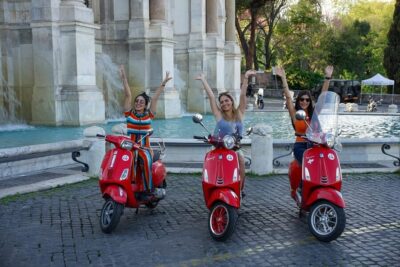
Explore the City by Vespa with an Optional Photoshoot
Read our review →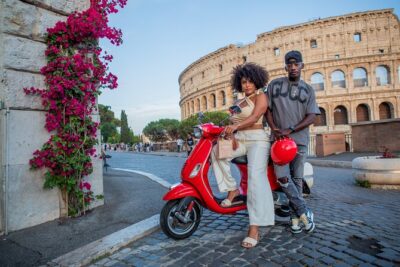
Rome Vespa Scooter Tour with Professional Photographer
Read our review →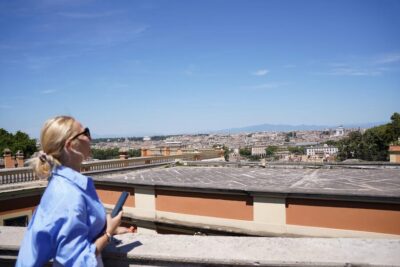
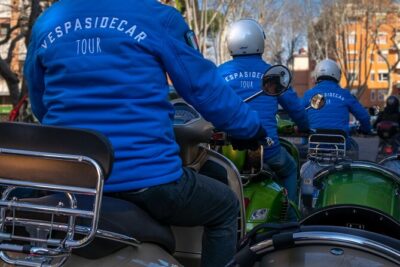
Rome Afternoon Sightseeing Vespa Sidecar Tour with Gourmet Gelato
Read our review →Pro Photoshoot include free transport with VESPA
Read our review →
Vespa Tour with Photo services Small‑Group Highlights
Read our review →
Vespa Sidecar Tour In Rome with Pickup, Drop-off, Gelato included
Read our review →
Browse the lists this tour appears in