St. Peter’s Basilica hits differently with a guide. You’ll get up close to Michelangelo’s Pietà and Bernini’s Baldachin, with explanations that make the art feel less like a museum and more like living faith. The one thing to plan for is the pace and the prep: you must cover knees and shoulders, and security lines can take a while even with a tour.
I also like how this visit handles the “what am I looking at?” problem. Names and dates fly past on a self-guided walk, but your guide can connect the Chair of St. Peter, the papal crypt, and the Tomb of St. Peter into one clear story. If you want to understand why this place matters, not just see it, this is a smart way to do it.
In This Review
- Key things to notice on this St. Peter’s Underground Tour
- The value of getting guided access to St. Peter’s Basilica
- Meeting near Via del Mascherino, then gearing up for security
- Inside St. Peter’s: Pietà, Baldachin, and the papal centerline
- Michelangelo’s Pietà, right near the entrance
- Bernini’s Baldachin, the bronze marker of the sacred below
- The Chair of St. Peter (Cathedra Petri)
- Quick note on the dome
- Timing, pacing, and why 90 to 150 minutes feels just right
- Vatican Grottoes and the Tomb of St. Peter: where the mood changes
- The Holy Door note, so you are not surprised
- What you really get for $20: value versus the typical Vatican headache
- Who this tour suits best, and who should consider another plan
- Should you book this St. Peter’s Basilica and Underground guided tour?
- FAQ
- Where is the meeting point for this tour?
- How long is the St. Peter’s Basilica and Underground Guided Tour?
- What will I see inside St. Peter’s Basilica?
- Are Vatican Museums and the Sistine Chapel included?
- Do I have to go through security?
- What are the rules for clothing and photography?
- Is this tour suitable for wheelchair users or mobility impairments?
Key things to notice on this St. Peter’s Underground Tour
- Pietà and Baldachin in context, not just as famous stops
- Chair of St. Peter (Cathedra Petri) and what it symbolizes for the Church
- Vatican Grottoes and the Tomb of St. Peter, a quieter side of the visit
- Security is still required, but your guide keeps the flow moving
- Small group or private options, with multiple language choices
- Headphones on many tours, so you can step aside and still hear the commentary
The value of getting guided access to St. Peter’s Basilica
St. Peter’s Basilica is big. Really big. Left on your own, you can end up speed-walking through awe, then leaving with a head full of vague impressions.
What makes this tour worth it is that you’re not just touring. You’re being taught how to look. I like that the highlights are specific and fixed in place, not dependent on guesswork. You’ll be directed to Michelangelo’s Pietà, Bernini’s Baldachin, and the Chair of St. Peter, then the guide explains why those items matter.
And yes, the building is stunning on its own. But the real payoff is the “why.” For example, the Chair of St. Peter is not just a relic behind glass. It’s shown as a symbol tied to the authority and continuity of the papacy, and that changes how you read the space around it.
A few more Rome options worth a look
- Vatican Museums, Sistine Chapel & St Peter’s Basilica Guided Tour
★ 4.5 · 39,149 reviews - Rome: Colosseum, Palatine Hill and Roman Forum Guided Tour
★ 4.8 · 32,814 reviews - Rome: Guided Tour of Colosseum, Roman Forum & Palatine Hill
★ 4.7 · 27,897 reviews - Rome: Colosseum & Forum with Audio Guide App -Optional Arena
★ 4.2 · 24,770 reviews
Meeting near Via del Mascherino, then gearing up for security
Your tour starts at Via del Mascherino 88, close to Via Porta Angelica. That matters because Vatican logistics are a little chaotic, and having a clear starting point saves time.
Next comes security, airport-style. The important truth here: you can’t skip the security check line. Peak seasons can mean anywhere from a short wait to something like 10 to 120 minutes, so I’d plan your schedule with that reality.
One practical plus I noticed from the way guides run this kind of experience: they keep talking during the wait. In the best cases, your guide uses the time to walk you through what you’re about to see, so the line does not feel like dead time. If your guide is Alexandra, Anna, Romina, Kelly, Alishba, or Volodymyr, you’ll likely experience that focused, story-driven pacing people rave about.
Dress check is part of it too. Knees and shoulders must be covered, and flash photography is not allowed. Bring a light layer you can adjust. If you arrive in a tank top or shorts, you might spend your first minutes scrambling, and that’s a bad way to start a sacred visit.
Inside St. Peter’s: Pietà, Baldachin, and the papal centerline
Your guided time begins in the basilica itself. This is where the tour feels most “worth the money,” because the big icons are hard to prioritize when you don’t know where to look.
Michelangelo’s Pietà, right near the entrance
Michelangelo’s Pietà is located near the entrance, and it’s the kind of artwork that grabs you even before the guide starts talking. The sculpture depicts the sorrow and tenderness of Mary holding the body of Christ. It was carved when Michelangelo was just 24, and that detail lands differently when someone gives you the emotional and historical framing.
If you only had five minutes here, you’d still be moved. But with a guide, you’ll likely notice more: the way the figures are composed, and why the work became a touchstone for Renaissance art. You stop looking at “a famous statue.” You start seeing craftsmanship and meaning at the same time.
Bernini’s Baldachin, the bronze marker of the sacred below
Next is Bernini’s Baldachin, rising above the papal altar. This massive bronze canopy is not a random centerpiece. It marks the tomb of St. Peter below.
The best part is that a guide helps you understand the geometry of the space. You’ll see how the Baldachin works visually as a focal point, pulling your eyes down to what’s underneath. It’s one of those moments where the building becomes a map, not just a hall.
Another shape for the same afternoon in Rome:
The Chair of St. Peter (Cathedra Petri)
Then you’ll see the Chair of St. Peter, enshrined in bronze and suspended above the apse. The tour framing explains that it is believed to include the wooden chair associated with St. Peter and that it symbolizes the authority of the papacy and the continuity of the Church.
This is a key stop for first-timers and return visitors. First-timers get a landmark that anchors everything else. Return visitors often expect “more art,” but the Chair gives you a different kind of connection, a political and spiritual thread that runs through the architecture.
Quick note on the dome
Your tour may include a dome ticket if you choose an option with a dome tour. Even if your itinerary does not send you up, your guide will explain the dome’s importance. Michelangelo designed it, and it was completed after his death. The basilica dome is one of the iconic elements of Rome’s skyline, and your guide will point out how that symbolism is meant to feel, like the soul’s ascent toward the divine.
Timing, pacing, and why 90 to 150 minutes feels just right
The tour runs 90 to 150 minutes. That range is intentional because Vatican visits vary by season and crowd size.
In practice, this length hits a sweet spot. You get enough time inside to see the major works and the underground sites, but not so much that you get numb. St. Peter’s can drain you, even on a good day. A structured route helps you keep your energy for the places that matter most.
Group size matters here too. The experience offers private or small groups, which tends to make it easier for your guide to keep control of pacing and answer questions. Many people specifically praise guides for being entertaining and attentive, not just listing facts. That’s exactly what you want when you’re walking through a space packed with meaning.
One small, practical tip: if the security line is long, bring patience and hydration. Water is not mentioned as allowed inside the basilica, and food and drinks are not allowed there, so plan for that. You’ll want to take care of yourself before you enter.
Vatican Grottoes and the Tomb of St. Peter: where the mood changes
The tour concludes in the Vatican Grottoes, a solemn space beneath the basilica where many popes are laid to rest. This is a very different atmosphere from the bright, high-energy main floor.
The centerpiece here is the Tomb of St. Peter, the apostle believed to be the first Bishop of Rome. The tour framing emphasizes that the site is supported by archaeological and historical evidence. Even without getting technical, you’ll feel the shift. The guide’s job is to slow you down and give you the “roots of the Church” perspective, so the stop doesn’t feel like another ticketed room.
This section is often where the tour becomes memorable. People often come for the famous sculptures, but the underground visit gives you something quieter and more personal. If you’re religious, it’s a reverent experience. If you’re not, it still offers context for why this city has shaped global faith and power for centuries.
The Holy Door note, so you are not surprised
You should know about the Holy Door. It is only open during Jubilee Years. That means if you travel outside those periods, you won’t see it as part of your visit even if the basilica remains extraordinary.
A good guide will mention this so you understand what is missing and why. If Jubilee timing is right, you may get a special moment, but otherwise you’ll still have plenty of deeply significant stops.
What you really get for $20: value versus the typical Vatican headache
At around $20 per person, the value comes from three things.
First, you get expert guidance through high-impact highlights. Pietà, Baldachin, Chair of St. Peter, and the tomb level are not interchangeable. They are the core anchors of the experience.
Second, you get access tied directly to the basilica and the underground sites. For many visitors, the “Vatican problem” is not ticket prices. It is confusion. Where do I go? What am I supposed to look at first? A guide turns your route into a plan.
Third, you get time efficiency. Even though you cannot skip the security check line, the tour still reduces wasted wandering. That matters in a place where queues and crowd density can sap your energy fast.
If you add options, it changes the picture. A dome tour ticket is available if you choose that option. A guided Vatican Museums and Sistine Chapel add-on may also be available, and that option includes skip the line. But as written, Vatican Museums and Sistine Chapel are not included by default. Keep that in mind so you do not budget expecting a full museum day.
Who this tour suits best, and who should consider another plan
This is a strong fit for you if:
- You are visiting St. Peter’s for the first time and want the major highlights with meaning.
- You prefer a guided walk rather than trying to piece together symbols alone.
- You want the underground element, not just the main floor show.
It may not be your best choice if:
- You have mobility impairments or use a wheelchair. The tour involves walking and is not suitable for wheelchair users.
- You hate queues. Security wait times can be long at peak hours.
If you are traveling with teens, this can still work well. People report that younger visitors enjoyed it when guides kept explanations clear and engaging rather than dry.
Language options are broad, including English, Spanish, French, Italian, Portuguese, German, Romanian, and Arabic. If you’re not fluent in English, confirm the language you want when booking.
Should you book this St. Peter’s Basilica and Underground guided tour?
I think you should book it if your goal is understanding, not just sightseeing. For $20, you’re paying mostly for two things: clear direction through an overwhelming church and guided context for the most important religious art and relics. That combination is hard to replicate on your own unless you already know what you’re looking at.
You should pause and plan carefully if you are sensitive to walking and lines. Bring the right clothing, expect security, and accept that this is a structured experience with a set pace.
If you want the Pietà, the Baldachin, the Chair of St. Peter, and the Tomb of St. Peter in one focused trip, this is one of the most efficient ways to do it. And if you’re lucky with your guide, names like Alexandra, Romina, Anna, Kelly, Alishba, and Volodymyr show up again and again in the kind of praise that matters, clear explanations, good humor, and smart pacing.
FAQ
Where is the meeting point for this tour?
You meet at Via del Mascherino 88, near Via Porta Angelica.
How long is the St. Peter’s Basilica and Underground Guided Tour?
The duration is 90 to 150 minutes.
What will I see inside St. Peter’s Basilica?
You’ll view Michelangelo’s Pietà, Bernini’s Baldachin, and the Chair of St. Peter. The tour also includes access and a guided visit inside the basilica.
Are Vatican Museums and the Sistine Chapel included?
They are not included by default. They are included only if you choose the option that adds a Vatican museum and Sistine chapel guided tour.
Do I have to go through security?
Yes. All visitors must pass through airport-style security, and skipping the security check line isn’t possible. Peak wait times can reach 10 to 120 minutes.
What are the rules for clothing and photography?
Knees and shoulders must be covered. Flash photography is not allowed, and food and drinks are not allowed inside the basilica.
Is this tour suitable for wheelchair users or mobility impairments?
No. The tour involves walking and may not be suitable for those with mobility issues, and it is not suitable for wheelchair users.
Latest additions from Rome
- Guided Tour Vatican Museums & Sistine Chapel★ 4.1 · 30 reviews
- Exclusive Rome by Night Vespa Tour★ 5.0 · 30 reviews
- Vatican: St.Peter’s Basilica & Dome – Reserved Entry & Tour★ 4.1 · 30 reviews
- Transfer Rome to Airports★ 4.5 · 30 reviews
- Rome street art tour: off the beaten path with a local guide★ 5.0 · 30 reviews
- Tivoli, Hadrians Villa and Villa d’Este, a charming day trip from Rome★ 4.5 · 30 reviews
- Rome Food Tasting with Wine Pairing Italian Authentic Flavors★ 5.0 · 31 reviews
- Inspirational Cooking on the Roman Chef’s Panoramic Terrace★ 5.0 · 30 reviews
Guided, compared.
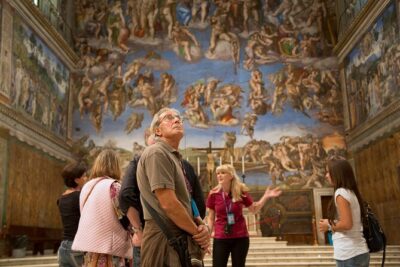
Vatican Museums, Sistine Chapel & St Peter’s Basilica Guided Tour
Read our review →
Colosseum, Palatine Hill and Roman Forum Guided Tour
Read our review →
Guided Tour of Colosseum, Roman Forum & Palatine Hill
Read our review →
Colosseum & Forum with Audio Guide App -Optional Arena
Read our review →
Colosseum, Roman Forum and Palatine Hill Guided Tour
Read our review →
Colosseum Arena Floor, Palatine & Forum Guided Tour
Read our review →
Colosseum Arena, Palatine Hill & Forum Guided Tour
Read our review →