
Rome really does keep its oldest layers below your feet. This small-group walk ties together pagan roots, early Christian persecution stories, and major relics in just a few focused hours. I especially like the maximum 10-person format (it stays calm and easy to hear) and the rare chance to see St. Clement’s site through three archaeological levels. The main downside to consider is that it is not for everyone, especially if you feel uneasy in tight underground spaces or need wheelchair access.
Guides can make or break a tour like this, and the names that come up for strong, patient guiding are Mario and Daniel. When lines and crowds build at key stops like St. John Lateran, a good guide keeps the pace under control, so you still cover the major points without feeling rushed. With headsets included, it’s also easier to follow the story while moving through sites that can get loud.
In This Review
- Key highlights you will feel on this tour
- Why Rome underground temples connect so well to early Christianity
- St. Clement al Laterano underground: 3 archaeological layers, one story you can see
- Mithraic Temple and the underground water channel below Rome
- St. John Lateran: why the Church of Rome earned the title Mother and head
- Scala Sancta, Constantine, and St. Helena: the route from judgment to Jerusalem
- Basilica of the Holy Cross in Jerusalem: relics you see, not just read about
- Santa Maria Maggiore add-on: the mosaics stop if you have time
- Price and time: what $88 buys in real comfort
- What to wear, what to expect, and who should skip it
- Should you book Rome Underground Temples and Crucifixion Relics?
- FAQ
- How long is the Rome Underground Temples & Crucifixion Relics walking tour?
- What is the group size for this tour?
- What locations does the tour include?
- What is included in the price?
- What should I bring and wear?
- Is the tour wheelchair-accessible?
- Is it suitable for claustrophobia?
- Is food included?
Key highlights you will feel on this tour
- Small group up to 10 keeps the visit personal and manageable through busy Rome streets and ticketed monuments
- St. Clement Underground in 3 layers shows pagan space, early Christian worship, and later church building all in one place
- Mithraic Temple focus connects pagan cult life with the background to early Christian persecutions
- Scala Sancta and Jerusalem-era relics turn big religious history into specific objects and sacred locations
- St. John Lateran as the center point gives you the why behind the title Mother and head of all churches on Earth
- Optional extra at Santa Maria Maggiore adds another major mosaic-filled stop if you have energy
Why Rome underground temples connect so well to early Christianity
If you only see Rome’s big-name churches above ground, you miss a major part of the timeline. This tour puts you at a physical intersection where layers of belief overlap in the same footprint, literally built one on top of another. That matters because early Christianity did not appear in a vacuum. It grew in a city with existing cult practices, political pressures, and public rules about religion.
You start at Basilica of St. Clement in a way that feels different from a standard church walk. Instead of treating it as one building with one story, you move through multiple levels of the site and watch the city’s religious changes become visible. You’ll also get the sense that the underground spaces are not just dramatic. They are practical, with elements like an underground water flow that the guide ties to other landmarks, including the Colosseum area.
More Walking Tours in Rome
- Rome: Guided Food Walking Tour with Wine in Trastevere
★ 4.9 · 3,105 reviews - Rome: Trastevere & Campo de Fiori Street Food Walking Tour
★ 4.9 · 2,768 reviews - Rome: Paranormal Night Walking Tour & Secret Backstreets
★ 4.9 · 1,921 reviews - Rome: Trastevere Street Food Walking Tour with Local Expert
★ 4.8 · 1,784 reviews
St. Clement al Laterano underground: 3 archaeological layers, one story you can see
The St. Clement visit is the real anchor of this experience. You begin at ground level and then go underground below the basilica’s foundations, where the site’s history is staged in layers you can actually stand in. This is where the tour becomes more than sightseeing, because you learn how one community used an earlier structure and then another community built over it.
Here is what you can expect as the layers unfold:
First layer, the earliest structures
You are standing in an area linked to the 1st century, connected to St. Clement (the third pope after St Peter) and his home setting. You also hear how this space connects to the pagan world underneath later Christian building.
Second layer, a pagan temple underneath Christian growth
As the tour progresses, you move toward a space used by the Mithraic cult, with the guide explaining what pagan worship looked like in the background. That context is important because it helps you understand why early Christians were targeted when Christianity became more visible.
Third layer, proto-Christian and then later church building
Higher up than the earliest foundations, the tour takes you into the 4th-century basilica space built on top of the older house. The preserved parts you see here include frescoes and large, open areas tied to the lives and stories of martyrs. Then you continue upward again to the 12th-century basilica for golden mosaics and symbolism that shows how the church communicated belief through art.
The payoff is that you walk through time in a controlled way. You do not just hear about centuries. You shift position, look around, and see what that century left behind.
Mithraic Temple and the underground water channel below Rome
One of the most memorable parts of the St. Clement underground portion is the Mithraic Temple connection plus the presence of an underground river. For many visitors, that combination sounds like a theme from a novel. On-site, it becomes a concrete explanation of why Rome’s religious life was so layered.
The guide also connects the water presence to a broader Roman setting, describing that the same kind of underground water flow runs below the Colosseum area too. You might not notice every engineering detail, but you will feel the continuity. It reinforces that the city’s physical systems, not just its ideas, shaped where people could gather, worship, and build.
If you love when history has a physical logic, this part will land for you. If you prefer a purely spiritual route with fewer cultural comparisons, you may still appreciate it, because it helps explain persecution and conversion pressures without turning it into abstract debate.
St. John Lateran: why the Church of Rome earned the title Mother and head
After the underground concentration at St. Clement, the tour shifts to major above-ground significance. You walk to Basilica di San Giovanni in Laterano (St. John Lateran), which the guide frames as the “Mother and head of all churches on Earth.” That title is not just marketing. It signals why this church sits at the center of Rome’s Christian identity.
Expect a guided stop that is shorter than St. Clement but still purposeful. You’ll learn how Emperor Constantine and the 313 legalization of Christianity changed the environment for believers, moving Christianity from a persecuted minority to a recognized faith. The pacing here is important. You get the key context without feeling like you are trapped in a long line of standing still.
A practical note: the route can include time spent dealing with queues, especially around periods when churches may have special observances. With a good guide, this usually means you do not lose the story even if entry lines slow you down.
Scala Sancta, Constantine, and St. Helena: the route from judgment to Jerusalem
One of the most striking transitions in the tour is moving from big basilicas to the Scala Sancta, also called the Holy Stairs. The guide explains that these are connected to the original praetorium stairs linked to Jesus’s judgment. Even if you know the story already, the physical focus on the stairs makes it easier to picture the moment.
From there, the tour connects the Constantinian era to a key figure behind relic collection, St. Helena, the Emperor’s mother. You’ll hear about her pilgrimage to Jerusalem to recover sacred artifacts, and how early Christians protected those relics. The point is not only that objects were moved. It is that the movement of objects helped shape Christian worship back in Rome.
If you like when religious history ties to real travel and political power, this sequence is a strength. It connects leadership, pilgrimage, and the material culture of faith.
Another shape for the same afternoon in Rome:
Basilica of the Holy Cross in Jerusalem: relics you see, not just read about
At Basilica of the Holy Cross in Jerusalem, the tour becomes object-focused. You do not just get general talk about the Passion. You’re shown items connected to key events, and the guide explains what makes each one meaningful.
The tour highlights include:
- A nail from the Crucifixion
- The walnut board associated with Pontius Pilate placing it above the cross
- The wood of the Cross connected with Jesus’s crucifixion
- Soil from the Holy Land
- Fragments from the wall of the cave of the Nativity in Bethlehem
- Two thorns from the crown of the Passion of Christ
Some groups also get extra emphasis on relics associated with the wider Passion story, and a well-prepared guide can help you keep the different items straight.
A balanced way to approach these relics is to treat them as part of Christian tradition and worship history. Even if you think critically about how relics were authenticated over centuries, the tour still offers value because you are learning how devotion took physical form and traveled. That is cultural history you can actually stand next to.
Santa Maria Maggiore add-on: the mosaics stop if you have time
If you choose to extend your journey, the tour can include Basilica Papale di Santa Maria Maggiore. This stop is mainly about mosaics and sacred significance, and it fits well for people who want one more major church moment without adding too much fatigue.
The time window matters here. You are already doing a fast, structured half-day. If your legs feel okay and you want more mosaic art in a guided context, it’s a solid add-on.
If you’re already feeling overloaded from underground walking, I’d treat it as optional rather than mandatory. The core experience is the St. Clement underground plus the relic circuit.
Price and time: what $88 buys in real comfort
At $88 per person for 2.5 to 3.5 hours, you are paying for three things: access to St. Clement’s underground portion, a live guide, and headsets for clarity. The headset detail is not trivial. Underground churches and busy Rome streets can make it hard to hear instructions, and you need to catch names, dates, and the “why” behind each step.
The short duration also makes sense for this specific theme. You are seeing several churches and moving between them. If you try to do this solo, you can end up stuck on logistics or reading slowly while missing the connections between the sites.
Value-wise, I think this tour is strongest if:
- You want a focused Christian history route rather than a random church checklist
- You care about the underground layers at St. Clement
- You want someone to connect pagan context, persecution stories, and relic tradition without turning it into a lecture
Price sensitivity note: you get real value from the first big stop. If your main goal is only relics, the St. Clement portion may feel heavy at first. But if you accept it as the backbone, the rest clicks.
What to wear, what to expect, and who should skip it
This is a walking-heavy tour, with underground sections and churches. You should come with comfortable shoes, and you’ll want clothing that fits the monument rules: no shorts, no short skirts, no sleeveless shirts. You also cannot bring weapons or sharp objects, and you should plan around restrictions on luggage or large bags.
Two comfort considerations matter most:
- Not wheelchair-accessible
- Not suitable for people with claustrophobia
If either of those affects you, it’s worth choosing a different route.
Weather can also matter. The tour is subject to weather conditions and liturgical-calendar events, and the guide may adjust the itinerary if certain areas are closed. The good part is the duration stays the same, so you do not lose your time window.
Should you book Rome Underground Temples and Crucifixion Relics?
Book it if you want a tight route that teaches you how Rome’s religious story layers over time, not just where to stand for photos. The St. Clement underground experience is worth planning around, because you see pagan worship context, early Christian building, and later church art in one guided flow. The relic-focused stop at Holy Cross in Jerusalem also gives you a physical connection to major Passion story points.
Skip or switch if you dislike underground spaces, need wheelchair access, or want long free time in each church. This tour is structured. It works best when you’re ready for guided pacing and brief, information-rich stops.
If you are short on time in Rome but want the kind of experience that makes the city feel layered and real, this is a strong choice.
FAQ
How long is the Rome Underground Temples & Crucifixion Relics walking tour?
It lasts about 2.5 to 3.5 hours.
What is the group size for this tour?
The tour has a maximum of 10 travelers.
What locations does the tour include?
It includes visits connected to Basilica of St. Clement, St. John Lateran, Scala Sancta, and Basilica of the Holy Cross in Jerusalem. You can also choose an extension to Santa Maria Maggiore.
What is included in the price?
Included are a live professional guide, entrance fees to St. Clement’s Undergrounds, headsets, and full on-site assistance.
What should I bring and wear?
Bring comfortable shoes. Shorts, short skirts, and sleeveless shirts are not allowed.
Is the tour wheelchair-accessible?
No. The tour is not wheelchair-accessible.
Is it suitable for claustrophobia?
No. It is not suitable for people with claustrophobia.
Is food included?
No. Food and drinks are not included.
Latest additions from Rome
- Rome: Testaccio Market Food Tour with Street Food & Wine★ 5.0 · 8 reviews
- Exclusive Pasta & Tiramisu Class with Wine near by Colosseum★ 5.0 · 8 reviews
- Private Professional Photoshoot in Rome★ 5.0 · 8 reviews
- Loreto “Shrine of the Holy House of the Virgin Mary” Private Tour from Rome★ 5.0 · 8 reviews
- Rome Day to discover Florence and Pisa Hotel Pickup★ 4.5 · 8 reviews
- Rome: Christmas Nativities and Angels Tour★ 3.1 · 8 reviews
- Guided Tour of Vatican Museums and Sistine Chapel★ 5.0 · 8 reviews
- Rome: Cooking Class of fresh Pasta and Tiramisu Cake★ 5.0 · 8 reviews
Walking Tours in Rome, compared.

Guided Food Walking Tour with Wine in Trastevere
Read our review →
Trastevere & Campo de Fiori Street Food Walking Tour
Read our review →
Paranormal Night Walking Tour & Secret Backstreets
Read our review →
Trastevere Street Food Walking Tour with Local Expert
Read our review →
Guided City Center Evening Sightseeing Walking Tour
Read our review →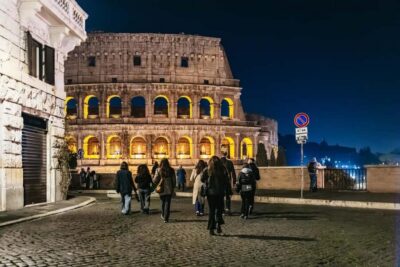
Small-Group City Highlights Moonlight Walking Tour
Read our review →
Best of Rome Walking Tour including Trevi Fountain
Read our review →Browse the lists this tour appears in