
Reviewed · WALKING TOURS IN ROME
Rome Fountains & Squares Walking Tour–Small Group w/ Local Expert
Rome has a way of doing things twice. Once in marble, then again in water, light, and story, and this walk is built around that idea. You’ll stitch together some of the city’s most famous squares and fountains, starting and ending in central piazzas, with a local guide who turns landmarks into something you can actually picture. The small group size also helps you slow down at the good moments.
I really like the small-group format here. With a maximum of 15 people, you get more than just a whistle-stop route, and there’s room to ask questions and get help with photos. I also like the focus on fountains and architecture, not random sightseeing, so you come away understanding why these places look the way they do.
One consideration: the route packs a lot into about 2 hours, and a fast pace can make it feel slightly rushed if you’re hoping for long photo sessions at every stop. If you want extra time, plan to ask your guide for brief breaks and settle in for a concentrated highlight reel.
In This Review
- Key Points That Make This Tour Worth Your Time
- Why This Fountain-And-Square Walk Feels Better Than a Big-Bus Ride
- The Route Design: Central Piazzas, Easy to Extend Your Day
- Piazza Navona and the Stadium of Domitian: See the Water, Then See the Hidden Layer
- Fontana dei Quattro Fiumi: The Four Rivers Myth You Can Actually Point To
- Campo de’ Fiori and the Giordano Bruno Statue: Market Energy With a Somber Center
- Stroll Past the Stadium Arches: Why Piazza Navona Feels So Built-In
- Pantheon in Piazza della Rotonda: Why This Dome Still Dominates the View
- Fontana della Barcaccia and the Spanish Steps Area: Baroque Drama at Walking Distance
- Trevi Fountain: The Big One, Seen With Context
- Price and Value: Is $67.29 for Two Hours a Smart Spend?
- What to Expect From the Guide: Stories, Practical Tips, and Better Photos
- Pace and Photo Time: The One Thing You Might Want to Manage
- Who This Tour Suits Best (And Who Might Prefer Something Else)
- Final Verdict: Should You Book This Rome Fountains and Squares Tour?
- FAQ
- How long is the Rome Fountains & Squares Walking Tour?
- What is the group size?
- What language is the tour offered in?
- Where do I meet and where does it end?
- Are entrance tickets included for the sights?
- Is a mobile ticket provided?
- Can I get a refund if my plans change?
Key Points That Make This Tour Worth Your Time
- Max 15 people, so you’re not lost in a crowd and can actually hear the guide
- Fountain and square storytelling, tied to architecture, power, and design details you’ll spot right away
- Central start and finish, easy to continue exploring on foot after the tour ends
- No separate paid attractions needed at the listed outdoor sights, so you can keep moving without ticket hassle
- Mobile ticket in English, plus practical tips from the guide that go beyond history
Why This Fountain-And-Square Walk Feels Better Than a Big-Bus Ride
Rome’s major sights can be loud in the most literal sense, crowded, and hard to connect. This tour works because it gives you a human pace. Instead of racing down wide streets like you’re on a schedule, you’re walking through the exact kind of spaces that shaped Roman life: piazzas where people met, traded, prayed, and performed.
The big advantage is the attention. A guide can point out the things most people miss when they’re looking up at the skyline with zero context, like how a fountain’s symbolism ties back to the papacy or how a square’s shape echoes an older arena beneath it. And because the group is small, you can ask follow-up questions without feeling like you’re interrupting a lecture.
There’s also a practical payoff. After you spend time with a local expert here, you get a mental map of central Rome: how squares connect, where the views open up, and which landmarks anchor the whole area. That makes it easier to explore on your own the rest of your trip.
More Small-Group Tours in Rome
- Skip-the-Line Vatican, Sistine Chapel & St. Peter’s | Small Group
★ 5.0 · 7,060 reviews - Rome: Colosseum Underground Small Group Guided Tour
★ 4.7 · 4,844 reviews - Rome: Skip the Line Vatican, Sistine Chapel, St Peter Small Group
★ 5.0 · 3,847 reviews - Rome on a Golf Cart Semi-Private Tour Max 6 with Private Option
★ 5.0 · 2,502 reviews
The Route Design: Central Piazzas, Easy to Extend Your Day
This walk is built to start and end in the kind of locations you can easily navigate. You begin at Piazza Barberini and finish at Piazza Navona, both in Rome’s central zone. That matters because you’re not stuck dragging yourself back to a hotel after the tour, and you can keep sightseeing while the “Roman stories” are still fresh in your head.
You’ll cover classic stops that create a strong sweep across the city’s best-known areas. Expect to move between:
- the theatrical Baroque set pieces around Piazza Navona
- the historically heavy atmosphere of Campo de’ Fiori and the Giordano Bruno statue
- the ancient-anchor feeling of the Pantheon
- the romantic stair-and-terrace area around the Spanish Steps
- the crowd magnet that is Trevi Fountain, in its full grand scale
Even if you’re only in Rome a few days, this kind of route helps you stop treating each place like an isolated postcard. You start seeing how the streets, squares, and buildings form a connected story.
Piazza Navona and the Stadium of Domitian: See the Water, Then See the Hidden Layer
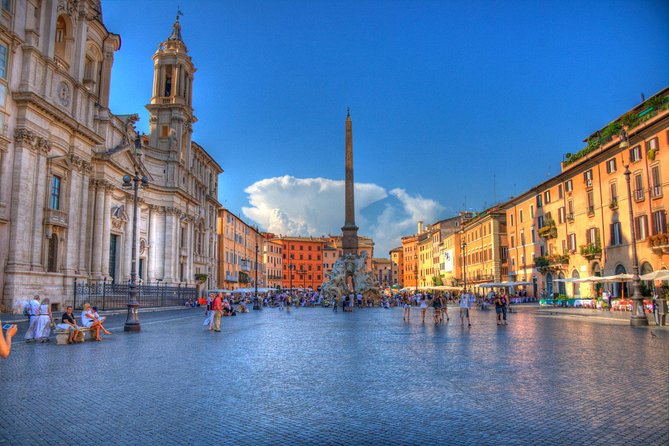
If you like the idea of Rome having multiple timelines in one glance, Piazza Navona is the place. The square takes its Baroque look from the 15th century onward, but it’s also sitting on top of older Roman structure. Under the sweep of buildings around the piazza, the Stadium of Domitian once formed a horseshoe-shaped arena for foot races in the 1st century AD.
That stadium detail isn’t just trivia. It changes how you read the space. When you stand in the piazza, you can start to imagine how the open shape would have held crowds, then notice how the later city designers embraced that layout. This is the kind of connection that makes a guided walk feel worth it.
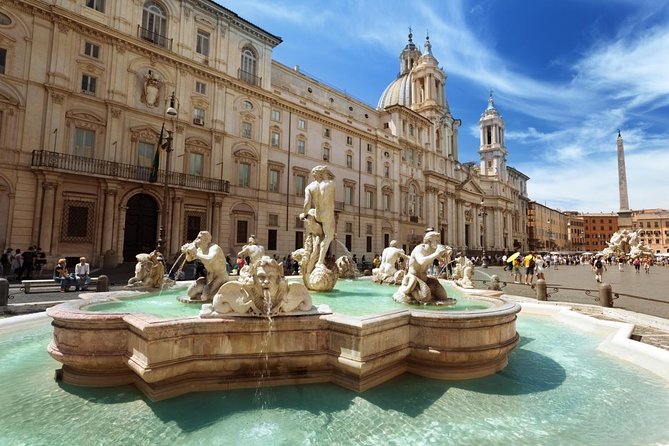
And then there’s the fountains. Piazza Navona is famous for having three magnificent ones in the same public room. As you move around the square, the design gives you different angles on the same theme, which is a big deal for photos. Also, these are free to view, so you spend your time on seeing, not lining up.
Fontana dei Quattro Fiumi: The Four Rivers Myth You Can Actually Point To
The Fontana dei Quattro Fiumi is the kind of fountain that looks like a sculpture lesson. It was designed in 1651 by Gian Lorenzo Bernini for Pope Innocent X, with the family palace and a sponsor church facing onto the piazza. That papal connection matters because it explains why the fountain feels like more than decorative water.
At the base, travertine rocks rise up to support four river gods. Above them sits a copy of an Egyptian obelisk topped with the Pamphili family emblem. The guide helps you connect what you’re seeing to the meaning: each river god represents a major river linked to continents across which papal authority spread. The Nile is Africa, the Danube is Europe, the Ganges is Asia, and the Río de la Plata is the Americas.
It’s a lot of symbolism for a fountain, but that’s the point. Once you know the mapping, you’ll start spotting the logic in the artwork instead of just admiring the carving. And with a smaller group, you’re not forced to look from one single spot.
Campo de’ Fiori and the Giordano Bruno Statue: Market Energy With a Somber Center
Campo de’ Fiori has two faces depending on when you visit it. In the morning, it’s known as a bustling marketplace. Later in the day, it shifts toward nightlife energy. Standing there, you’ll feel how Rome turns public space into a daily stage.
But the history is darker than the vibe. This piazza was also the site of executions. The most direct reminder is the Statua di Giordano Bruno, centered in the piazza. The statue was created in 1888 and placed at the exact location of his execution.
That’s one reason this stop works in a guided format. Without context, you might treat the statue like another landmark in the background. With context, it becomes a focal point, and you start to notice how the city layers daily life over difficult chapters.
If you’re the kind of traveler who likes your Rome stories balanced, this is a key moment. It’s not only pretty piazzas and famous names. It also shows how history sits right in the middle of everyday street life.
More Walking Tours in Rome
Stroll Past the Stadium Arches: Why Piazza Navona Feels So Built-In
Another smart feature of this tour is that it doesn’t treat Piazza Navona as a single stop. It frames the square as a whole concept: a surface above an older arena.
The Stadium of Domitian is also known as the Circus Agonalis, and it sat to the north of the Campus Martius. The sweep of buildings around Piazza Navona incorporates original lower arcades from the stadium. When you’re walking with a guide, you’re more likely to notice those structural echoes instead of just admiring the big open view.
For me, this is one of the most “Rome” moments on the route. The city’s ability to reuse and refashion space is one of the reasons Rome feels uniquely deep even in casual sightseeing.
Pantheon in Piazza della Rotonda: Why This Dome Still Dominates the View
At some point on every first Rome visit, you want one “wow” that feels ancient but still real. The Pantheon delivers that. It’s widely seen as one of the best-preserved ancient monuments in Rome, and it’s also an example of a sacred building being re-used through a Christian lens.
The architecture is the headline: an imposing facade dominates the southern side of Piazza della Rotonda. But what makes it compelling is what happened after the Roman period. In 1870, the Pantheon became a shrine for the kings of Italy. It’s also where the mortal remains of Victor Emanuel II, Humbert I, and Margaret of Savoy rest, plus Raffaello Sanzio is buried there.
That mix can feel like a time-travel trick, and it’s exactly why a guided walk helps. You don’t just stand in front of a famous dome. You understand how it changed jobs over centuries, while keeping its physical authority.
This is also a good stop for calm. Even if the area is busy, the guide’s pace gives you a chance to look, absorb, and ask questions, instead of just moving on immediately.
Fontana della Barcaccia and the Spanish Steps Area: Baroque Drama at Walking Distance
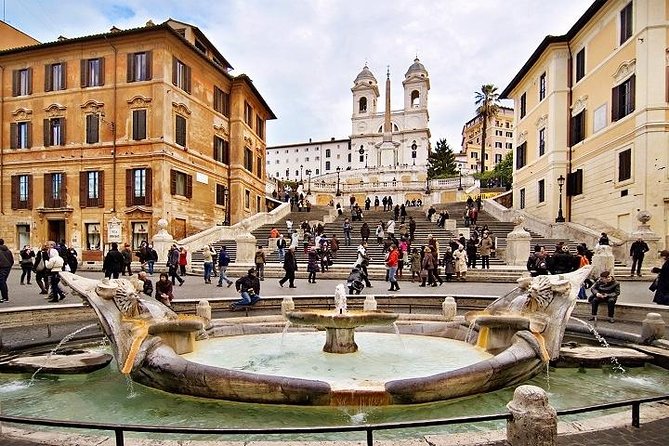
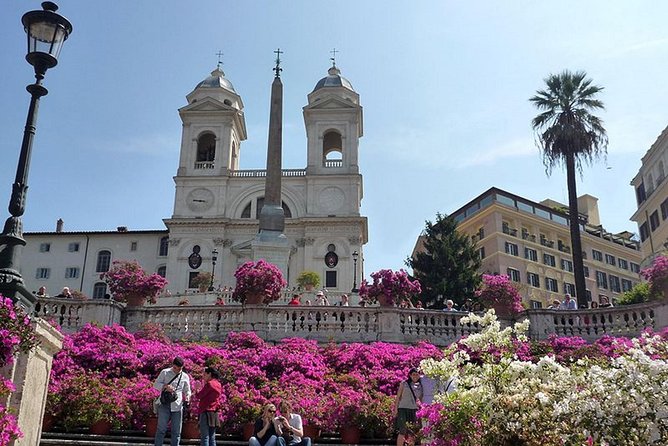
From the Pantheon, you’ll move toward the Piazza di Spagna area and the famous stair views. Here you’ll find the Fontana della Barcaccia, a Baroque-style fountain at the foot of the Spanish Steps.
The details are part of what you’ll want to look for, because the fountain is decorated with two papal coats of arms. Water gushes out of the mouths of two suns, symbols connected to the Barberini family. This stop rewards your attention. The more you know, the more you see.
Then there’s the commanding presence above the square: the Trinità dei Monti church, the Santissima Trinità dei Monti, often shortened to Trinità dei Monti. The church sits above the Spanish Steps, and the surrounding area including Villa Medici is tied to French state property. If you care about how borders and empires leave physical marks, this is one of those quiet-but-smart details to notice.
Trevi Fountain: The Big One, Seen With Context
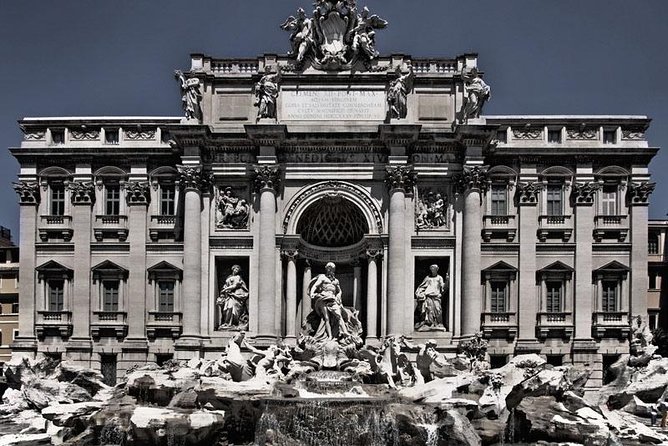
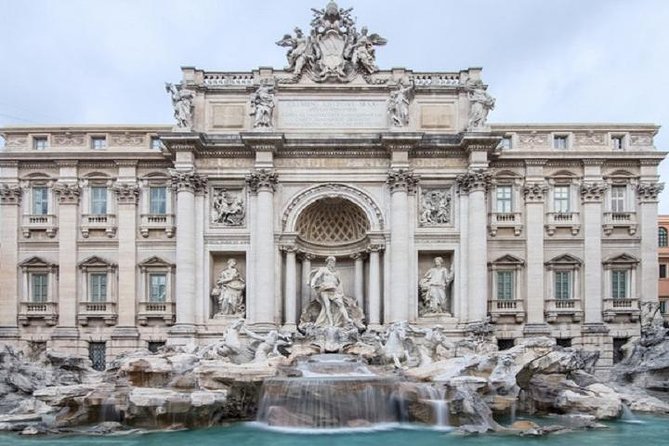
The walk finishes at a place that’s both famous and easy to misunderstand: Trevi Fountain. It’s an 18th-century Baroque masterpiece designed by Nicola Salvi and completed by Giuseppe Pannini in 1762. It’s also massive, measuring 26.3 meters high and 49.15 meters wide, and it’s often considered the largest Baroque fountain in Rome.
When you arrive with a guide, you’re less likely to treat it as a single photo moment. You’ll have a sense of the design scale and the Baroque logic behind it. And since the tour is small, you can get a better viewing angle than you would by fighting for space in a huge crowd.
Also, this is an outdoor, free-to-view stop. So you can decide how long you want to stay after the tour. If you like to linger, Trevi is a place you can extend without needing a ticket or changing your plan.
Price and Value: Is $67.29 for Two Hours a Smart Spend?
At $67.29 per person for an approximately 2-hour small-group guided walk, the value comes from what you get alongside the sights.
You’re paying for:
- a local expert who connects architecture, symbolism, and historical context
- a small group experience, max 15 people, which increases your chance to ask questions
- a route that hits multiple major icons without requiring you to plan transportation between them
If you try to self-tour all these landmarks in a short window, you’ll spend that time researching and building context, and you might still miss the meaning of what you’re seeing. With a guided format, the context arrives while you’re standing in front of the object.
One more value signal: this tour is often booked well in advance, with an average booking lead time of 81 days. That usually means demand stays high during peak weeks. If you’re traveling in high season, booking ahead is a good move.
What to Expect From the Guide: Stories, Practical Tips, and Better Photos
The tour is designed for more than just facts. The best guides here do two things: they tell stories that make the sights easier to remember, and they help you get better at actually seeing.
Some of the guides’ strengths highlighted in feedback include:
- clear, engaging historical background that helps you picture how the city evolved
- practical recommendations along the way, like where to eat and even how to handle public transportation safely
- hands-on help with photos, so you’re not constantly stuck waiting for a good shot
Guides with names like Felice, Luisa, Federico, Valentina, and Gigi have led this experience, and the common thread is that they try to make the route feel personal rather than robotic.
A small-group walk also means you can control the moment. If a fountain detail catches your eye, you can ask a question on the spot. That’s how you turn a simple sightseeing block into a memory you’ll actually keep.
Pace and Photo Time: The One Thing You Might Want to Manage
Here’s the only real downside to plan around: the route is timed, and a fast pace can leave you wishing you had more time at certain stops. A couple of people noted that the tour can move quickly through squares and fountains, so if you care about photography or just soaking in atmosphere, you’ll want to be proactive.
My practical advice:
- Bring comfortable shoes and expect a solid walk, not a slow stroll
- If you want photos, say so right when you arrive at each main stop
- Use the guide’s help to find the best angles, then step back and enjoy without rushing
Two hours can go by fast, especially when the group is small and everyone is engaged. But that speed can be a feature too. You’ll cover a lot and still have energy left to explore after.
Who This Tour Suits Best (And Who Might Prefer Something Else)
This walk is ideal if you:
- want a first-time Rome foundation that focuses on fountains and architecture
- like understanding the symbolism and design choices behind major landmarks
- prefer a more intimate experience than a bus tour
- enjoy walking between central areas without dealing with complicated planning
It might be less ideal if you:
- want to spend long, slow hours at only one or two major monuments
- dislike being on a schedule during sightseeing
- need lots of unstructured time, because the route is compact by design
If you’re the type who likes to return later to your favorite stop, this is a great starter. You’ll know exactly where to go back, and why it mattered in the first place.
Final Verdict: Should You Book This Rome Fountains and Squares Tour?
If you’re trying to choose between “random walking” and “a smart plan,” I think this one lands firmly in the smart plan category. It’s focused, central, and small-group, and it gives you the kind of context that turns photos into understanding.
I’d book it if you want:
- a high-value 2-hour intro to central Rome’s fountain-and-square highlights
- small-group attention so you can ask questions and get photo help
- a guided route that connects Piazza Navona, Campo de’ Fiori, the Pantheon, the Spanish Steps area, and Trevi Fountain into one coherent story
If you’re chasing a slow, chill day with minimal structure, you might want a different style of tour. But for most first-time visitors, this is a strong way to get oriented fast and see the city’s most iconic “water moments” with meaning.
FAQ
How long is the Rome Fountains & Squares Walking Tour?
It lasts about 2 hours.
What is the group size?
It is a small group with a maximum of 15 participants.
What language is the tour offered in?
The tour is offered in English.
Where do I meet and where does it end?
You start at Piazza Barberini and end at Piazza Navona.
Are entrance tickets included for the sights?
Entrance tickets are not included, though the stops listed are admission free to visit.
Is a mobile ticket provided?
Yes, you’ll receive a mobile ticket.
Can I get a refund if my plans change?
Free cancellation is available up to 24 hours before the experience starts for a full refund.
Latest additions from Rome
- Rome: Testaccio Market Food Tour with Street Food & Wine★ 5.0 · 8 reviews
- Exclusive Pasta & Tiramisu Class with Wine near by Colosseum★ 5.0 · 8 reviews
- Private Professional Photoshoot in Rome★ 5.0 · 8 reviews
- Loreto “Shrine of the Holy House of the Virgin Mary” Private Tour from Rome★ 5.0 · 8 reviews
- Rome Day to discover Florence and Pisa Hotel Pickup★ 4.5 · 8 reviews
- Rome: Christmas Nativities and Angels Tour★ 3.1 · 8 reviews
- Guided Tour of Vatican Museums and Sistine Chapel★ 5.0 · 8 reviews
- Rome: Cooking Class of fresh Pasta and Tiramisu Cake★ 5.0 · 8 reviews
Walking Tours in Rome, compared.

Guided Food Walking Tour with Wine in Trastevere
Read our review →
Trastevere & Campo de Fiori Street Food Walking Tour
Read our review →
Paranormal Night Walking Tour & Secret Backstreets
Read our review →
Trastevere Street Food Walking Tour with Local Expert
Read our review →
Guided City Center Evening Sightseeing Walking Tour
Read our review →
Small-Group City Highlights Moonlight Walking Tour
Read our review →
Best of Rome Walking Tour including Trevi Fountain
Read our review →Browse the lists this tour appears in