
Reviewed · GOLF CART TOURS IN ROME
Nocturnal Rome Golf Cart Tour
A city at night feels different fast, and this tour leans into that.
You ride an open-air golf cart through Rome’s big-name landmarks with your guide, plus headsets so the stories stay clear even while you’re moving. I also like the tight pacing, you get a lot of famous sights without the usual daytime grind.
One thing to consider: the carts are open and the best views depend on where you sit. If you end up in the last row facing backward, you may find it harder to watch the streets and skyline as you go.
In This Review
- Key points to know
- Meeting at Piazzale Flaminio, then rolling toward Piazza del Popolo
- Why this golf cart night format makes Rome easier
- Headsets, pacing, and Eliphas style storytelling
- Pantheon at night, then a second look later
- Trevi Fountain after dark, famous and still worth it
- The route includes a quick ancient facade reveal
- Colosseum quick stop, and the ticket planning you need
- Piazza del Campidoglio and the climb of Roman politics
- Teatro di Marcello: Rome’s older entertainment shape
- Piazza Venezia and the wide Rome center view you can feel
- Terrazza del Pincio in Villa Borghese for skyline breathing room
- Baths and presidential pomp, in the same night ride
- St Charles Church, Fontana fountains, and Bernini energy at Piazza Navona
- A quick pass through the French district before the final climb
- Spanish Steps to finish, with a longer photo window
- How to get the most from a 3-hour night ride
- Value check: is $93.12 a fair deal?
- Who this tour fits best
- Should you book Nocturnal Rome by golf cart?
- FAQ
- How long is the Nocturnal Rome Golf Cart Tour?
- Where does the tour start and where does it end?
- Is the tour in English?
- What is included in the price?
- Are attraction tickets included?
- How many people are on the tour?
- Do I need good weather?
- Is free cancellation available?
- Are service animals allowed?
Key points to know
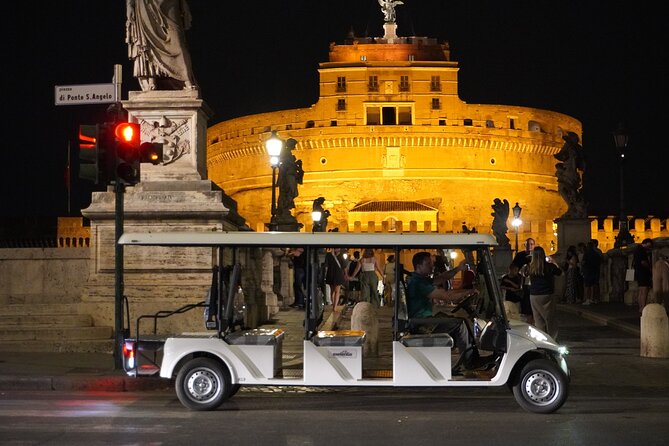
- Open-air golf cart at night for big illuminated sights with less foot traffic
- Headsets help you hear the guide’s narration clearly while you ride
- Short, focused stops mean more photos and less standing around
- An end-to-end route that starts near Piazza del Popolo and finishes at Piazza di Spagna
- English-only guidance is the default, so plan around that if you need another language
Meeting at Piazzale Flaminio, then rolling toward Piazza del Popolo
The tour starts at Piazzale Flaminio 15, right in front of McDonald’s. It sits across from Piazza del Popolo, and if you arrive a little early, I’d use the time to wander into Santa Maria del Popolo, a church known for standout works including pieces by Raphael and Caravaggio.
Here’s a practical tip that can save you stress: don’t trust Google Maps blindly. People have had meeting-point confusion, so the safest move is to look for the McDonald’s location near the metro area and check in early.
This is a small-group experience, capped at 14 travelers. That matters because it keeps the ride feeling personal and helps the guide manage timing for photos and quick stops.
More Golf Cart Tours in Rome
- Rome by Golf Cart Private Tour: Beyond the Landmarks
★ 5.0 · 4,361 reviews - Rome on a Golf Cart Semi-Private Tour Max 6 with Private Option
★ 5.0 · 2,502 reviews - Rome Highlights by Golf Cart Private Tour
★ 5.0 · 2,379 reviews - Rome: Golf Cart Tour with Artisanal Gelato Tasting
★ 4.8 · 1,396 reviews
Why this golf cart night format makes Rome easier
I like the logic of seeing Rome after dark by golf cart. Instead of walking between far-flung landmarks, you cover the distance while the city lights do the heavy lifting for atmosphere.
You’re also not stuck parking and squeezing into crowded entry points in the same way you would on foot. One of the most repeated wins from people is simply how close the cart gets you to stops, which can mean less time shuffling around and more time looking up, framing a shot, and listening.
Weather matters with open-air tours, but this one has a bit of built-in comfort. On at least one tour, there was light rain and the carts were covered enough to keep the experience going smoothly.
Headsets, pacing, and Eliphas style storytelling
The headsets are not a small detail. When you’re in motion, trying to hear over traffic or other voices, audio clarity becomes the difference between a fun loop and a frustrating one.
The guide also shapes the experience through pacing. People noted that the tour kept moving at a good rhythm, with time carved out for family photos so you’re not always feeling rushed.
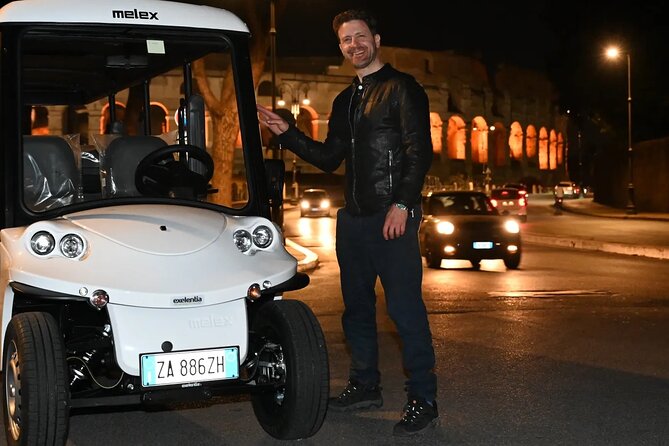
Eliphas is the name that shows up in multiple reviews, and the vibe is consistent: he tells Rome’s story in a way that feels like a conversation, not a scripted lecture. One review even called out that he helped with photography and worked like a spotter, so families could get pictures without everyone holding phones and crossing fingers.
If you want your “first night in Rome” to set the tone, this is the kind of format that helps you get your bearings fast. The route hits major icons plus lesser-seen streets, so the city starts to make sense in your head.
Pantheon at night, then a second look later
The tour hits the Pantheon early, with a short stop of about 10 minutes. This is a classic “see it while it’s lit up” moment. The Pantheon is famous for its near-perfect preservation, and especially its massive dome that still holds the record for the largest dome of its kind without internal reinforcement.
You also get a bit of extra time built in later. There’s another brief Pantheon stop later in the route (about 5 minutes), which can feel like a bonus chance to reframe your photos once you’ve seen the surrounding area at night.
One thing I’d plan for: 10 minutes goes fast when you’re stopping for a photo every few steps. If you’re chasing a specific angle, pick it quickly, then use the remaining time to look around and absorb the scale.
Trevi Fountain after dark, famous and still worth it
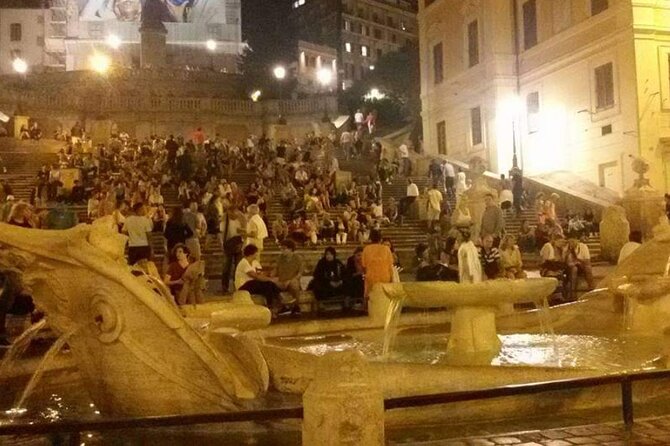
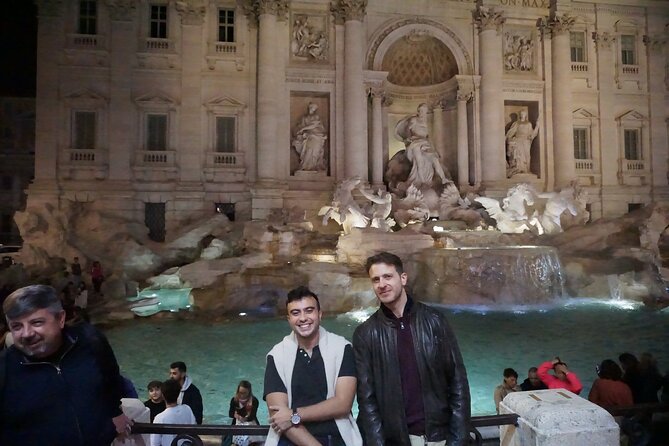
Trevi Fountain gets a 10-minute stop. At night, it shifts from a daytime crowd magnet into something more manageable, more cinematic, and easier to enjoy without constantly stepping aside.
This stop also works as a reset point. You go from major architecture to one of Rome’s most recognizable scenes, and it’s one of the landmarks people specifically mention as breathtaking at night.
If you’re hoping for clean photos, go in with a quick plan. Spend the first minute deciding your spot, take your pictures, then let the rest of the time be about enjoying the fountain rather than trying to solve the perfect shot.
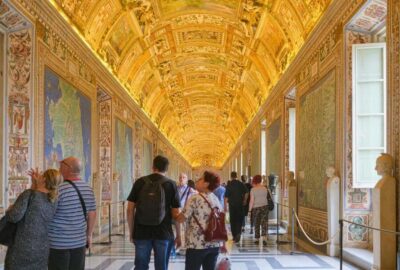
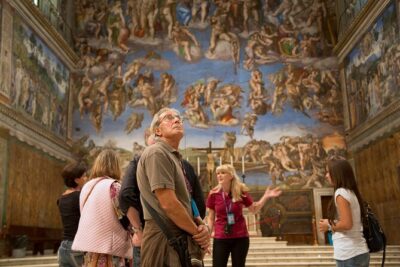
Another shape for the same afternoon in Rome:
The route includes a quick ancient facade reveal
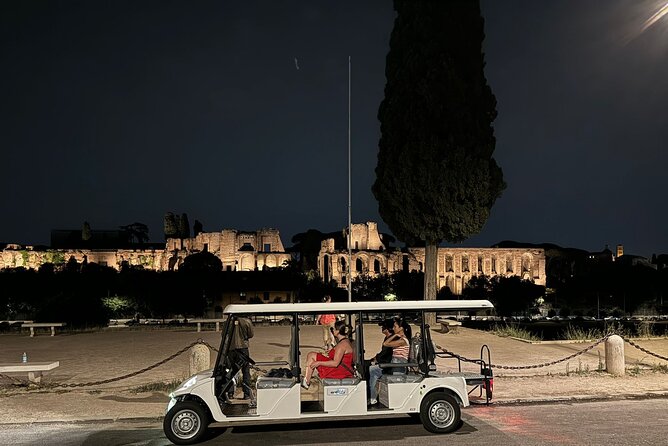
Between Trevi and the Colosseum area, there’s a short moment built around a surprising reveal. The idea is that a building can look ordinary until you turn and suddenly see an ancient facade that still carries real age and weight.
Even without extra time for a deep explanation at that exact corner, this kind of stop is good for two reasons. First, it breaks up the big landmark rhythm. Second, it trains your eye to notice Rome’s layers as you move.
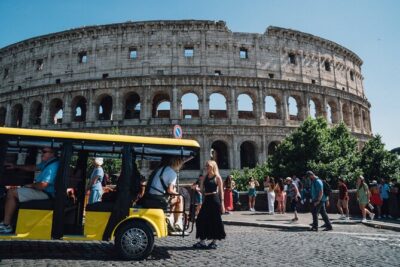
Colosseum quick stop, and the ticket planning you need
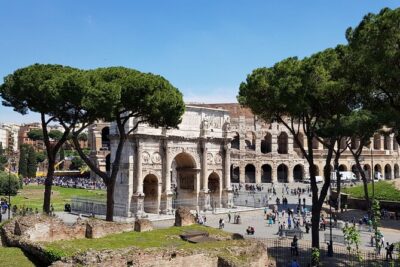
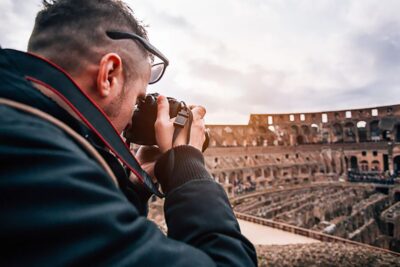
The Colosseum stop is about 10 minutes, but admission is not included for this specific monument. That means you should be ready to pay separately if you want to do anything beyond exterior views.
Still, even a short Colosseum visit can land hard at night. You get to see the scale and the engineering from a different angle than daytime crowds allow. The amphitheater setting makes it easy to imagine the past, especially when the stone is lit and the street noise softens.
If you want more than a quick look, treat this as your heads-up. Decide in advance whether you’re comfortable with exterior-only time here, because the stop duration is not long.
Piazza del Campidoglio and the climb of Roman politics
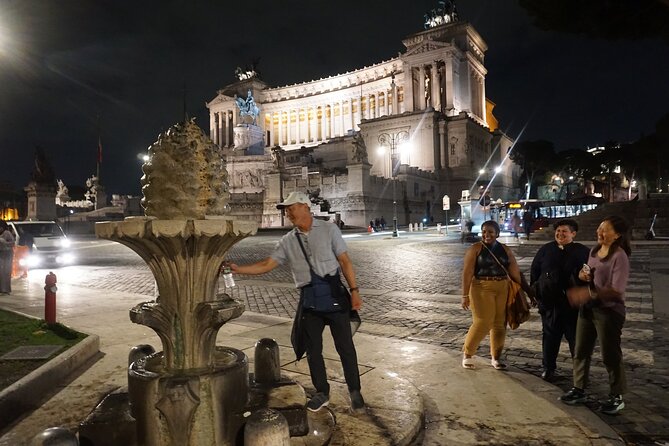
Next up is Piazza del Campidoglio on Capitoline Hill. This area was central to Roman political and religious life, so it’s a big deal historically even when your time there is brief.
The square also connects to later art and design. Michelangelo shaped the area’s Renaissance look, and the space gives you a sense of how Rome repeatedly reinvented its most important power points.
Time here is tight, around 5 minutes, so don’t plan to read every detail. Instead, look for the overall layout and the way the monuments frame the space. That’s what makes the hill feel like the city’s command center.
Teatro di Marcello: Rome’s older entertainment shape
The route also stops at Teatro di Marcello, a 1st-century BC open-air theater built under Julius Caesar and completed by Augustus. What makes it especially interesting is how it served as a model for later forms like the Colosseum.
At night, you get to see the curve and structure without the usual daytime crush. The time is short, but the payoff comes from noticing how different Roman construction looks when it’s lit from the right direction.
If you like architecture, this stop is a nice counterbalance to the big headline attractions.
Piazza Venezia and the wide Rome center view you can feel
Piazza Venezia is one of those Rome squares that feels like a crossroads. The center is dominated by Altare della Patria, the grand white marble monument honoring Victor Emmanuel II.
Even if you don’t go inside, the square gives you a sense of Rome’s scale. One reason it fits this tour is practical: it acts like a hub area, so the ride flows logically from major monuments to the next set of baroque scenes.
The stop here is brief, around 5 minutes, so treat it as a photo-and-orientation moment.
Terrazza del Pincio in Villa Borghese for skyline breathing room
Terrazza del Pincio is built for views, and it comes with a quick stop (about 5 minutes). The setting is in Villa Borghese, and the point is simple: you step away from the street-level stops and get a panoramic moment to reset your brain.
This is the kind of pause that helps if you’ve been walking all day already. If you’re the type who likes to take in a city from above at least once, don’t skip this timing.
Baths and presidential pomp, in the same night ride
The tour also includes a stop for what’s described as the biggest Ancient Roman baths and among the best preserved in Rome. This is a strong example of why a golf cart tour works: you can cover major sites quickly while you still get a short look at huge structures you might otherwise only see in daylight with long lines.
Another stop brings in Quirinal Palace, once the Pope’s residence and now the headquarters of Italy’s president. This is more ceremonial than many of the other monuments on the route, and it helps round out the night theme. You’re not only seeing ancient Rome, you’re also seeing how later power centers took over existing importance.
If you like contrasts, these stops give it to you: ancient engineering next to modern symbolism, all under night lighting.
St Charles Church, Fontana fountains, and Bernini energy at Piazza Navona
This portion of the ride leans into baroque Rome. You’ll pass by (and stop near) the four fountains built by Domenico Fontana in limited space, plus the Baroque church of St Charles designed by Borromini. The architecture is described as an architectural landmark, especially with complex forms and the way the design bends perception.
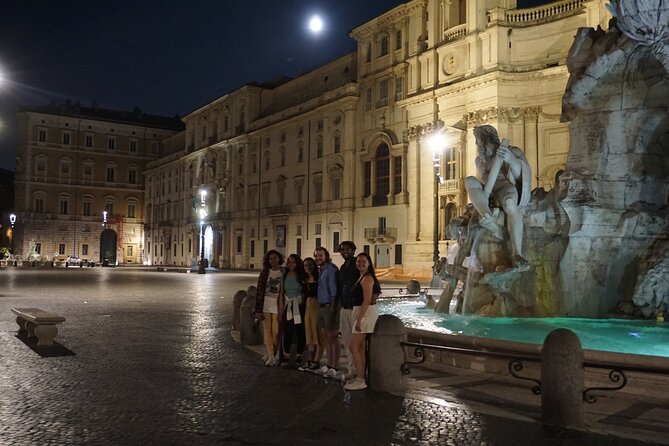
Then the tour lands at Piazza Navona. It’s about a 5-minute stop, but it’s one of the most satisfying at night because of the baroque focus. Bernini and Borromini are directly tied to what you see here, and the square itself sits on top of a 2,000-year-old stadium.
That last detail matters because it gives you an anchor. You’re not just looking at pretty buildings, you’re standing in a layered space where old and new Rome overlap.
If you have only one night to do this kind of architectural sampling, Piazza Navona is the kind of stop that makes the list feel worth it.
A quick pass through the French district before the final climb
The route also includes a stop in Rome’s French area, described as a district that houses the French Academy of Art and the French Basilica. The time here is short, so it’s not an extended visit, more of a chance to spot context and add another thread to your Rome map.
These in-between moments are part of what makes a guided loop feel smarter than independent wandering. You’re not guessing what you’re looking at, you’re getting the story fast.
Spanish Steps to finish, with a longer photo window
The tour ends at Piazza di Spagna, and Spanish Steps are the final highlight. You get about 15 minutes here, which is longer than several other stops on the route.
This is your chance to capture the staircase without the peak daytime crush. It’s also a good landing point for the end of the evening because it’s central, and you can keep exploring on foot afterward if you still have energy.
If you’re traveling with teens or family members who want one clear “cool photo spot,” this finish gives it to you.
How to get the most from a 3-hour night ride
This tour runs about 3 hours, and the pacing is designed to maximize stops rather than linger. That’s great if you want a fast overview, not ideal if you expect to read every inscription or do long museum-style visits.
Pack for the obvious reality of open-air Rome nights. Wear layers, and if rain is in the forecast, bring something light. One reason people were happy during light rain is that the carts were covered enough to keep the experience comfortable.
Also, pick your priorities before you get on the cart:
- Decide which two or three places you most want photos at.
- Keep your camera ready but don’t sprint from stop to stop.
- If you have a choice of where you sit, consider how you like to view the city while riding. People have flagged that the last row facing backward can reduce the view experience.
Value check: is $93.12 a fair deal?
At $93.12 per person for about 3 hours, the value depends on what you want out of your Rome time.
I think it’s a good deal if:
- You’re short on days and want a strong first overview.
- You hate daytime queues and crowd pressure.
- You want your guide to connect landmarks with story, not just point at monuments.
- You want to see a lot while minimizing walking.
The math gets better when you compare it to the cost of building multiple separate activities, especially if you’re considering how much time you save by using a vehicle for between-sight movement. The tour also includes headsets and private transportation, so you’re not paying extra for the audio comfort and logistics.
The one price wrinkle is that Colosseum admission is not included. If you want to enter there, factor that into your budget.
Who this tour fits best
This is a strong match for first-time Rome visitors who want context fast. It’s also great for travelers who want an easier night plan, including families, people who find long walking tiring, and anyone who prefers viewing Rome lit up rather than sweating through it in midday heat.
It’s also a good option if your group has mixed interests. One person can focus on photography and landmarks, while someone else can listen to the history and architectural threads.
And if you’re the type who likes to start with a “big picture” tour on day one, this kind of route helps everything else you do afterwards.
Should you book Nocturnal Rome by golf cart?
I’d book it if your goal is a smart first night that mixes iconic sights with night energy, without turning your vacation into a marathon. The combination of golf cart convenience, headset audio, and a guide like Eliphas who can answer questions and keep the pace moving is what makes the experience feel worth it.
I’d think twice if you strongly prefer to spend lots of time entering monuments, or if language is a concern since it’s offered in English and translations are not provided. And if you’re picky about seeing the city from your seat, arrive with enough flexibility to choose where you sit.
If you can handle a short stop at each major point, this tour is one of the most efficient ways to see Rome looking its best, lit up and calmer.
FAQ
How long is the Nocturnal Rome Golf Cart Tour?
The tour lasts about 3 hours.
Where does the tour start and where does it end?
It starts at Piazzale Flaminio 15, in front of McDonald’s, and ends at Piazza di Spagna.
Is the tour in English?
Yes, the tour is offered in English.
What is included in the price?
Included features are private transportation and headsets, plus you’ll receive a mobile ticket.
Are attraction tickets included?
For this route, admission is free at the Pantheon and Trevi Fountain, while Colosseum admission is not included.
How many people are on the tour?
There is a maximum of 14 travelers.
Do I need good weather?
Yes. The experience requires good weather, and if it’s canceled due to poor weather you’ll be offered another date or a full refund.
Is free cancellation available?
Yes. You can cancel up to 24 hours in advance for a full refund.
Are service animals allowed?
Yes, service animals are allowed.
Latest additions from Rome
- Guided Tour Vatican Museums & Sistine Chapel★ 4.1 · 30 reviews
- Exclusive Rome by Night Vespa Tour★ 5.0 · 30 reviews
- Transfer Rome to Airports★ 4.5 · 30 reviews
- Vatican: St.Peter’s Basilica & Dome – Reserved Entry & Tour★ 4.1 · 30 reviews
- Rome street art tour: off the beaten path with a local guide★ 5.0 · 30 reviews
- Tivoli, Hadrians Villa and Villa d’Este, a charming day trip from Rome★ 4.5 · 30 reviews
- Rome Food Tasting with Wine Pairing Italian Authentic Flavors★ 5.0 · 31 reviews
- Inspirational Cooking on the Roman Chef’s Panoramic Terrace★ 5.0 · 30 reviews
Golf Cart Tours in Rome, compared.
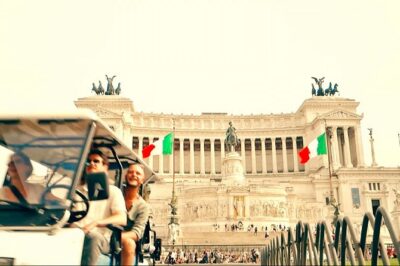
Rome by Golf Cart Private Tour: Beyond the Landmarks
Read our review →
Rome on a Golf Cart Semi-Private Tour Max 6 with Private Option
Read our review →
Rome Highlights by Golf Cart Private Tour
Read our review →
Golf Cart Small-Group Guided Tour: Rome City Highlights
Read our review →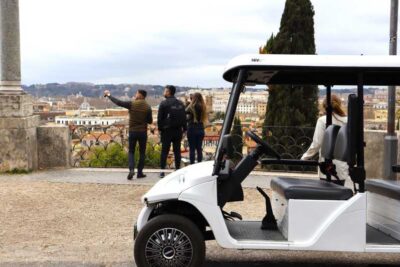
Private/Group 4 Hours Golf Cart SightseeingTour
Read our review →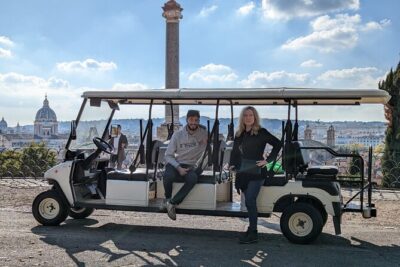
Browse the lists this tour appears in