
Reviewed · VIP
Exclusive Golf Tour Private VIP with Local & Gelato o Wine
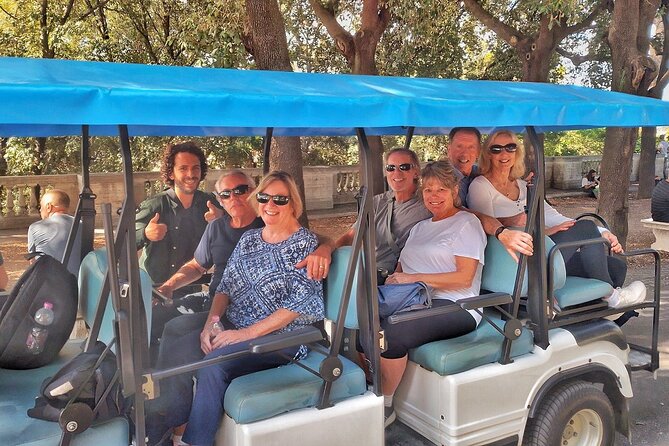
Rome on a golf cart beats the heat. This private VIP tour strings together big Roman landmarks, classic photo stops, and scenic viewpoints into one smooth ride with a local guide who keeps the story moving.
I especially like the electric cart format. You still get real Rome highlights like Trevi Fountain and the Colosseum area, but without the long walking-and-waiting grind. I also love the built-in rhythm: short time at each standout spot, plus a proper gelato tasting with a long-running recipe.
One thing to plan around: pickup depends on where you are. Golf carts can’t leave the restricted central traffic zone, so you may need to meet at a nearby point instead of right at your hotel, and Colosseum access is limited to external viewing, not inside tickets.
In This Review
- Key things I think you will like about this tour
- A 3-hour Rome loop on an electric golf cart
- Trevi Fountain, the roads called tre vie, and why Rome’s water still matters
- Piazza Venezia and the “center” that keeps rewriting the skyline
- Along Via dei Fori Imperiali, see the Forum corridor without the marathon
- Theatre of Marcellus and Circus Maximus, big-scale Rome entertainment
- Giardino degli Aranci on the Aventine, Rome’s rooftop view
- Victory arches and the Constantine connection
- Colosseum and the big amphitheater, what you see and what you do not
- The stop tied to Rome’s first condominium idea
- Aventine hill walking time, away from the loudest streets
- Gelato break at Gelateria La Romana dal 1947
- Piazza in Campo Marzio, an easy wander through Rome layers
- Basilica di Santa Maria Maggiore and the art you can actually see
- Guide style matters, and the names you might get
- Is the price fair for what you get?
- Who should book this VIP cart tour?
- Should you book this Rome VIP golf cart tour?
- FAQ
- How long is the private VIP golf cart tour?
- Is this tour private?
- Do I need tickets to enter the Colosseum and Roman Forum?
- What’s included during the tour?
- Where does pickup happen if I am staying in the center of Rome?
- Is the tour wheelchair friendly?
- What happens if the weather is poor?
- What languages does the guide speak?
Key things I think you will like about this tour
- Electric cart comfort for a 3-hour highlights loop, with less walking on Rome’s uneven streets
- Private, customizable feel, so you can spend a little more time where you care most
- Aventine views that feel like a breath of fresh air, especially from Giardino degli Aranci
- Gelato tasting included, at Gelateria La Romana dal 1947 with a 1947 recipe
- A guide who can tailor the pace, with English support and sometimes Russian or Spanish as well
- You see more than just the postcard sites, including Circus Maximus and the Theatre of Marcellus areas
A 3-hour Rome loop on an electric golf cart

This is the kind of Rome tour that helps you get your bearings fast. You cover a smart spread of sights across the center and the hills, and you do it on an electric golf cart, which changes the whole experience. Rome is gorgeous, but it can be tiring, especially if you’re doing it all by foot from one “must-see” to the next.
The timing works well. In about three hours, you’ll hit a sequence of landmarks that normally means a lot of backtracking. It’s also a nice format for your first day, when you want a practical overview and a few insider angles on where to return later for deeper exploring.
This is a private tour for your group only. That matters because you can ask questions on the spot, adjust the pace, and pause for photos without feeling rushed. In the real world of Rome traffic and crowds, having space to breathe makes a difference.
More Private Tours in Rome
- Rome by Golf Cart Private Tour: Beyond the Landmarks
★ 5.0 · 4,361 reviews - Early Morning Vatican, Sistine, St. Peter’s Semi or Private Tour
★ 5.0 · 3,779 reviews - Rome on a Golf Cart Semi-Private Tour Max 6 with Private Option
★ 5.0 · 2,502 reviews - Rome Private Arrival Transfer: Fiumicino Airport to Hotel in Rome
★ 4.5 · 2,492 reviews
Trevi Fountain, the roads called tre vie, and why Rome’s water still matters
You start in the gravity zone of Rome: Trevi Fountain. It sits at the junction associated with the name “tre vie,” three roads, and it connects to Rome’s old water system. The fountain ties back to the Acqua Vergine, revived as Aqua Virgo, one of the aqueducts that supplied water to ancient Rome. There’s also the famous story about a source of pure water being found with the help of a virgin, which is the kind of detail your guide can turn into a quick, memorable mini-lesson.
This stop is a win because it gives you a strong anchor point. Even if you’ve already seen Trevi in photos, being there in person, with context, makes it click. You also get a short, realistic time window for photos and a first taste of what Rome looks like at fountain scale: dramatic, crowded near the edges, and very alive.
Practical note: Trevi is popular, so plan for some foot traffic near the fountain. The cart ride helps you avoid the hardest parts of walking, but the area itself is still busy.
Piazza Venezia and the “center” that keeps rewriting the skyline
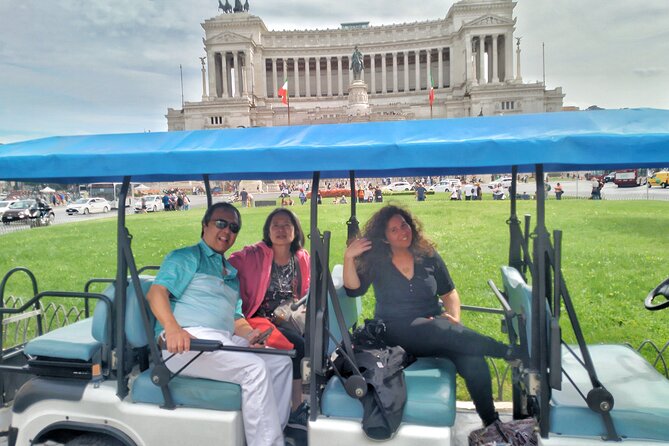
Next up you are in the orbit of Piazza Venezia. This is where you get a sense of Rome as both ancient and modern, and not just in a museum way. One side of the square is tied to the Altare della Patria, the Tomb of the Unknown Soldier, which sits within the larger Monument to Vittorio Emanuele II.
This stop is short but useful. It’s the kind of location that helps you understand the “why” behind the city’s geography. You’re also positioned for the next big move: heading toward the ancient corridors that lead you toward the Colosseum area.
If you like monuments but hate wasting time, this is a good use of minutes. You get orientation without a long detour.
Along Via dei Fori Imperiali, see the Forum corridor without the marathon
One of the smartest parts of this tour is the ride along Via dei Fori Imperiali, a straight shot connecting Piazza Venezia to the Colosseum area. The road has had different names over time, and it runs directly over parts of the Forum of Trajan, Forum of Augustus, and Forum of Nerva.
Why that matters for you: you get the “layout” feeling. You see the line Rome creates between the big imperial zones, without needing to spend hours in the field. The route also gives you sight angles from street level, which can be surprisingly informative if you’re the type who likes to map what you’ll visit later.
This is also where the electric cart shines. The alternative is often walking and crossing busy streets, then losing time to uneven sidewalks. Here, you keep moving.
Theatre of Marcellus and Circus Maximus, big-scale Rome entertainment
From the imperial road energy, the tour swings into two major “where people went to watch stuff” areas.
First is the Theatre of Marcellus, an ancient open-air theatre built in the late Republican era. The big takeaway is simple: locals and visitors came here for drama and song. It’s not just ruins for ruins’ sake. It’s a reminder that ancient Rome was built around public entertainment.
Then comes Circus Maximus, the famous chariot-racing stadium and mass entertainment venue. It sat in the valley between the Aventine and Palatine hills and was the first and largest of its kind in Rome.
These stops are valuable because they broaden the usual Colosseum-only story. If you only think of Rome as gladiators, you’ll miss how much of the city’s ancient life revolved around public spectacles.
More Lazio bottles opened near Rome:

Giardino degli Aranci on the Aventine, Rome’s rooftop view
Now you get the shift you came for: a viewpoint break. Giardino degli Aranci on the Aventine hill is one of those places where you can finally breathe and look out over the city rooftops. You’ll get a fantastic view while up on the hill, and it feels like Rome slows down around you.
This is also a smart placement in the tour. After a run of monuments and ancient structures, the hill gives you visual relief. It helps photos too, because the horizon opens up and the light hits differently than it does down at street level.
Victory arches and the Constantine connection
You also get a close look at Roman victory arches that still stand in Rome. The tour ties this stop to Constantine the Great, connected with the arch associated with him, and the larger historical shift of Christianity gaining power in Rome.
This kind of stop is a good fit for a cart tour because you can get the meaning without adding a bunch of extra walking. It’s a quick, story-driven angle, not just a “look at this rock” moment.
Colosseum and the big amphitheater, what you see and what you do not
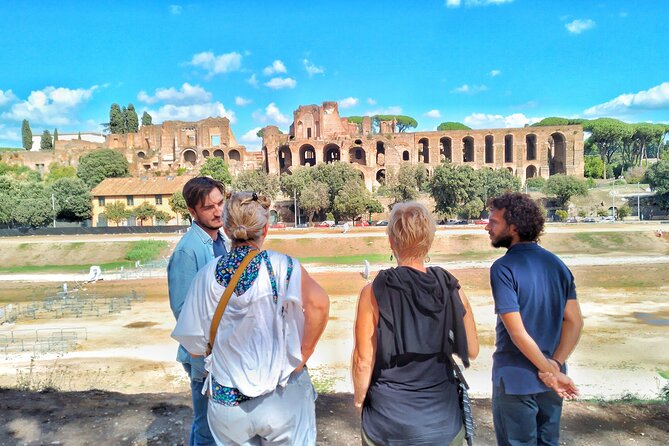
No Rome “highlights” loop is complete without the Colosseum area. This tour brings you to the iconic Flavian amphitheater for an external look. The gladiator connection is the obvious headline, but your guide can also frame it as the place emperors used to win over the people.
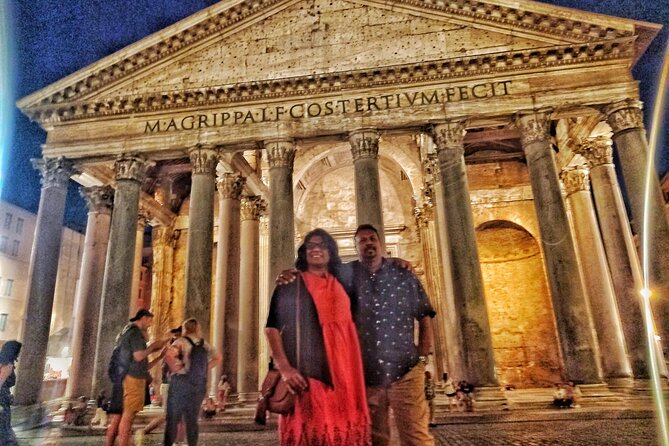
Here’s the key detail to understand up front: Colosseum admission is not included, and Roman Forum and Pantheon entry are also not included in this format. You’re seeing the sites from the outside, which is great for orientation and great for photos, but it’s not the same as going inside the amphitheater or walking through the Forum at your own pace.
If your dream is to get tickets and linger, you might pair this with a separate timed-entry visit later. If your dream is to see the skyline of Rome’s classics and get the context, this cart stop nails it.
Also, one practical reminder: road noise can make it hard to hear your guide at times, since you’re outside and moving through traffic.
The stop tied to Rome’s first condominium idea
The tour also includes a quick look at a site described as the first condominium in the world from ancient Rome. The framing here is interesting because it moves beyond emperors, temples, and battles. It points you toward everyday Roman life and how housing worked in the ancient world.
Because the time at each spot is short, you won’t get a full excavation lesson. But you will leave with a prompt to read more or visit a related area later, which is exactly what you want on a highlights tour.
Aventine hill walking time, away from the loudest streets
After the rooftop view, you’re given time at Monte Aventino, often spelled on tours as Aventine. This area is still known for being a more pleasant walk away from the noise of the modern city below.
Even with a cart, it helps to have at least some foot time here. You get different perspectives, and it also gives you a small reset before the gelato and the later church stop.
Gelato break at Gelateria La Romana dal 1947
Then comes the part you’ll remember after the photos are sorted: gelato. This tour includes a tasting at Gelateria La Romana dal 1947, featuring a recipe said to be from 1947.
This is not just a random sweet stop. It’s timed as a natural pause after ancient-heavy stops, so you feel human again. If you care about authenticity, this is a good move because it’s a long-running gelateria, not a generic “shop that happens to sell gelato.”
Practical tip: eat slowly enough to taste the differences, but don’t overdo it right before the next walking moments. Rome heat can be real, even when the rest of the city looks perfect in photos.
Piazza in Campo Marzio, an easy wander through Rome layers
Later, you head to Campo Marzio for time in the historic center. This area is known for a mix of ancient ruins, Baroque squares, and Renaissance palaces. The vibe is ideal for a short “walk and look” segment, especially after sitting in the cart for most of the first half.
If you love wandering, you’ll enjoy the way this stop encourages light strolling. You’ll have a chance to spot the contrast between eras without needing to plan a full day around it.
Keep your expectations realistic: this is a sampling stop, not a long self-guided museum day. But it sets you up to choose what you return to.
Basilica di Santa Maria Maggiore and the art you can actually see
Your tour ends with Basilica di Santa Maria Maggiore. This is one of Rome’s major churches, and the highlights you’ll want to focus on are the mosaics, the rich chapels, and the sacred relic tied to Christ’s crib.
Church time can vary by day, based on crowd levels and what is open. Still, for a short stop, it’s a meaningful finale because it gives you a different kind of Rome than the ancient street-and-stadium route earlier in the day.
If you like your Rome with a mix of faith, art, and historical symbolism, this church stop lands well.
Guide style matters, and the names you might get
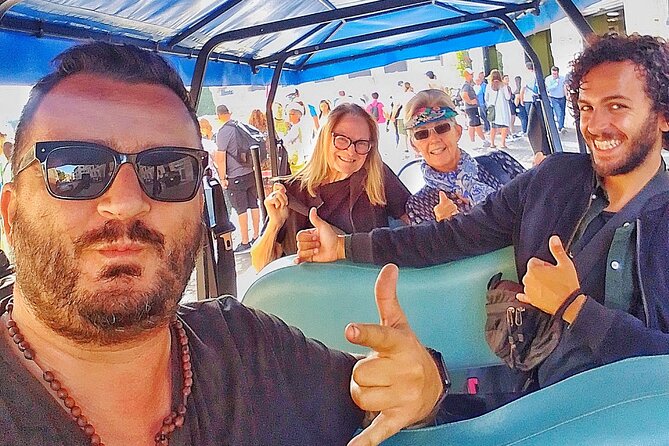
A big reason this tour scores so high is the guide. You might ride with guides such as Cristian, Matteo, Alex, or Stephen, depending on your date. Names aside, the common thread is pacing and storytelling: the guide helps connect what you see to how Rome worked.
It also helps that the tour often runs with an English-speaking local guide, and in some cases Russian or Spanish is also available. If you want to ask practical questions, like where to eat near the sights later, this is the part where that pays off.
Is the price fair for what you get?
At $115.16 per person for about 3 hours, you are paying for three main things: privacy, convenience, and included experiences.
You get a private format, so there’s no “half your group disappeared” problem. You get the electric cart, which saves energy and time in a city where streets and hills can slow you down fast. And you get included gelato tasting, plus the guide’s help with best restaurant suggestions.
The main value trade-off is access. This is not a ticket tour. Colosseum, Roman Forum, and Pantheon entry are not included, and you should plan on seeing the Colosseum externally in this experience. If you want to go inside, you’ll likely book that separately.
That said, many people use this tour as the day that makes all later visits easier. You learn the geography, you learn what matters most to you, and then you choose your next stops with confidence.
Who should book this VIP cart tour?
This is a great fit if:
- You want a first-day orientation without burning your legs
- You have limited time and want the main “Rome classics” in one outing
- You want a smoother pace than long walking tours
- You appreciate a mix of ancient landmarks and scenic viewpoints
- You need wheelchair-friendly support, since the tour is designed to be suitable for wheelchairs
It may be less ideal if:
- You specifically want to enter the Colosseum, Roman Forum, or Pantheon as part of the same tour
- You rely on quieter, more sheltered guiding conditions, since outdoor traffic noise can sometimes be a factor when you’re listening while moving
Should you book this Rome VIP golf cart tour?
I’d book it if you want Rome to feel manageable on day one. The combination of electric cart comfort, a private local guide, and a clean route that hits Trevi, major ancient areas, the Aventine viewpoints, and a standout gelato stop is a strong value for many visitors.
Before you book, be clear about your priorities. If going inside the big sites is your top goal, plan timed-entry tickets separately. If your top goal is getting oriented, seeing the right areas, and finishing with a memorable church and gelato moment, this tour does exactly that.
Also, try to book early if you can. This experience tends to get scheduled about 66 days in advance on average, which hints at steady demand.
FAQ
How long is the private VIP golf cart tour?
It runs for about 3 hours.
Is this tour private?
Yes. It is a private tour/activity, and only your group participates.
Do I need tickets to enter the Colosseum and Roman Forum?
No. Admission to the Colosseum, Roman Forum, and Pantheon is not included. The Colosseum is listed as an external view only.
What’s included during the tour?
The tour includes hotel pickup and drop-off when available (based on the hotel list and ZTL limits), a local guide/driver, electric golf cart, insurance, restaurant suggestions, and a gelato tasting at Gelateria La Romana dal 1947. It also includes snacks as part of the gelato experience.
Where does pickup happen if I am staying in the center of Rome?
Pickup is only possible in a way that fits the rules for the central restricted traffic zone. The details say there is no pickup outside the ZTL zone, and no pickup outside the hotel list because golf carts cannot leave the restricted traffic zone. You are asked to request pickup at least 24 hours before.
Is the tour wheelchair friendly?
Yes. The experience is wheelchair friendly, and this should be communicated at booking.
What happens if the weather is poor?
The experience requires good weather. If it’s canceled due to poor weather, you’ll be offered a different date or a full refund.
What languages does the guide speak?
The tour lists a local guide/driver who can speak English, and also Russian and Spanish.
Latest additions from Rome
- Guided Tour Vatican Museums & Sistine Chapel★ 4.1 · 30 reviews
- Exclusive Rome by Night Vespa Tour★ 5.0 · 30 reviews
- Vatican: St.Peter’s Basilica & Dome – Reserved Entry & Tour★ 4.1 · 30 reviews
- Transfer Rome to Airports★ 4.5 · 30 reviews
- Rome street art tour: off the beaten path with a local guide★ 5.0 · 30 reviews
- Tivoli, Hadrians Villa and Villa d’Este, a charming day trip from Rome★ 4.5 · 30 reviews
- Rome Food Tasting with Wine Pairing Italian Authentic Flavors★ 5.0 · 31 reviews
- Inspirational Cooking on the Roman Chef’s Panoramic Terrace★ 5.0 · 30 reviews
VIP, compared.
Colosseum Arena, Roman Forum & Palatine Hill VIP Tour
Read our review →
Rome Catacombs & Capuchin Crypts VIP Group Tour with Transfers
Read our review →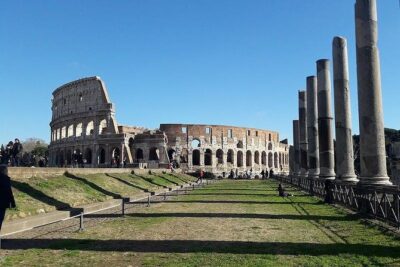
Private Rome WOW Tour in 1 Day: Luxury Car, Guide, Tkts & Lunch!
Read our review →
Rome Fiumicino Airport Transfer in Luxury Private Transportation
Read our review →
VIP Colosseum Underground and Ancient Rome Small Group Tour
Read our review →
Luxury Private Full-Day Rome Tour from Civitavecchia Port
Read our review →
Luxury Private Transfer Rome from /to Civitavecchia Port
Read our review →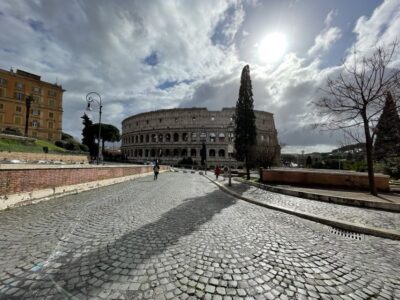
Colosseum: Semi Private Tour with VIP Arena Access
Read our review →Browse the lists this tour appears in