
Reviewed · ROME IN A DAY TOURS
E-Tuk Tour Express Highlights of Rome
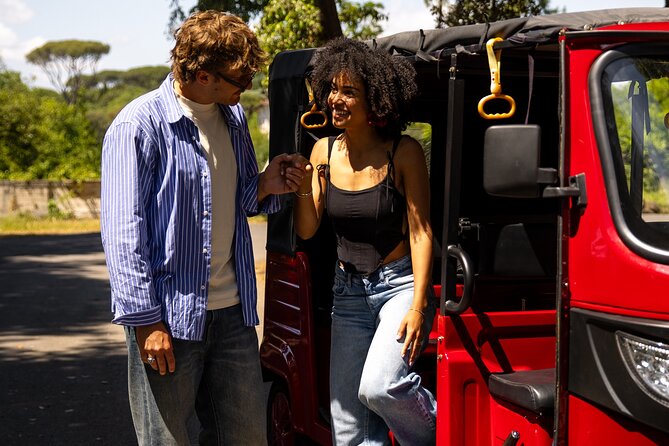
Seven Roman icons, one short ride. This e-tuk tour strings together the Spanish Steps, Trevi Fountain, and the Pantheon, then keeps going with several more big names, all with an English-speaking driver/guide and stops timed for a fast, manageable circuit. I like that it trades long walks for quick rolling views and photo stops at major landmarks. My one real caution is the Italian child safety seat rule, which can affect families traveling with toddlers.
If you want to see a lot of the classic center without exhausting yourself, this is built for you. It’s also handy if you’d rather listen, look, and move on than stand in long lines and shuffle at your own pace all day.
The route starts and ends back at Piazza del Popolo, and the whole thing runs about 1 hour 30 minutes with small groups (up to 15 people). You’ll also have the option of audio guides if they’re available, plus headsets can be provided so the narration does not get lost in the crowd.
In This Review
- Key things to know before you go
- Getting oriented at Piazza del Popolo
- Why the e-tuk format beats a marathon walk
- Spanish Steps, fast context at Piazza di Spagna
- Trevi Fountain, Baroque spectacle and coin-toss tradition
- Pantheon, the dome and oculus moment
- Piazza Navona and Fontana dei Quattro Fiumi
- Teatro di Marcello, arches from the Roman era
- Colosseum and the Roman Forum area without the grind
- Circo Massimo, the chariot-racing arena scale
- What you actually hear: headsets, English guiding, and audio on request
- Price and value at $72.23 for 90 minutes
- Safety seat reality check for toddlers and families
- Who this Rome e-tuk tour suits best
- Should you book this E-Tuk Highlights of Rome tour?
- FAQ
- Where does the E-Tuk Tour Express Highlights of Rome start?
- How long is the tour?
- How much does the tour cost?
- Is the tour offered in English?
- Is this tour good for people who prefer less walking?
- Are admission tickets included for the stops?
- Does the tour include audio or headsets?
- How many people are in the group?
- Do I need a mobile ticket?
- What’s the rule about child seats for toddlers?
Key things to know before you go
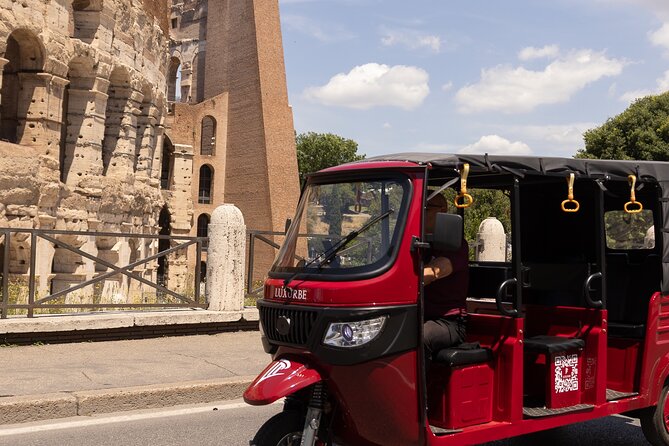
- Short, efficient stops: each landmark is about 10 minutes, with travel time filling the gaps.
- English-led narration: you travel with an English driver/guide, not a self-guided audio scavenger hunt.
- Headsets may be provided: helpful in noisy streets so you actually catch the commentary.
- Photo stops at main sights: the tour aims to get you pictures without you sprinting.
- Max 15 travelers: a size that feels more personal than big-bus herds.
- Child safety seat rule applies: children under 3 years old or below 15 kg need an appropriate car seat by law.
Getting oriented at Piazza del Popolo
The tour begins at Piazza del Popolo, right at Piazza del Popolo 11 in central Rome. This is a good launch spot because it puts you on familiar ground for getting around the historic core, and it also makes it simpler to plan your day on either side of the tour.
You’ll meet up with a small group, and then the e-tuk route starts moving. The operator Luxurbe keeps things simple with a mobile ticket, and you’ll receive confirmation at booking time. The activity also lists that it’s near public transportation, which matters if you’re building the rest of your Rome day before or after.
A small but important detail: this is designed to minimize walking. That does not mean you never walk at all, but it does mean you are not doing a full-day foot tour while carrying everything. For first-time visitors, it can also help you get the city’s layout into your head fast.
More Rome in a Day Tours
- Rome in a Day Group Tour with Vatican Museums and Colosseum
★ 4.5 · 2,450 reviews - Rome Highlights by Golf Cart Private Tour
★ 5.0 · 2,379 reviews - Best of Rome Walking Tour including Trevi Fountain
★ 4.5 · 923 reviews - Golf Cart Small-Group Guided Tour: Rome City Highlights
★ 5.0 · 907 reviews
Why the e-tuk format beats a marathon walk
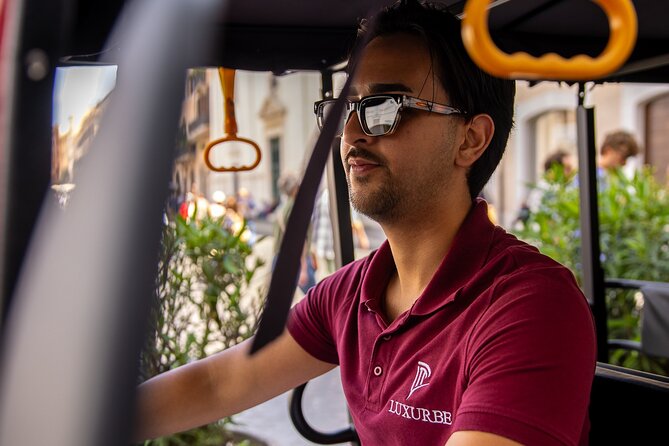
Rome is gorgeous, but your feet can get a vote. This tour is a clean answer to that problem: you cover multiple headline sites in a short window without doing a long slog between each stop.
The e-tuk does two things well. First, it keeps the pace moving so you spend more time seeing and less time routing yourself. Second, it helps you move as a group, so you do not lose time while regrouping at random intersections.
And then there is the listening factor. The tour highlights headsets as something that can be provided. If you’ve ever tried to hear a guide over fountains, street noise, and traffic rumble, you know that ability to actually hear the story matters. Optional audio guides are also mentioned as available upon request, so the plan is set up to support multiple ways of listening.
The tradeoff is time. Every stop is short, so you get the main idea and key visuals, but not hours in each monument. Think of it as a guided whirlwind with breaks.
Spanish Steps, fast context at Piazza di Spagna
Stop one is the Spanish Steps, a famous Baroque landmark built in 1725 that connects Piazza di Spagna to the Trinità dei Monti church. You’re there for about 10 minutes, and that is enough time to absorb what they are and why people care.
Here’s what makes this stop useful on a tour like this. The Spanish Steps are not just a photo spot. They are a visual link between two major points in the area, and understanding that connection makes the rest of your day easier. You also get the scale: they’re known for 135 elegant steps, so you can immediately picture why they are such a natural gathering place.
A practical tip for your comfort: treat the Spanish Steps stop as a chance to get steady photos and a quick understanding, then move on. If you linger too long, you will feel it later because the rest of the schedule stays tight.
Trevi Fountain, Baroque spectacle and coin-toss tradition
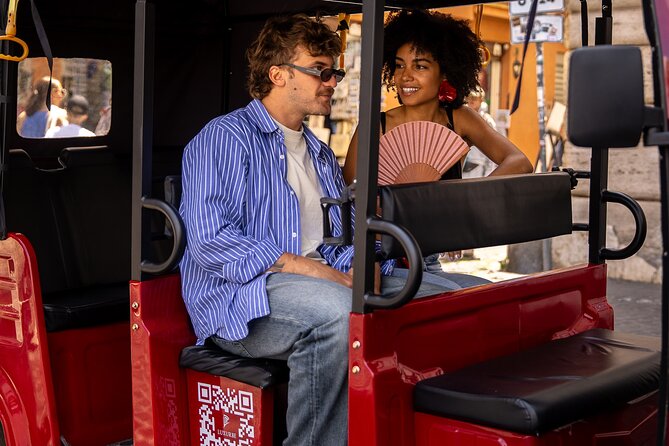
Next up is the Trevi Fountain, which the tour describes as a Baroque masterpiece with mythical sculptures. The highlight here is the grandeur: the chariot of Neptune and the surrounding sculptures create a sight so famous it needs less explanation.
You’re there for about 10 minutes, and that time is meant for a look, a listen, and a few photos. One reason the Trevi Fountain works on a short guided stop is that the spectacle is basically self-explanatory once you know what to watch for, especially the Neptune chariot and the overall sculpted group.
The tour also points out the sound of flowing water and the tradition of tossing coins and making wishes. Even if you do not plan to toss one, knowing the ritual helps you understand why crowds cluster exactly there, not just around the building in general.
A realism note: because it’s Trevi, it can be crowded. The e-tuk format helps because you are not walking a long distance through the busiest lanes to reach it. But within the fountain area, you still need to handle the crush politely and keep your movement smooth.
Pantheon, the dome and oculus moment
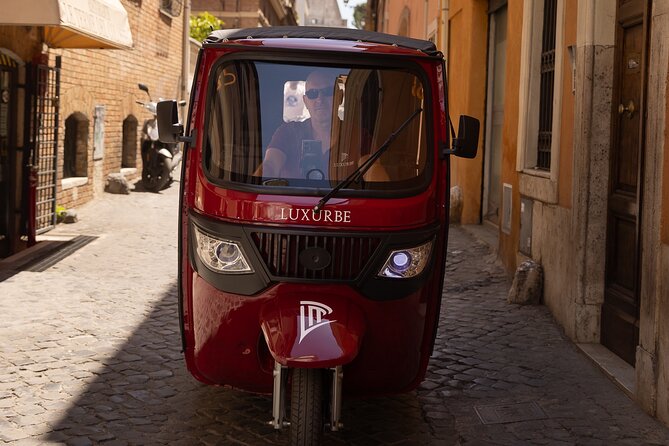
After Trevi, you head to the Pantheon, described as a marvel of ancient engineering. This is the kind of stop where, even in a short time, the big details can hit you hard: the iconic dome and the oculus create that open, sky-view feeling that makes people slow down.
The tour frames the Pantheon as more than a pretty building. It was originally a temple dedicated to all gods, and the interior is known for well-preserved marble and artistic details. Even if you only spend a brief window here, those facts turn the visit from I saw it to I understand why it matters.
With a 10-minute stop, you are not going to soak in every square foot. But you can still do something valuable: look for the dome, then take a moment to spot how the opening draws your eye upward. That simple sequence is the fastest way to get the full impact of the Pantheon in a time-boxed tour.
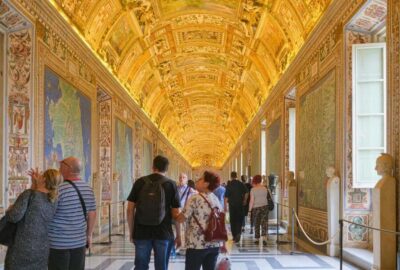
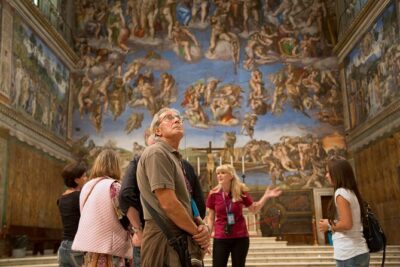
Another shape for the same afternoon in Rome:
Piazza Navona and Fontana dei Quattro Fiumi
Stop four is Piazza Navona, a well-known square recognized for its Baroque elegance. The centerpiece mentioned here is the Fontana dei Quattro Fiumi, plus the square is surrounded by cafes and has the feel of a cultural hub.
This stop works well in the middle of the circuit because Piazza Navona gives you a change of pace. You shift from individual icons to a broader square setting. It’s also an easy area to take a few photos while you stand in one spot. That matters because the tour keeps each stop timed around 10 minutes.
What I like about this stop on the e-tuk format is the social context. You can see why people hang around squares in Rome, not just why they check off buildings. Even if you do not plan to sit down for coffee, you get the “why here” of the space.
Teatro di Marcello, arches from the Roman era
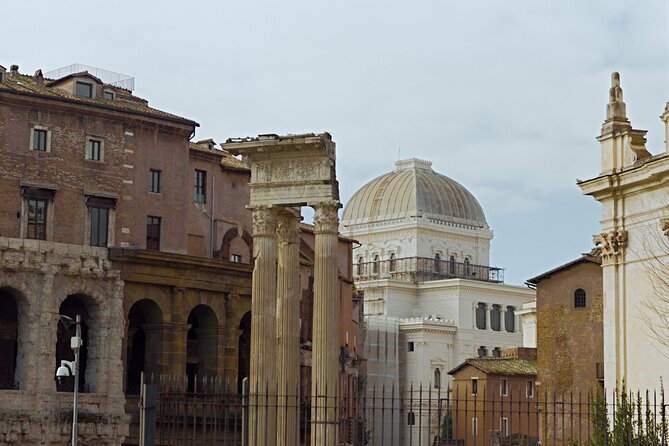
Next you visit the Teatro di Marcello, built in 13 BC, commissioned by Augustus. This stop is described as an ancient open-air theater that once hosted plays and music, with arches and grandeur still visible today.
This is a nice break from the most famous names. The Colosseum and Pantheon get a lot of attention, but Teatro di Marcello gives you a sense of everyday spectacle in Roman life, but in a quieter, more textured way.
With only about 10 minutes, your goal here is to see the structure clearly. Focus on the arches and the scale that still comes through, even after centuries. If you are someone who likes architecture more than crowds, this is often the kind of stop that surprises you in a good way.
Colosseum and the Roman Forum area without the grind

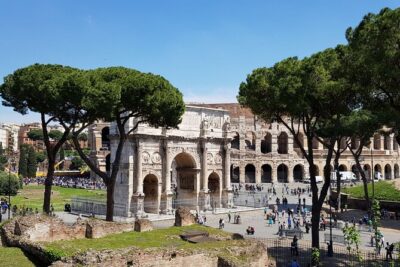
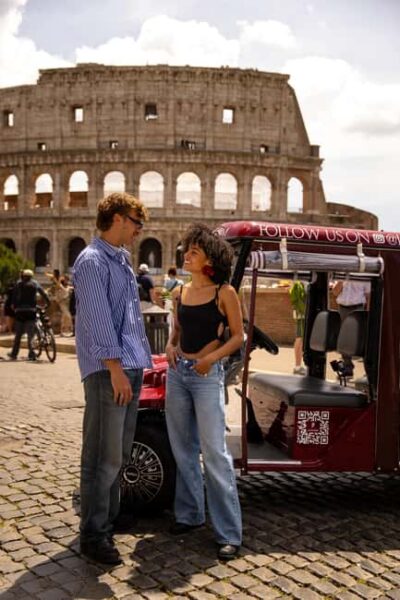
Then comes the big one: the Colosseum. The tour describes it as an iconic Roman amphitheater that hosted gladiator games and events. It also points out that the Roman Forum is nearby, with ruins of temples, basilicas, and public spaces.
In a short tour format, the Colosseum stop is more about getting oriented than doing a deep dive. Ten minutes is not meant for an entire slow exploration of every corner. Still, it’s enough time to understand the site’s role as a centerpiece of ancient public entertainment.
The Roman Forum mention matters too. If you connect the dots between the Colosseum as a stadium and the Forum as the heart of ancient Rome, your photos start making more sense. You’re not just capturing a landmark. You’re capturing a relationship between sites.
Practical note: if you want a calmer visit inside, this might not be the best way to do that. But if your goal is to see the main landmarks efficiently, this is exactly where the e-tuk earns its keep.
Circo Massimo, the chariot-racing arena scale
Stop seven is Circo Massimo, the ancient chariot racing stadium. The tour states it could hold over 250,000 spectators and was built in the 6th century BC. It’s also described as still a venue for public events today.
This stop can be a real mental reset after the tight-feeling architecture of some other sights. Circo Massimo is all about scale. Even in a brief window, you can grasp the idea of huge crowds gathered for chariot racing, and you get another example of Roman engineering shown in a different style than theaters or amphitheaters.
If you like Roman history explained in plain visuals, Circo Massimo is a strong closer. It helps round out the picture of what Romans gathered to watch, not just what they built to worship.
What you actually hear: headsets, English guiding, and audio on request
This tour leans into narration. It’s offered in English, and it includes an English-speaking driver/guide. That is a huge comfort factor if you want context without guessing what you’re looking at.
Headsets are highlighted as something that can be provided. That sounds small, but it can change the whole experience. When you can clearly hear your guide, you stop treating the tour like transportation and start treating it like a lesson.
Audio guides can be provided upon request, if available. That means you have an option depending on how you like to listen. If you want quiet while still having guidance, you can use the system in that way. If you want live commentary, you can focus on the guide.
The overall feel is meant to be approachable. “Highlights” is the word for a reason. You’re not getting everything. You’re getting the parts that make the rest of the city make sense.
Price and value at $72.23 for 90 minutes
At $72.23 per person for about 1 hour 30 minutes, you’re paying for guided transport by electric e-tuk plus curated photo stops. The itinerary lists each stop with admission ticket free, so you’re not likely paying separate entry fees for these specific sights.
What makes the math work is that you cover a lot of major names in a tight window. You’re essentially buying time and guidance: less walking, clearer context, and a smooth route between sites that are far enough apart to feel annoying on foot.
Whoever this tour is best for is the person who values efficiency. If you want to linger inside museums or chase side streets for hours, you’ll feel rushed here. But if you want a strong first-pass introduction to the classics, it’s a fair price for what it delivers.
Also, note the group size: max 15 travelers. Smaller groups usually mean you get more attention and fewer delays.
Safety seat reality check for toddlers and families
One of the most important considerations here is safety, especially for families. Italian road safety laws prohibit transporting children under 3 years old, or below 15 kg, without an appropriate child safety seat. The tour provider’s response to a customer issue made that legal rule very clear.
So here’s my practical advice for you: if you’re traveling with a toddler, confirm the child seat situation before you show up. If you do not have a seat, you may be turned away, even if the tour sounds like it fits your family’s mobility needs.
This is one area where policies need to be crystal clear. And if you are relying on this tour to avoid walking, it’s worth treating child-safety logistics as the first step, not an afterthought.
Who this Rome e-tuk tour suits best
This tour is a good fit if you:
- Want to see the Spanish Steps, Trevi Fountain, and the Pantheon without a long walking day
- Prefer short guided stops over long self-guided wandering
- Like having an English guide connect what you see to what it means
- Travel with limited mobility, since the plan is built for less walking
- Enjoy photo stops at main landmarks and want help getting “I was there” shots
It might be less ideal if you:
- Want a long, slow, inside-the-monument experience at each stop
- Hate crowds and need quiet time to appreciate landmarks
- Are traveling with a young child and cannot bring or arrange a child safety seat
Should you book this E-Tuk Highlights of Rome tour?
I think this is a solid choice when your priority is efficiency plus guided context. You get a concentrated sweep of Rome’s top icons in about 1.5 hours, led in English, with the option of headsets and audio support.
But I’d only book if you can handle two realities. First, each stop is brief, so it’s highlights, not deep study. Second, if you’re bringing a toddler, treat the child safety seat rule as a deal-breaker checklist item.
If that fits your travel style, you’ll probably appreciate how the e-tuk helps you get your bearings fast, without turning Rome into a walking test.
FAQ
Where does the E-Tuk Tour Express Highlights of Rome start?
It starts at Piazza del Popolo, 11, 00187 Roma RM, Italy. The activity ends back at the meeting point.
How long is the tour?
The duration is approximately 1 hour 30 minutes.
How much does the tour cost?
The price is $72.23 per person.
Is the tour offered in English?
Yes. The tour is offered in English.
Is this tour good for people who prefer less walking?
Yes. The tour is described as perfect for those less mobile or who prefer less walking.
Are admission tickets included for the stops?
The tour notes indicate admission ticket free for each listed stop. At the same time, the tour’s included list says entrance tickets to monuments and attractions are not included. Based on the itinerary, you likely will not need paid tickets for these specific stops.
Does the tour include audio or headsets?
Headsets can be provided. Audio guides are provided upon request, if available.
How many people are in the group?
The tour has a maximum of 15 travelers.
Do I need a mobile ticket?
Yes. It’s listed as including a mobile ticket.
What’s the rule about child seats for toddlers?
Italian road safety laws require children under 3 years old, or below 15 kg, to be transported in an appropriate child safety seat. The tour provider indicated this rule applies and is enforced for safety.
Latest additions from Rome
- Rome: Testaccio Market Food Tour with Street Food & Wine★ 5.0 · 8 reviews
- Exclusive Pasta & Tiramisu Class with Wine near by Colosseum★ 5.0 · 8 reviews
- Private Professional Photoshoot in Rome★ 5.0 · 8 reviews
- Loreto “Shrine of the Holy House of the Virgin Mary” Private Tour from Rome★ 5.0 · 8 reviews
- Rome Day to discover Florence and Pisa Hotel Pickup★ 4.5 · 8 reviews
- Rome: Christmas Nativities and Angels Tour★ 3.1 · 8 reviews
- Guided Tour of Vatican Museums and Sistine Chapel★ 5.0 · 8 reviews
- Rome: Cooking Class of fresh Pasta and Tiramisu Cake★ 5.0 · 8 reviews
Rome in a Day Tours, compared.
Rome in a Day Group Tour with Vatican Museums and Colosseum
Read our review →
Rome Highlights by Golf Cart Private Tour
Read our review →
Best of Rome Walking Tour including Trevi Fountain
Read our review →
Golf Cart Small-Group Guided Tour: Rome City Highlights
Read our review →
Rome Highlights & Hidden Gems Guided Walking Tour
Read our review →Browse the lists this tour appears in