
Reviewed · ROME BY NIGHT TOURS
500 Dolce Vita Tour Rome by Night
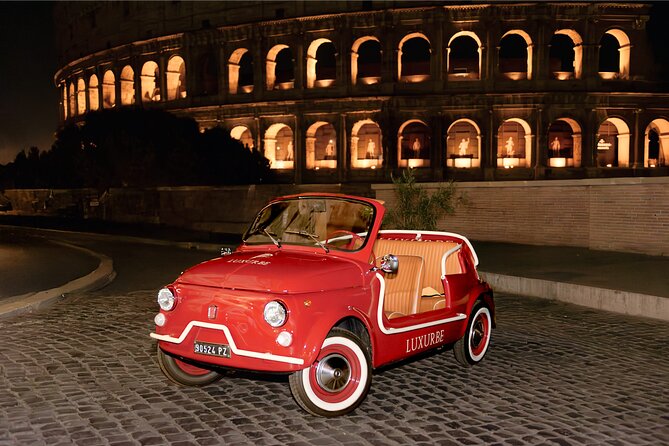
Night in Rome changes everything. This Rome by night 3-hour loop strings together the city’s top landmarks with smart photo stops, so you get the why behind the sights, not just the where. I especially like the hotel pickup option when you select it, and I like that the route is built around places with free admission listed for each stop.
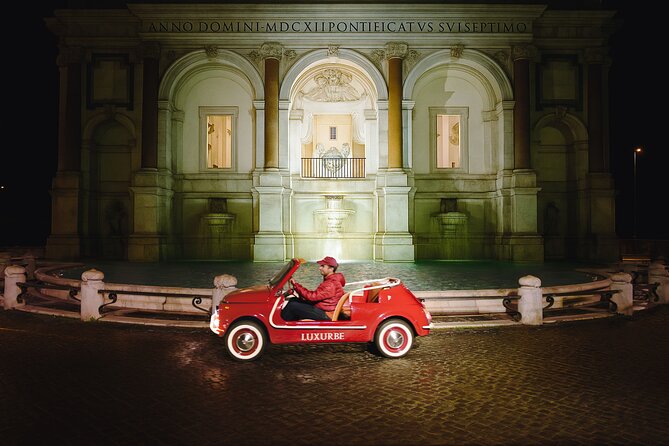
There is one thing to keep in mind: the time at each landmark is short, so you will want to pick what you want to linger on later. Also, one guide-day note from past riders says the Dolce 500 vehicle may be swapped for a golf cart if something is off, so treat the ride as flexible rather than precious.
In This Review
- Key highlights to look for
- How the 3-hour Rome by Night loop keeps your schedule sane
- Start at Piazza del Popolo, then use the night light for quick orientation
- Hotel pickup, a small group of up to 9, and why it matters
- Piazza del Popolo to Trevi Fountain: instant Rome, without the ticket hassle
- The Pantheon stop that rewards you for looking up
- Piazza Navona: where Rome’s fountains do the entertaining
- Piazza Venezia, the Altar of the Fatherland, and the Colosseum in one sweep
- The Roman neighborhoods: the Ghetto and Trastevere for a more human side
- Gianicolo viewpoint and cannon at noon, then St. Peter’s Square
- What the tour includes, and how to judge the $120.28 price
- Getting the most out of short stops without rushing
- Who this tour is best for
- Should you book the 500 Dolce Vita Tour Rome by Night?
- FAQ
- How long is the 500 Dolce Vita Tour Rome by Night?
- What is the price per person?
- What language is the guide?
- Is hotel pickup available?
- Where does the tour start and end?
- How large is the group?
- Are tickets to the sights included?
- Are there photo stops?
- Is an audio guide included?
- What is the cancellation policy?
Key highlights to look for
- Small group (up to 9), which makes photo stops and Q and A feel more natural
- English-speaking driver/guide focused on the story behind each stop
- Hotel pickup and drop-off (if selected) for a low-friction start and finish
- Mostly free sights on the route, which keeps your out-of-pocket costs sane
- Photo stops at main landmarks, not just curbside passing
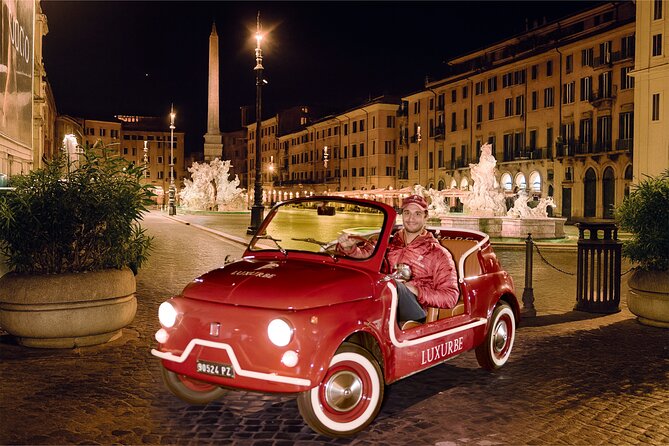
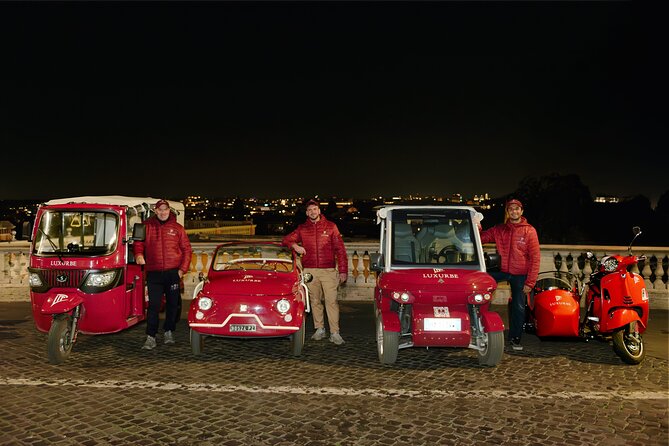
- A classic-ride vibe with a reported ability to switch vehicles if needed
How the 3-hour Rome by Night loop keeps your schedule sane
This is the kind of tour that helps when you have limited time, but still want more than a bus ride. At about three hours, you can cover major Rome north to south without spending your whole evening stuck in planning mode.
The big value is the pacing. Instead of turning one stop into an all-night project, the tour slices time across icons like Trevi Fountain, the Pantheon, Piazza Navona, and the Colosseum, plus stops that show a more local Rome like the Ghetto and Trastevere. You leave with a clearer map of where everything sits, and that makes the rest of your trip easier.
One more practical point: most of the route is listed as free admission. That matters because your money is going mostly to guiding, transport, and timing, not to ticket lines.
More of Rome after the lights come on:
- Rome: City Highlights Open-Top Bus Night Tour
★ 4.1 · 2,038 reviews - Rome: Paranormal Night Walking Tour & Secret Backstreets
★ 4.9 · 1,921 reviews - Rome by Night: E-bike Small Group Tour -Food & Wine (Option)
★ 4.9 · 1,233 reviews - Colosseum Sunset Tour with Entry
★ 4.5 · 1,230 reviews
Start at Piazza del Popolo, then use the night light for quick orientation
Your tour begins at Piazza del Popolo, right where Rome’s grand north-side arrival energy is strongest. This square was historically a main entrance for people coming from the north, and it is still a great mental starting point because you immediately see the “shape” of central Rome.
At the center is an ancient Egyptian obelisk brought to Rome by Emperor Augustus, and the twin churches framing the square give you a rare, clear symmetry. If you look toward the hill above, Pincian Hill, you also get that classic Rome “layering” effect, with viewpoints that explain why the city looks the way it does.
Time-wise, you only need a short window here to get oriented. That is the point of the first stop, and it pays off later when you see how the route threads through the city.
Hotel pickup, a small group of up to 9, and why it matters
The tour can include hotel pickup and drop-off if you select it, and pickup is described as street level outside your hotel or accommodation. That simple detail can save real time, especially in Rome where you might otherwise be walking to a meeting point while traffic and crowds steal minutes.
The group size is capped at 9 travelers, which keeps the experience from turning into a loud herding session. In a small group, the guide can slow down for questions, and you are more likely to get useful comments during those short stops.
You do not need special gear, but you do want basic nighttime comfort. Wear shoes you trust on cobblestones, and keep your phone charged, because you will want photos at multiple landmarks while the light is still good.
Piazza del Popolo to Trevi Fountain: instant Rome, without the ticket hassle
After Piazza del Popolo, the route moves to Trevi Fountain, Rome’s headline fountain and one of the world’s most famous Baroque creations. Designed by Nicola Salvi in the 18th century, it centers on Oceanus riding a shell-shaped chariot with sea horses.
Here is a useful detail for your visit: the coin ritual says you toss a coin with your right hand over your left shoulder to ensure your return to Rome. It is a tourist custom, sure, but it also tells you something about how Rome performs in public spaces, where people share traditions right in front of big monuments.
You get about 10 minutes at Trevi, which is enough for one strong photo, a quick look at details, and then to move before the crowd thickens too much. If you want a longer Trevi moment, plan to return after your tour.
The Pantheon stop that rewards you for looking up
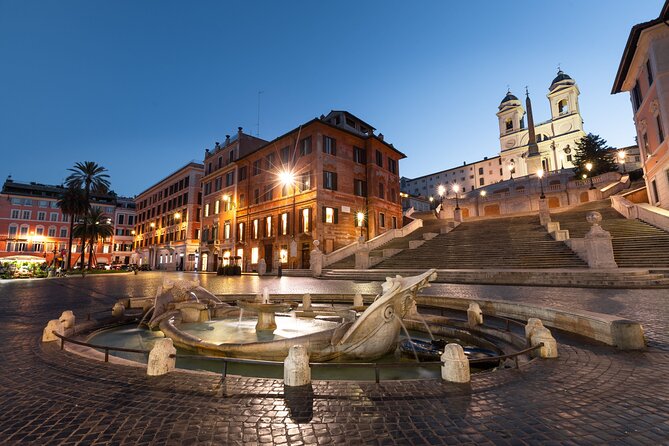
The Pantheon is ancient Rome at its most graceful and well-preserved. Built over 2,000 years ago, it started as a temple dedicated to all gods and later became a church.
The dome is the star. It is still described as the largest unreinforced concrete dome in the world, and the central oculus opens to the sky. In evening light, the interior often feels dramatic because the roof hole lets daylight do the work.
This is a stop where you can use your time well. Spend a moment noticing the dome, then rotate your gaze slowly through the interior. Even in a short stop, the Pantheon gives you a “wow” that does not require extra tickets or museum detours.
More of Rome once the piazzas fill:
Piazza Navona: where Rome’s fountains do the entertaining
Piazza Navona is built on the old Stadium of Domitian, so you are standing in a place that has hosted crowds for a very long time. The square is famous for three fountains, including the Fountain of the Four Rivers by Gian Lorenzo Bernini.
That fountain is worth your attention because it represents the four major rivers of the known continents at the time. It is also a good example of how Baroque art turns city space into theatre.
You get a brief stop here, around 5 minutes. Treat it like a quick visit to a stage: one look at the fountains, one look at the surrounding buildings, then move on. If you later want a longer pause with a drink at a café, you will know exactly where you want to sit because you have already seen the layout.
Piazza Venezia, the Altar of the Fatherland, and the Colosseum in one sweep
Piazza Venezia can feel like Rome at full volume. It sits at the intersection of major roads and is dominated by the grand Vittorio Emanuele II Monument, commonly called the Altar of the Fatherland. This is Italy’s big national monument moment, and it is a useful counterweight to the ancient sites on the route.
Also in the area is Palazzo Venezia, which once served as a papal residence and later became Mussolini’s World War II headquarters. That mix of roles in one spot helps you understand how power changes form in Rome, but the city’s central stage stays the same.
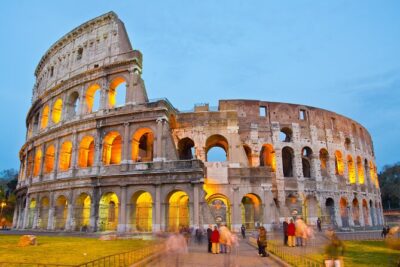
Then comes the Colosseum, Rome’s icon and one of the engineering marvels of the ancient world. Built in the 1st century AD, it was the largest amphitheater ever constructed, holding over 50,000 spectators for gladiator battles, animal hunts, and public spectacles.
You have about 10 minutes here. That is not enough to explore every angle like you would on a longer, ticket-focused visit, but it is perfect for getting your bearings. Look at the outer scale first, then check how the building sits in the modern city. That contrast is the lesson.
The Roman neighborhoods: the Ghetto and Trastevere for a more human side
Not every Roman night tour includes neighborhood time, but this one does, and that is a big reason it feels different. After the main monuments, you move toward the Ghetto, a historic area with deep Jewish heritage.
You will see the synagogue area and traditional shops, plus a mix of historical traces including ancient Roman ruins. It is a reminder that Rome is not only emperors and churches. It is also everyday life, community, and survival through centuries.
Time is around 15 minutes here, which is long enough for a small stroll, a few photos, and a sense of how the streets feel. Keep your eyes open for details, but do not expect it to feel like a museum. This is a neighborhood.
Then the route finishes with Trastevere. You get about 10 minutes, and the focus is on the atmosphere: narrow alleys, cobblestone streets, and lively squares. It is one of Rome’s most popular places for a reason, but your best move is not to treat it like a checklist. Instead, walk a few steps off the busiest path and enjoy the small views that pop between buildings.
Gianicolo viewpoint and cannon at noon, then St. Peter’s Square
Colle del Gianicolo is one of Rome’s higher hills, which means better city views. It is also tied to Italian unification, including battles led by Giuseppe Garibaldi. If you have ever wondered why Rome looks so layered and angled, a viewpoint like this is the answer.
There is also a tradition connected to the hill. Every day at noon, a cannon is fired from Gianicolo. The practice started in 1847 under Pope Pius IX to standardize the city’s clocks. Even if your tour is at night and you miss the cannon moment, the story helps you understand why locals tie the hill to daily timekeeping.
After that, you reach St. Peter’s Square, the ceremonial heart of Vatican City. Bernini’s design uses colonnades arranged like embracing arms in a semicircle. In the center is an Egyptian obelisk with fountains on either side.
This stop also points you toward St. Peter’s Basilica, where masterpieces like Michelangelo’s Pietà are housed and where the dome is associated with Michelangelo. The square is less about quiet contemplation and more about scale and symbolism, and it works well as a night finale because everything feels bigger in the evening.
What the tour includes, and how to judge the $120.28 price
The price listed is $120.28 per person for about 3 hours. On paper, that is not cheap for a short evening. But when you look at what is included, the value starts to make sense.
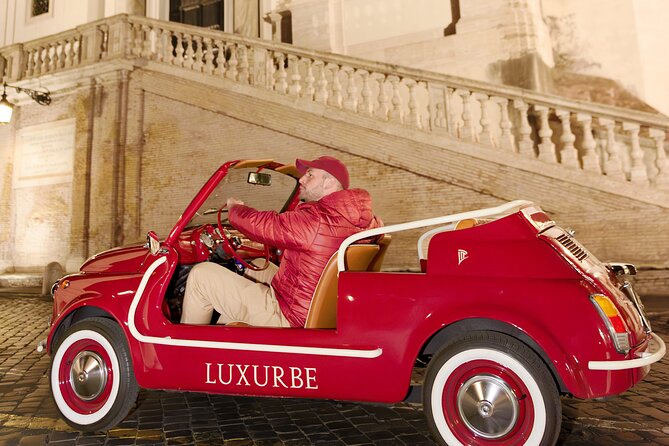
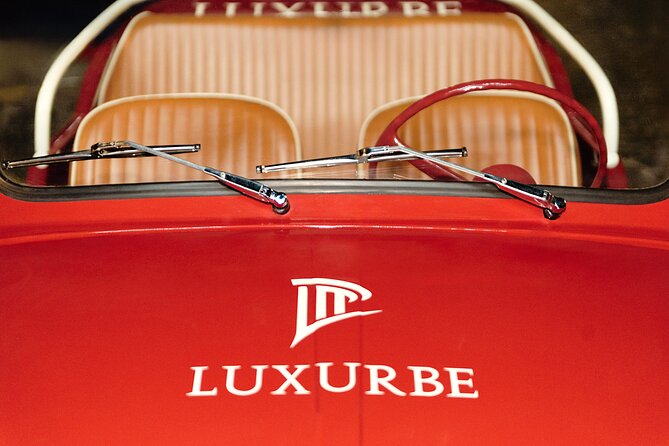
You get a guided sightseeing experience by 500 Spiaggina with an English-speaking driver/guide, plus photo stops at the main landmarks. You also get a mobile ticket. If you choose pickup, you get hotel pickup and drop-off.
Audio guides are described as available upon request if they are offered. That is useful if you want more self-paced listening without relying only on the live guide.
Now the spending side: entrance tickets to monuments and attractions are listed as not included. However, the route stops themselves are marked as free admission for the itinerary. So in practice, you are not paying extra ticket fees just to see the planned stops. You are paying for transport, timing, and the guide’s pacing.
My take: this is good value if you want to connect the dots between ancient Rome, Baroque Rome, and local neighborhoods in one go. It is less of a bargain if you are already planning to spend most evenings wandering the same central zones by yourself and you do not care much about the stories.
Getting the most out of short stops without rushing
Because each landmark is timed, your job is to move with intention. Here is how I would optimize the experience.
First, decide what “good” looks like for each stop. For Trevi Fountain, it is the fountain and the coin ritual spot. For the Pantheon, it is the dome and oculus view. For the Colosseum, it is scale and exterior lines.
Second, use the guide’s photo stops. When the guide pauses you at the right angle, do not treat it as an interruption. It is the moment that prevents you from taking 10 blurry shots and calling it a day.
Third, pack patience for crowd energy. Rome’s big sights pull in people at all hours, and at Trevi and the Pantheon you will feel it. Short time stops keep the tour efficient, but you will still want to stay calm, move with the group, and let your photos happen during the pause.
Who this tour is best for
This 500 Dolce Vita Rome by Night tour fits best if you are a first-timer, a returner who wants a tighter overview, or anyone trying to make limited time feel richer.
It is also a strong choice if you want guided context without committing to long museum time. You still get the big names: Piazza del Popolo, Trevi Fountain, the Pantheon, Piazza Navona, Piazza Venezia, the Colosseum, the Ghetto, the Gianicolo viewpoint, St. Peter’s Square, and Trastevere.
If you love slow wandering and you already know you will spend 45 to 90 minutes per site, you may want a ticket-focused plan for your key monument days instead. This tour is about stitching together a full “Rome at night” picture.
Should you book the 500 Dolce Vita Tour Rome by Night?
I would book it if you want an efficient evening that covers Rome’s greatest hits plus a couple neighborhood textures, and you like getting story context from an English guide. It is especially appealing because the itinerary is built around stops that are listed as free admission, so the tour fee is mostly buying your route, your timing, and your guiding.
I would skip it if you already have your heart set on deep, long visits at one or two monuments. In that case, you might get more satisfaction spending your time and money on a smaller number of ticketed sites.
If you are somewhere in the middle, book it. It is the kind of night tour that helps you return to Rome’s streets later with a better sense of direction and meaning.
FAQ
How long is the 500 Dolce Vita Tour Rome by Night?
The tour lasts about 3 hours.
What is the price per person?
The price is $120.28 per person.
What language is the guide?
The tour is offered in English, with an English-speaking driver or guide.
Is hotel pickup available?
Pickup is offered if selected. Guests should wait outside the main entrance of their hotel or accommodation at street level.
Where does the tour start and end?
It starts at Piazza del Popolo, 11, 00187 Roma RM, Italy, and it ends back at the meeting point.
How large is the group?
The tour has a maximum of 9 travelers.
Are tickets to the sights included?
Entrance tickets to monuments and attractions are not included. The itinerary sights listed are marked as having free admission.
Are there photo stops?
Yes. Photo stops at the main landmarks are included.
Is an audio guide included?
Audio guides are provided upon request, if available.
What is the cancellation policy?
Cancellation is free. You can cancel up to 24 hours in advance for a full refund. If you cancel less than 24 hours before the start time, the amount paid is not refunded.
Latest additions from Rome
- Rome: Testaccio Market Food Tour with Street Food & Wine★ 5.0 · 8 reviews
- Exclusive Pasta & Tiramisu Class with Wine near by Colosseum★ 5.0 · 8 reviews
- Private Professional Photoshoot in Rome★ 5.0 · 8 reviews
- Loreto “Shrine of the Holy House of the Virgin Mary” Private Tour from Rome★ 5.0 · 8 reviews
- Rome Day to discover Florence and Pisa Hotel Pickup★ 4.5 · 8 reviews
- Rome: Christmas Nativities and Angels Tour★ 3.1 · 8 reviews
- Guided Tour of Vatican Museums and Sistine Chapel★ 5.0 · 8 reviews
- Rome: Cooking Class of fresh Pasta and Tiramisu Cake★ 5.0 · 8 reviews
Rome by Night Tours, compared.
Paranormal Night Walking Tour & Secret Backstreets
Read our review →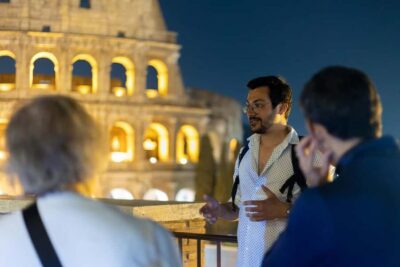
Rome by Night: E-bike Small Group Tour -Food & Wine (Option)
Read our review →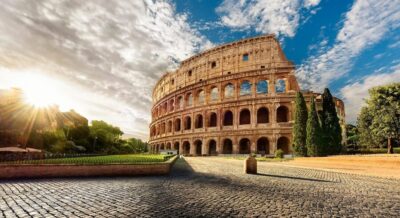
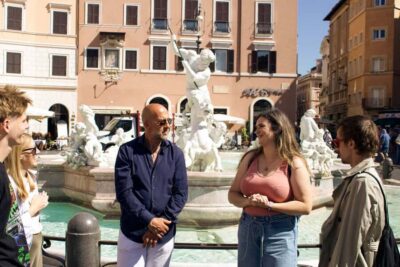
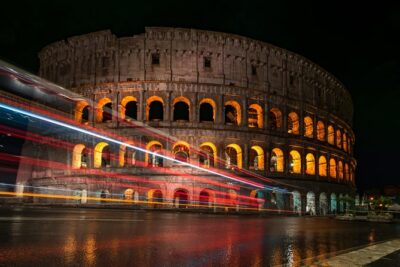
Night Tour of Rome with Local Pizza Dinner and Gelato Experience
Read our review →
Rome Bar Crawl: Interactive Night Tour with Games and Karaoke
Read our review →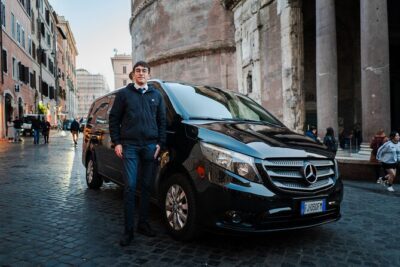
Rome After Dark: Explore the Eternal City Under the Moonlight
Read our review →Browse the lists this tour appears in