
Reviewed · MUSEUMS
Rome: Private Leonardo da Vinci Exhibition Guided Tour
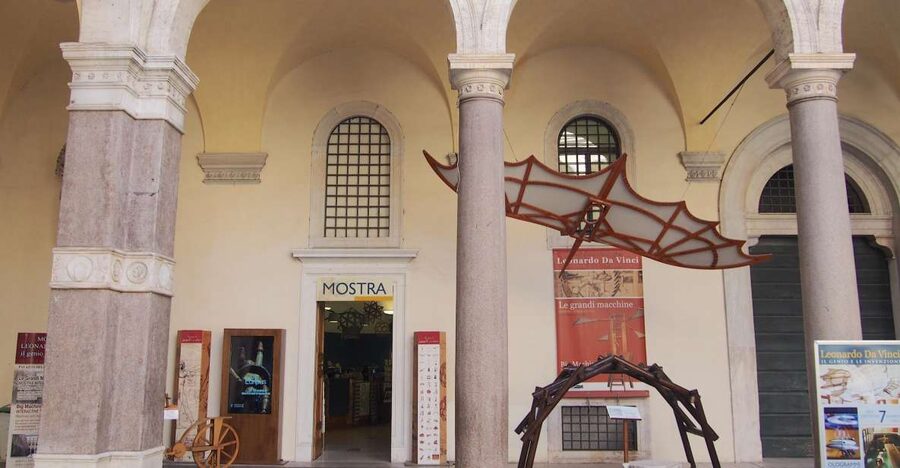
Leonardo in 3D, with hands-on machines. This private guided tour takes you into a multimedia exhibition in Rome’s Palazzo della Cancelleria, where 9 holograms and full-scale reproductions help explain how Leonardo’s ideas worked. I especially like the 3D holograms that make paintings and inventions feel less like museum objects and more like living concepts.
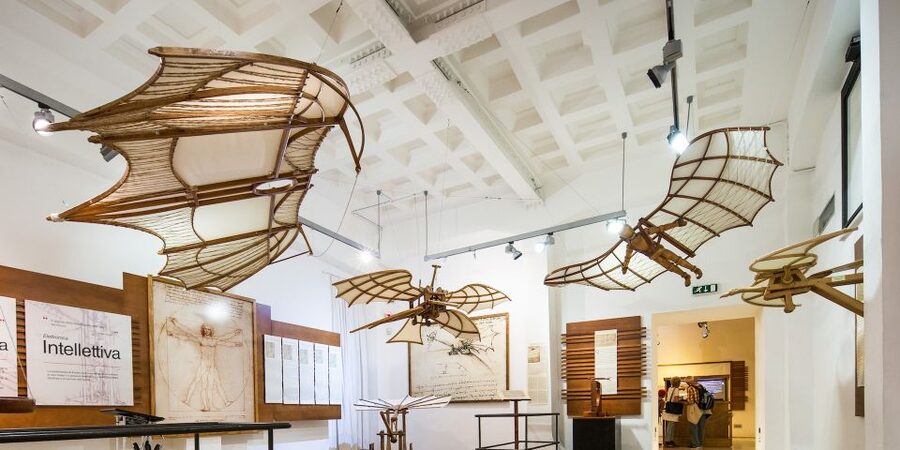
You’ll also get plenty of interaction, including time with 65+ full-scale machines built from Leonardo’s designs, plus workshops you may be able to access beyond the standard route. One thing to consider is the pace: with a 1.5 to 2 hour time window, you’ll want to focus your attention on what interests you most, since there is not time to linger in every room forever.
- Palazzo della Cancelleria as the setting: a Vatican-owned palace with its own architectural and cultural layers
- 9 3D holograms: paintings and inventions visualized in a way that makes details easier to follow
- 65+ full-scale machines: you can get up close, and you’ll be encouraged to touch and play with many of them
- Workshop access on a private tour: you get a more flexible feel and extra opportunities to explore
- Da Vinci’s science by element: Water, Air, Fire, and Earth framed as engineering thinking
- A rare Roman twist: a tomb from 43 B.C. set in an underground pond
In This Review
- Palazzo della Cancelleria sets the stage for Leonardo
- Skip-the-line entry and a true private pace
- The 4-section exhibition flow, powered by 9 3D holograms
- Touch 65+ full-scale machines, then build a bridge idea
- Water, air, fire, and earth: how Leonardo reasoned like an engineer
- Anatomy, invention videos, and the art-science connection
- The Auro Irzio tomb from 43 B.C., set in an underground pond
- Is it worth $93 for a private Leonardo da Vinci tour?
- Should you book this private Leonardo da Vinci guided tour?
- FAQ
- How long is the Rome private Leonardo da Vinci exhibition guided tour?
- Where do I meet for the tour?
- Is this tour private?
- What’s included in the tour price?
- Do I skip the ticket line?
- What languages are available for the live guide?
- Is the tour wheelchair accessible?
- What can I see inside the exhibition?
- Is free cancellation available?
- Can I reserve and pay later?
Palazzo della Cancelleria sets the stage for Leonardo
First, the location is not random. The museum sits inside Palazzo della Cancelleria, a palace owned by the Vatican. Even if you only notice it from the outside briefly, the building gives you that “you’re stepping into Rome’s institutional world” feeling, not just another museum box.
The tour focus stays on Leonardo da Vinci, but the palace context helps you understand why this sort of exhibition fits here. It is not only about art history. It is about systems, rooms, and knowledge organized like a workshop. That matches the way the exhibit is arranged into sections, with a guided flow that keeps you moving from one concept to the next.
There is also a bonus detail for the curious: on the upper floor, the Sacra Rota is associated with marriage dissolution through church processes. You are not going there on this tour, but it’s a useful reminder that this is a working historic building, tied to Rome’s religious and legal machinery.
If you like your art with engineering thoughts attached, the palace background makes the experience feel more believable. It also helps break up the usual museum rhythm where everything is behind glass and you move on fast.
Skip-the-line entry and a true private pace
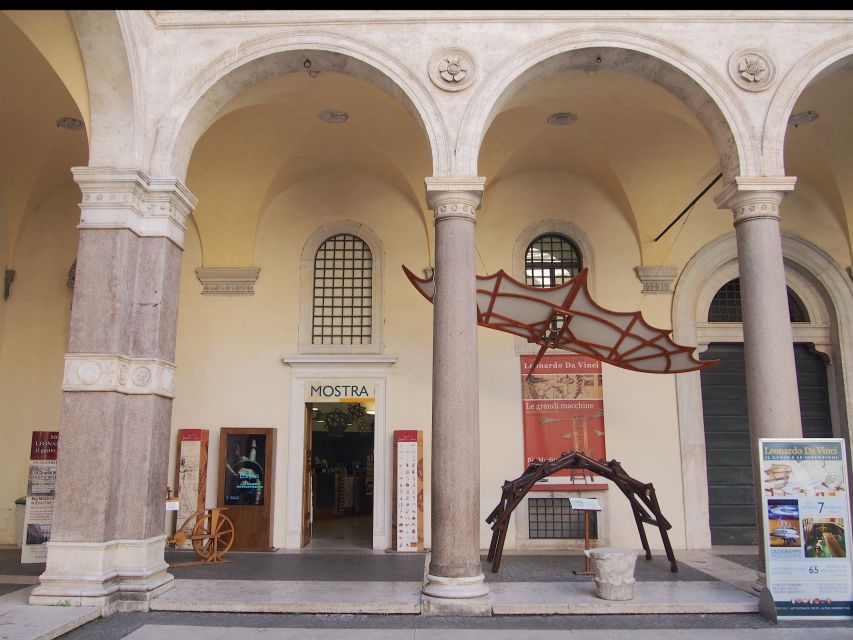
This is priced as a private group experience, listed at $93 per group up to 1, for about 1.5 to 2 hours. In practice, that format tends to matter more than the sticker price, because you get a guide who can adapt to your speed, your questions, and what you want to spend time on inside the exhibition.
You also get skip the ticket line. That sounds small, but in Rome, it can save real time when you arrive hungry, late, or simply tired. Here, arriving 15 minutes early at the meeting point is your best move, so you start on time and do not compress your museum time.
A guide is the key to making this style of exhibit work. Leonardo’s world is visual and technical at the same time. Without help, you might see machines and holograms but miss what the designer was trying to communicate. With a live guide in Italian, French, Spanish, English, German, or Portuguese, the experience shifts from “cool props” to a clearer story of how Leonardo studied the natural world and turned observations into inventions.
The tour includes exhibition entrance and a gadget. The data does not say what kind of gadget it is, but it signals that you are meant to participate, not just watch. Add in the fact that the tour provides child-friendly explanations and that art historians are available for extra context, and you can see why people often come away feeling the guide handled more than just the script.
More Private Tours in Rome
- Rome by Golf Cart Private Tour: Beyond the Landmarks
★ 5.0 · 4,361 reviews - Early Morning Vatican, Sistine, St. Peter’s Semi or Private Tour
★ 5.0 · 3,779 reviews - Rome on a Golf Cart Semi-Private Tour Max 6 with Private Option
★ 5.0 · 2,502 reviews - Rome Private Arrival Transfer: Fiumicino Airport to Hotel in Rome
★ 4.5 · 2,492 reviews
The 4-section exhibition flow, powered by 9 3D holograms
Inside, you go through four sections. Each one is built to change how you look at Leonardo. Instead of treating him as only a painter, the exhibit uses multimedia and scale to show him as an engineer and inventor who tracked patterns in nature.
The headline feature is the set of 9 holograms. You’ll see Da Vinci’s paintings and inventions rendered in 3D. That matters because Leonardo’s notebooks and sketches can be hard to translate into real-world understanding. A hologram format helps you follow form, layering, and structure quickly, especially when you are trying to understand how something might work in three dimensions.
As you move between sections, the guide also points out that Leonardo hid features and symbols in his work. That’s where the exhibition gets more intriguing, because you are not only seeing an invention. You’re also learning how to look for hidden meaning and technical intent.
A practical tip: when the holograms start, resist the urge to treat them like “wow visuals only.” Ask your guide (even quietly) what you are supposed to notice. Is it movement, alignment, proportions, or symbolic detail? When you focus on one or two takeaways per section, you remember more, and the time flies in a good way.
Language choice also affects comfort here. If German or Portuguese is an option for your group, pick what you are most confident with. You’ll be better able to catch the small explanatory points, especially around engineering reasoning and the logic behind his studies.
Touch 65+ full-scale machines, then build a bridge idea
If you want your Leonardo experience to feel hands-on, this tour is designed for that. You’ll see more than 65 full-scale machines made according to Leonardo da Vinci’s designs. The best part is that you do not just walk past them. You are encouraged to touch and play with almost all of the machines on display, or to interact with them in ways tied to the exhibit’s learning goal.
There’s also a workshop activity where you can build your own version of a bridge that Leonardo invented. That kind of exercise can seem gimmicky in some museums, but here it supports the exhibit’s broader message. Leonardo was not just drawing objects. He was testing ideas, thinking about stress and structure, and using drawings as a bridge between concept and reality.
What should you look for while you’re interacting? Focus on how the machine is constructed and how parts relate to each other. Ask yourself: what is the purpose of this mechanism? What do you think would happen if one component changed?
This is also where a great guide makes a difference. One guide named Barbara is praised for being thoughtful with group photo moments and for adding broader context about Roman sights like the Colosseum and the Forum. That kind of extra storytelling can make the museum feel less disconnected from the rest of your Rome trip, even though you’re technically “stuck” inside Palazzo della Cancelleria.
If you tend to get overwhelmed by lots of objects, pick a strategy: choose two machines you want to understand deeply, and let the rest be “context.” Otherwise, the amount of material can make your brain work overtime. The tour is short enough that you’ll enjoy it more if you decide what matters most to you early.
Water, air, fire, and earth: how Leonardo reasoned like an engineer
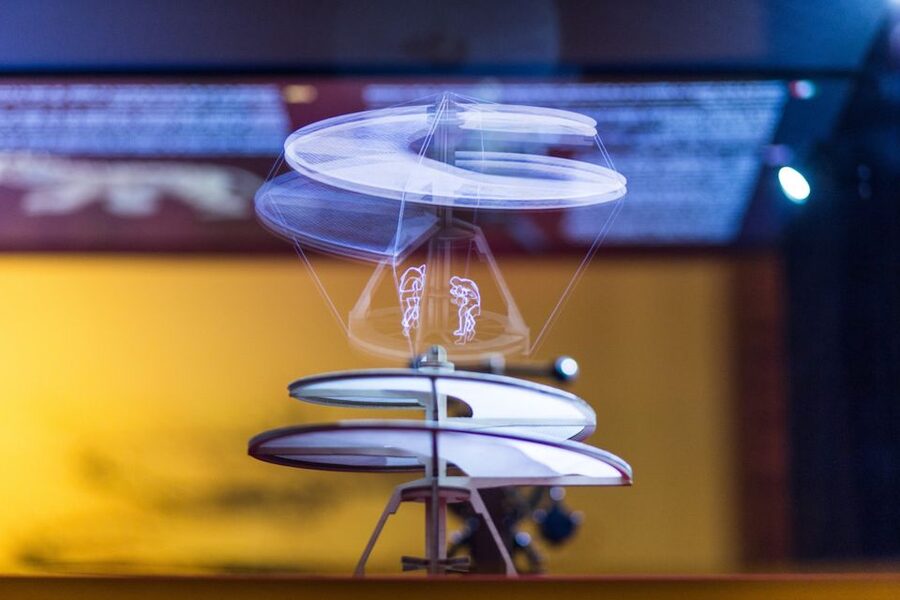
Leonardo’s studies are presented through four themes: Water, Air, Fire, and Earth. It’s a simple structure, but it’s a smart one. It mirrors how many people naturally think about science, and it gives the exhibit a clear intellectual backbone.
Instead of treating these as separate curiosities, the tour uses them as a way to understand Leonardo’s method. You’ll get a better picture of how his mind connected observation to engineering. For example, water is not only about rivers and waves. It also becomes a study in flow and pressure. Air can point you toward thinking about movement and the behavior of gases. Fire and earth expand the idea into transformation and material behavior.
This is also where the “mystery” element mentioned in the exhibit description makes sense. If Leonardo left clues through symbols and features, then the studies become more than diagrams. They become hints about how he was thinking, not just what he built.
One practical approach: after each element section, ask yourself which part felt most “engineering-like.” Was it the physical explanation? The structure of the machines? The way Leonardo framed a problem? That reflection helps the exhibit stick in your memory, rather than sliding by as a set of attractions.
Anatomy, invention videos, and the art-science connection
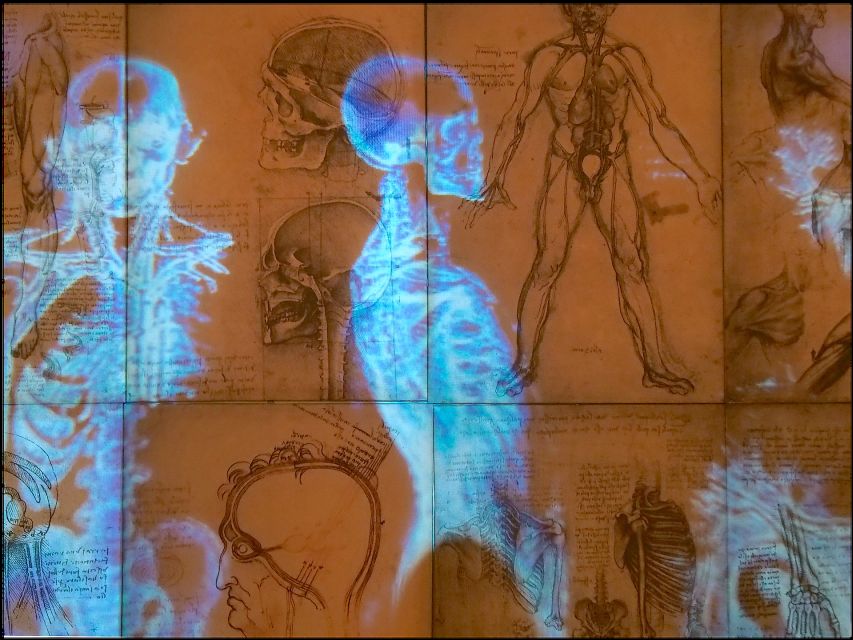
Even though this is an engineering-heavy exhibition, it does not forget Leonardo’s artistic side. You’ll see a video about Leonardo’s inventions, plus his study of anatomy. The anatomy component is important because it shows Leonardo’s range. He wasn’t guessing. He studied bodies in detail, then used that understanding to improve how he represented movement and structure.
For many visitors, the anatomy study is the moment where the tour clicks emotionally. You can see that the man who painted and sketched also chased precision, and that his curiosity connected disciplines that people often keep separate.
And this is where the guide’s role matters again. The exhibit mixes science visuals, engineering objects, and interpretive explanation. A good guide helps you connect the dots so it doesn’t become a fragmented experience where each room feels unrelated.
The strongest scenario is when you like learning in mixed formats. If you enjoy seeing how videos explain what you might not immediately understand from machines alone, you’ll appreciate the structure. If you only want mechanical details, you might still find value in the anatomy section because it gives you insight into why Leonardo’s work feels so methodical.
Other Roman collections with a shorter wait:
The Auro Irzio tomb from 43 B.C., set in an underground pond
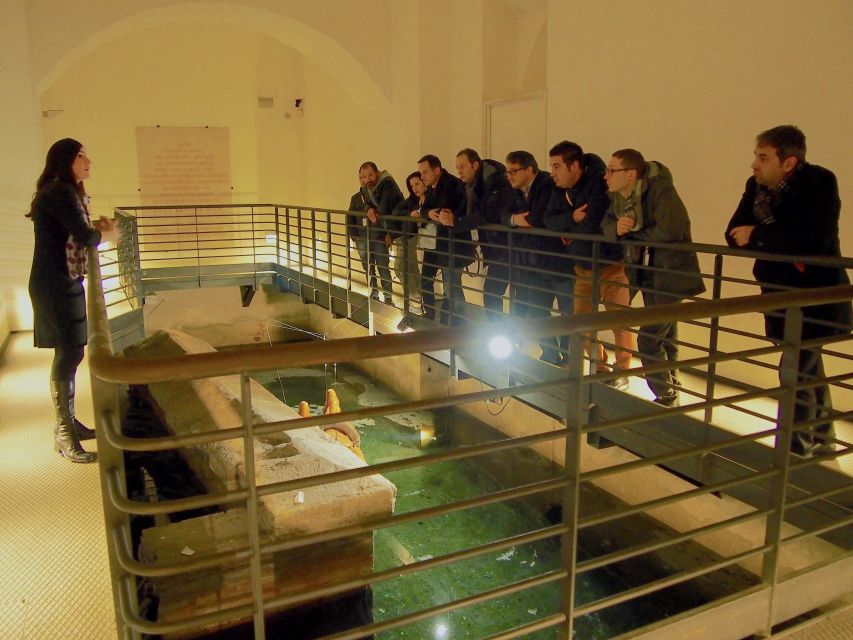
One of the most distinctive surprises in this exhibition is the tomb of the architect Auro Irzio, dating back to 43 B.C. It is set in an underground pond, which gives the space a very different mood than the bright hologram rooms.
This is not just a history footnote. It acts like a “time portal” inside the museum. You go from Renaissance-era invention thinking, to an ancient Roman burial space, and suddenly you feel how long Rome has been collecting knowledge, power, and symbolism in physical spaces.
In a practical sense, it also gives you a breathing moment. If the machines and holograms are visually intense, the tomb area lets your eyes and mind slow down. You can look at what is preserved, and you can appreciate how architecture and environment change the way you experience information.
If you like atmosphere and storytelling as much as you like technology, this stop is worth paying attention to. Spend a bit more time here and let the underground pond setting do its work. It’s one of those elements that becomes part of the memory long after the specific machine names blur together.
Is it worth $93 for a private Leonardo da Vinci tour?
At $93 per group up to 1, the value question is really about what you get for that time. You’re paying for more than access. You’re paying for:
- a live guide
- skipping the ticket line
- entrance to the exhibition
- a gadget
- and the chance to access more workshops, which matters when interactive stations are a big part of the experience
If you were planning to do only a self-guided visit, the private format can feel expensive. But this exhibit is built around interpretation and interaction. A guide can help you understand what you are touching and why you’re seeing it. That turns the exhibit into a learning experience rather than a checklist.
You also get language choice across Italian, French, Spanish, English, German, and Portuguese, which is a major comfort boost in Rome. When you are trying to understand engineering concepts and symbols, clarity is worth real money.
Who gets the best value? People who enjoy hands-on learning, families who benefit from child-friendly explanations, and anyone who likes when art and science meet in the same room. If you want only original Leonardo manuscripts and paintings, this might not be your perfect match, since this is an exhibition of reproductions, multimedia, and full-scale machines.
Should you book this private Leonardo da Vinci guided tour?
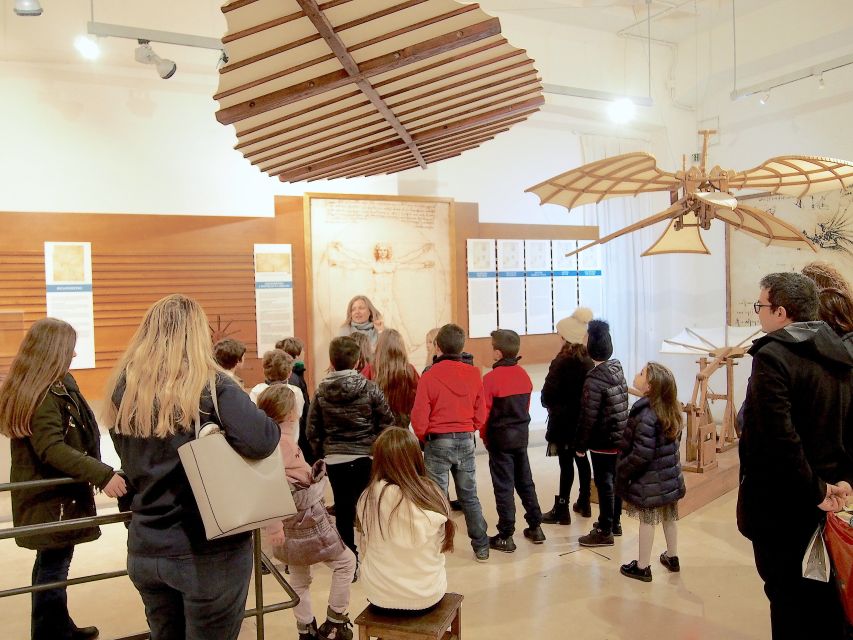
Book it if you want a Leonardo experience that feels active. The mix of 3D holograms, 65+ touchable machines, the bridge-building workshop, and the element-based studies (Water, Air, Fire, Earth) is a great way to understand how Leonardo thought, not just what he made.
You should also book it if you’re the type who asks questions and likes a guide who can explain in your language. Guides such as Barbara and Julia are noted for being patient, answering questions, and keeping the experience engaging, including for families.
Consider skipping or adjusting expectations if you dislike hands-on museums, if you prefer slower, purely contemplative art viewing, or if you only want standalone history facts. The tour is short on purpose, and it is built to keep moving.
If that pacing sounds fine, you’ll likely leave with more than photos. You’ll have a clearer mental picture of Leonardo as an inventor who studied nature like a scientist and expressed ideas like an artist.
FAQ
How long is the Rome private Leonardo da Vinci exhibition guided tour?
The tour lasts about 1.5 to 2 hours.
Where do I meet for the tour?
You should arrive at the meeting point 15 minutes before your tour departure.
Is this tour private?
The price is listed per group up to 1, which indicates a private group setup.
What’s included in the tour price?
Included are exhibition entrance, the guided tour, and a gadget.
Do I skip the ticket line?
Yes, this experience includes skip the ticket line.
What languages are available for the live guide?
The tour offers live guidance in Italian, French, Spanish, English, German, and Portuguese.
Is the tour wheelchair accessible?
Yes, it is wheelchair accessible.
What can I see inside the exhibition?
You can see 9 holograms, more than 65 full-scale machines made from Leonardo’s designs, a tomb from 43 B.C. set in an underground pond, plus video content about inventions and an anatomy study.
Is free cancellation available?
Yes, you can cancel up to 24 hours in advance for a full refund.
Can I reserve and pay later?
Yes. The experience offers reserve now & pay later, so you can book your spot without paying immediately.
Latest additions from Rome
- Guided Tour Vatican Museums & Sistine Chapel★ 4.1 · 30 reviews
- Exclusive Rome by Night Vespa Tour★ 5.0 · 30 reviews
- Transfer Rome to Airports★ 4.5 · 30 reviews
- Vatican: St.Peter’s Basilica & Dome – Reserved Entry & Tour★ 4.1 · 30 reviews
- Tivoli, Hadrians Villa and Villa d’Este, a charming day trip from Rome★ 4.5 · 30 reviews
- Rome street art tour: off the beaten path with a local guide★ 5.0 · 30 reviews
- Rome Food Tasting with Wine Pairing Italian Authentic Flavors★ 5.0 · 31 reviews
- Inspirational Cooking on the Roman Chef’s Panoramic Terrace★ 5.0 · 30 reviews
Museums, compared.

Vatican Museums, Sistine Chapel & St. Peter’s Basilica Tour
Read our review →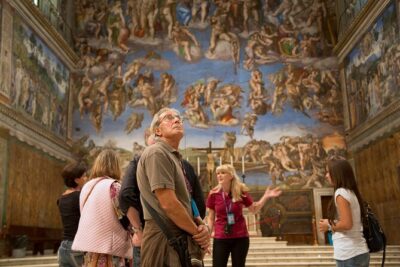
Vatican Museums, Sistine Chapel & St Peter’s Basilica Guided Tour
Read our review →
Vatican Museums, Sistine Chapel and Basilica Tour
Read our review →
Vatican Museums & Sistine Chapel Skip-the-Line Entry Ticket
Read our review →
Vatican Museums, Sistine Chapel & Basilica Tour
Read our review →
Vatican Museums & Sistine Chapel Skip-The-Line Ticket
Read our review →